
非急性脑卒中患者的结构和功能连接中断
Structural and functional disconnections in non-acute post-stroke patients.
作者信息
Wu Yanan, Tian Chuanshuai, Yu Zhixuan, Liu Zaixing, Wu Han, Ming Jie, Hong Wenjun, Xu Rong
机构信息
Department of Rehabilitation Medicine, Nanjing Drum Tower Hospital, Affiliated Hospital of Medical School, Nanjing University, Nanjing, China.
Department of Radiology, Nanjing Drum Tower Hospital, Affiliated Hospital of Medical School, Nanjing University, Nanjing, China.
出版信息
Front Neurol. 2025 Jun 25;16:1542292. doi: 10.3389/fneur.2025.1542292. eCollection 2025.
BACKGROUND
Structural alterations and functional reorganizations related to motor dysfunction after stroke remain unclear. This study aims to investigate alterations in structural connectivity (SC) and functional connectivity (FC) in non-acute post-stroke patients, and their associations with motor performance.
METHODS
Thirty-six non-acute post-stroke patients and thirty-eight well-matched healthy controls (HCs) were included. SC and FC differences between groups were analyzed using diffusion tensor imaging and resting-state fMRI, respectively. Correlations between SC and FC in regions with significant intergroup differences, along with their correlations with motor performance, were assessed.
RESULTS
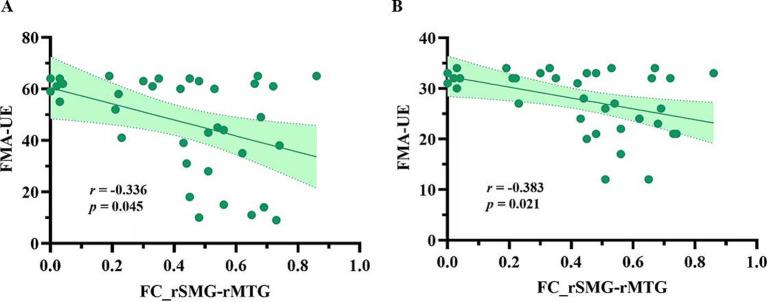
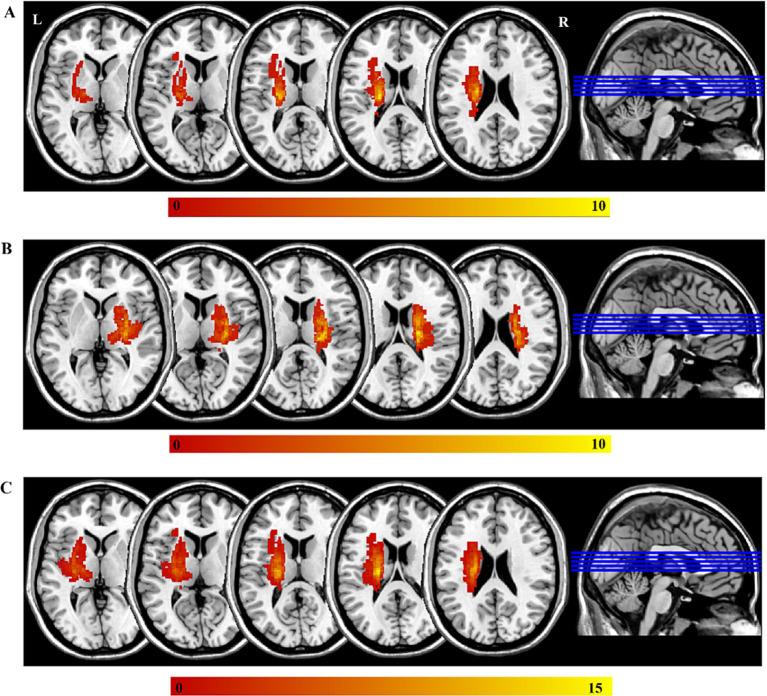
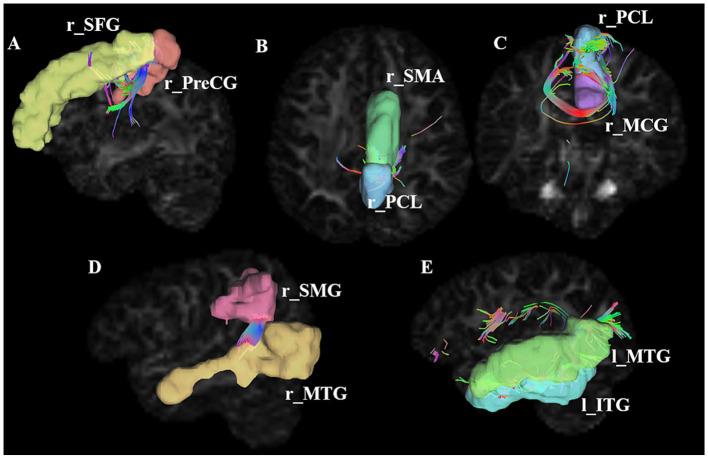
Compared with HCs, significant decreases in both SC and FC were observed in stroke patients among the right precentral gyrus, right superior frontal gyrus, right supplementary motor area, right paracentral lobule, right middle cingulate gyrus, right superior marginal gyrus, right middle temporal gyrus, and left inferior temporal gyrus. A negative correlation of SC-FC was found between the right middle cingulate gyrus and right paracentral lobule in stroke group, while a positive correlation was found between the right superior marginal gyrus and right middle temporal gyrus. Moreover, the FC between the right superior marginal gyrus and right middle temporal gyrus showed negative correlations with the Fugl-Meyer assessment of the Upper/Lower Extremity scores.
DISCUSSION
This study identified disconnections in both SC and FC in sensorimotor-related and high-order brain regions, which may enhance understanding of the structure-function interactions underlying motor deficits in post-stroke patients.
背景
中风后与运动功能障碍相关的结构改变和功能重组仍不明确。本研究旨在调查非急性中风患者的结构连接性(SC)和功能连接性(FC)改变,以及它们与运动表现的关联。
方法
纳入36例非急性中风患者和38例匹配良好的健康对照者(HCs)。分别使用扩散张量成像和静息态功能磁共振成像分析两组之间的SC和FC差异。评估组间差异显著区域的SC和FC之间的相关性,以及它们与运动表现的相关性。
结果
与HCs相比,中风患者右侧中央前回、右侧额上回、右侧辅助运动区、右侧中央旁小叶、右侧扣带回中部、右侧缘上回、右侧颞中回和左侧颞下回的SC和FC均显著降低。中风组右侧扣带回中部和右侧中央旁小叶之间的SC-FC呈负相关,而右侧缘上回和右侧颞中回之间呈正相关。此外,右侧缘上回和右侧颞中回之间的FC与上肢/下肢Fugl-Meyer评估得分呈负相关。
讨论
本研究确定了感觉运动相关和高阶脑区的SC和FC均存在连接中断,这可能有助于加深对中风后患者运动缺陷潜在的结构-功能相互作用的理解。

 Zotero 插件