
在慢性冠状动脉综合征患者中,冠状动脉周围脂肪组织的高水平炎症与冠状动脉粥样硬化相关,且独立于心外膜脂肪组织体积。
High levels of pericoronary adipose tissue inflammation are associated with coronary atherosclerosis independent of epicardial adipose tissue volume in patients with chronic coronary syndrome.
作者信息
Yamaura Hiroki, Otsuka Kenichiro, Ishikawa Hirotoshi, Hojo Kana, Matsumoto Kotaro, Fujisawa Naoki, Okamoto Akihiro, Yamaguchi Tomohiro, Kagawa Shunsuke, Shimada Takenobu, Shibata Atsushi, Ito Asahiro, Yamazaki Takanori, Shimada Kenei, Kasayuki Noriaki, Fukuda Daiju
机构信息
Department of Cardiovascular Medicine, Osaka Metropolitan University Graduate School of Medicine, Osaka 545-8585, Japan.
Department of Cardiovascular Medicine, Kashibaseiki Hospital, Kashiba, Nara 639-0252, Japan.
出版信息
Eur Heart J Imaging Methods Pract. 2025 Jun 10;3(2):qyaf079. doi: 10.1093/ehjimp/qyaf079. eCollection 2025 Jul.
AIMS
This study aimed to assess clinical risks and coronary atherosclerotic burden in patients with chronic coronary syndrome (CCS) stratified by pericoronary artery adipose tissue (PCAT) composition and epicardial adipose tissue volume (EAV).
METHODS AND RESULTS
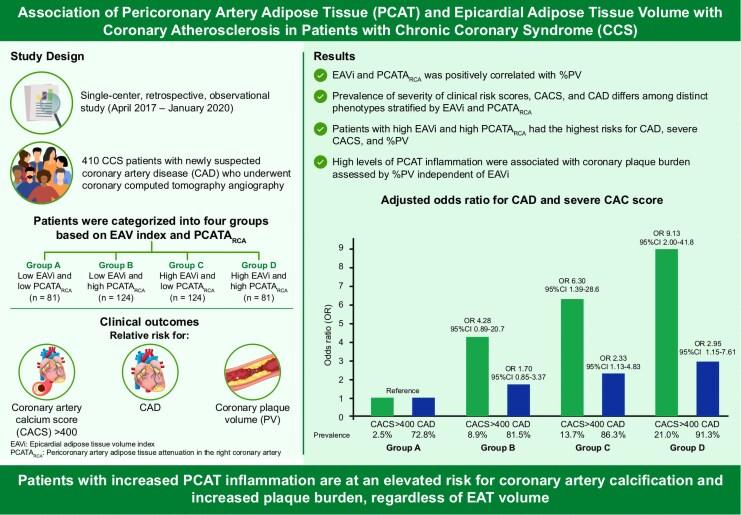
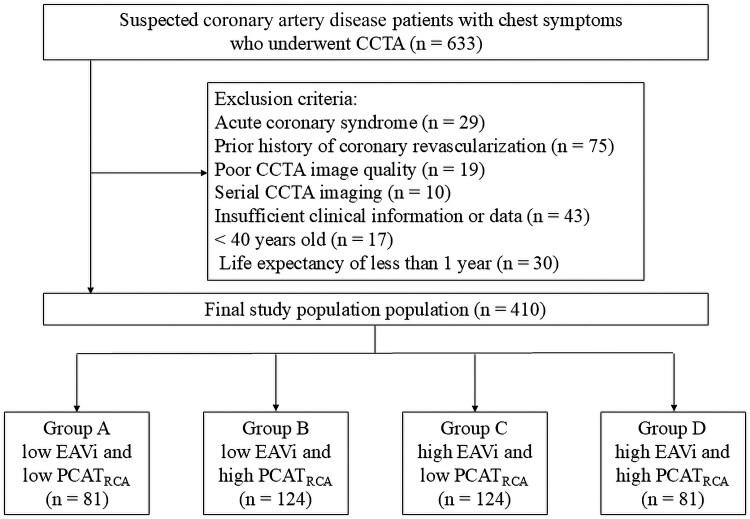
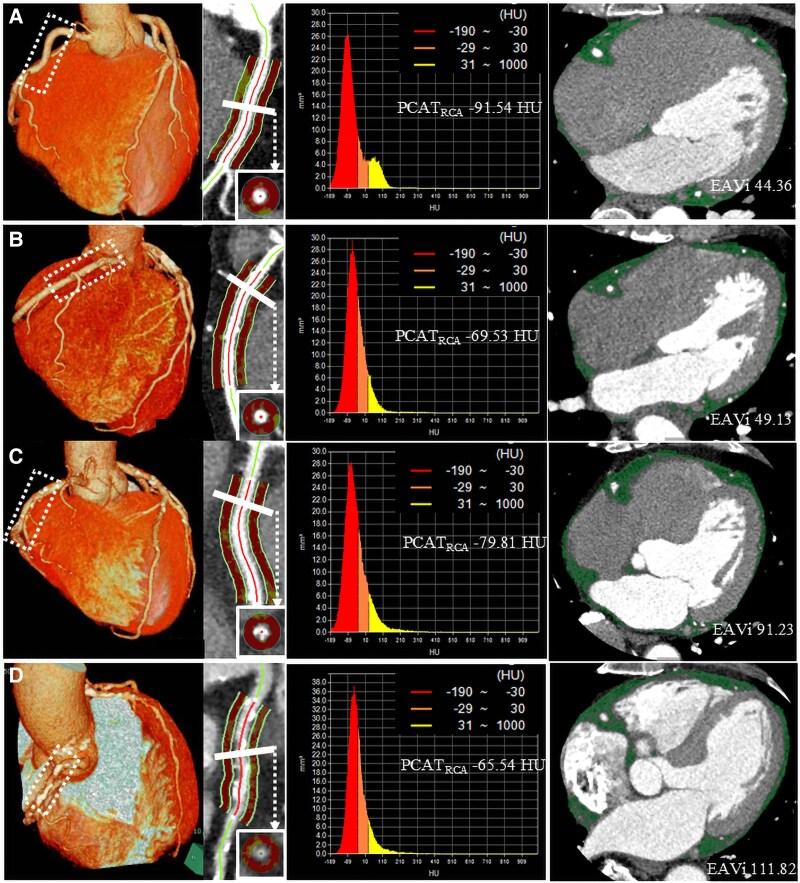
We retrospectively included 410 CCS patients who underwent coronary computed tomography angiography. Patients were divided into four groups based on an EAV index ≥ 73.5 mL/mm and PCAT attenuation (PCATA) in the right coronary artery (PCATA) ≥ -76.6 HU (above median); Groups A (low EAV index and low PCATA), B (low EAV index and high PCATA), C (high EAV index and low PCATA), and D (high EAV index and high PCATA). Multivariable models assessed the relative risk of coronary artery calcium score (CACS) > 400 and coronary artery disease (CAD), and predictors of coronary plaque volume. The log-transformed CACS increased progressively, with Group D showing the highest values. Group D had the highest prevalence of Hisayama risk score of 10-year risk > 10%, CACS > 400, and CAD. The high EAVi group (C and D) showed increased risks of CACS > 400 [Group C: adjusted odds ratio, 6.30; 95% confidence interval (CI), 1.39-28.6; Group D: adjusted odds ratio, 9.13; 95% CI, 2.00-41.5] and CAD (Group C: adjusted odds ratio, 2.33; 95% CI, 1.13-4.83; Group D: adjusted odds ratio, 9.13; 95% CI, 2.00-41.5). Multivariate linear regression analysis demonstrated that PCATA was associated with a greater plaque volume independent of EAV index.
CONCLUSION
Elevated PCAT inflammation is associated with the coronary plaque burden independent of EAV index in patients with CCS.
LAY SUMMARY
• This study demonstrates that distinct phenotypes based on ectopic fat volume and composition-the volume of epicardial adipose tissue (EAT) and the inflammation status of pericoronary adipose tissue (PCAT)-can characterize coronary atherosclerotic disease burden in patients with chronic coronary syndrome.• While both increased EAT volume and PCAT inflammation have been reportedly associated with coronary artery disease (CAD) and cardiovascular events, evidence investigating the association of EAT volume and PCAT inflammation with CAD disease burden is limited.• Patients with increased EAT volume are at an elevated risk for coronary artery calcification and increased plaque burden, regardless of PCAT inflammation. In contrast, among patients without increased EAT volume, increased PCAT inflammation is correlated with an increased risk of coronary artery calcification and plaque burden.
目的
本研究旨在评估根据冠状动脉周围脂肪组织(PCAT)成分和心外膜脂肪组织体积(EAV)分层的慢性冠状动脉综合征(CCS)患者的临床风险和冠状动脉粥样硬化负担。
方法和结果
我们回顾性纳入了410例行冠状动脉计算机断层扫描血管造影的CCS患者。根据EAV指数≥73.5 mL/mm以及右冠状动脉的PCAT衰减(PCATA)≥ -76.6 HU(高于中位数),将患者分为四组:A组(低EAV指数和低PCATA)、B组(低EAV指数和高PCATA)、C组(高EAV指数和低PCATA)和D组(高EAV指数和高PCATA)。多变量模型评估了冠状动脉钙化积分(CACS)>400和冠状动脉疾病(CAD)的相对风险以及冠状动脉斑块体积的预测因素。对数转换后的CACS逐渐增加,D组的值最高。D组的久山10年风险评分>10%、CACS>400和CAD的患病率最高。高EAVi组(C组和D组)显示CACS>400的风险增加[C组:调整后的优势比为6.30;95%置信区间(CI)为1.39 - 28.6;D组:调整后的优势比为9.13;95%CI为2.00 - 41.5]以及CAD(C组:调整后的优势比为2.33;95%CI为为1.13 - 4.83;D组:调整后的优势比为9.13;95%CI为2.00 - 41.5)。多变量线性回归分析表明,独立于EAV指数,PCATA与更大的斑块体积相关。
结论
在CCS患者中,PCAT炎症升高与独立于EAV指数的冠状动脉斑块负担相关。
简要总结
• 本研究表明,基于异位脂肪体积和成分(心外膜脂肪组织(EAT)的体积和冠状动脉周围脂肪组织(PCAT)的炎症状态)的不同表型可表征慢性冠状动脉综合征患者的冠状动脉粥样硬化疾病负担。
• 虽然据报道EAT体积增加和PCAT炎症均与冠状动脉疾病(CAD)和心血管事件相关,但研究EAT体积和PCAT炎症与CAD疾病负担之间关联的证据有限。
• 无论PCAT炎症如何,EAT体积增加的患者发生冠状动脉钙化和斑块负担增加的风险升高。相比之下,在EAT体积未增加的患者中,PCAT炎症增加与冠状动脉钙化和斑块负担增加的风险相关。

 Zotero 插件