
阿尔茨海默病临床谱系中脑脊液淀粉样蛋白和 Tau 生物标志物的变化
Cerebrospinal Fluid Amyloid and Tau Biomarker Changes Across the Alzheimer Disease Clinical Spectrum.
作者信息
de Leeuw Diederick M, Trieu Calvin, Vromen Ellen M, Blujdea Elena R, Verberk Inge M W, Duits Flora H, Teunissen Charlotte E, Pijnenburg Yolande A L, van der Flier Wiesje M, van Harten Argonde C, Visser Pieter Jelle, Tijms Betty M
机构信息
Alzheimer Center Amsterdam, Neurology, Vrije Universiteit Amsterdam, Amsterdam University Medical Center, Location VUmc, Amsterdam, the Netherlands.
Amsterdam Neuroscience, Neurodegeneration, Amsterdam, the Netherlands.
出版信息
JAMA Netw Open. 2025 Jul 1;8(7):e2519919. doi: 10.1001/jamanetworkopen.2025.19919.
IMPORTANCE
The trajectories of core Alzheimer disease (AD) cerebrospinal fluid (CSF) biomarkers and the concurrent cognitive changes across the clinical spectrum remain unclear yet are important for clinical trial design.
OBJECTIVE
To map longitudinal CSF amyloid, tau, and cognitive trajectories along the clinical spectrum of AD and amyloid-negative controls.
DESIGN, SETTING, AND PARTICIPANTS: This longitudinal cohort study included participants with a minimum of 2 CSF samples from Alzheimer Centrum Amsterdam cohorts across the AD clinical spectrum (ie, abnormal amyloid levels at first visit, in different clinical stages) and cognitively normal controls with initially normal CSF markers from November 2003 to July 2019. The maximum follow-up period was 19.5 years (median [IQR], 2 [0-3] years). Data were analyzed from March 2024 to May 2025.
EXPOSURES
AD biomarkers (ß-amyloid [Aß]1-42 to Aß1-40 ratio, total tau [t-tau], and phosphorylated tau [p-tau]) detected in serially collected CSF.
MAIN OUTCOMES AND MEASURES
CSF AD biomarkers were measured with Lumipulse G600II. Cognition was measured using the Mini-Mental State Examination (MMSE) and delayed memory recall component of the of the Rey Auditory Verbal Learning Test. Analysis was conducted using linear mixed models, including random intercepts and slopes, adjusting for age, education level, and sex. Each model included an interaction term of time and clinical stage to study stage-specific slopes. Biomarker conversion rates per clinical stage were studied by comparing biomarker status between visits.
RESULTS
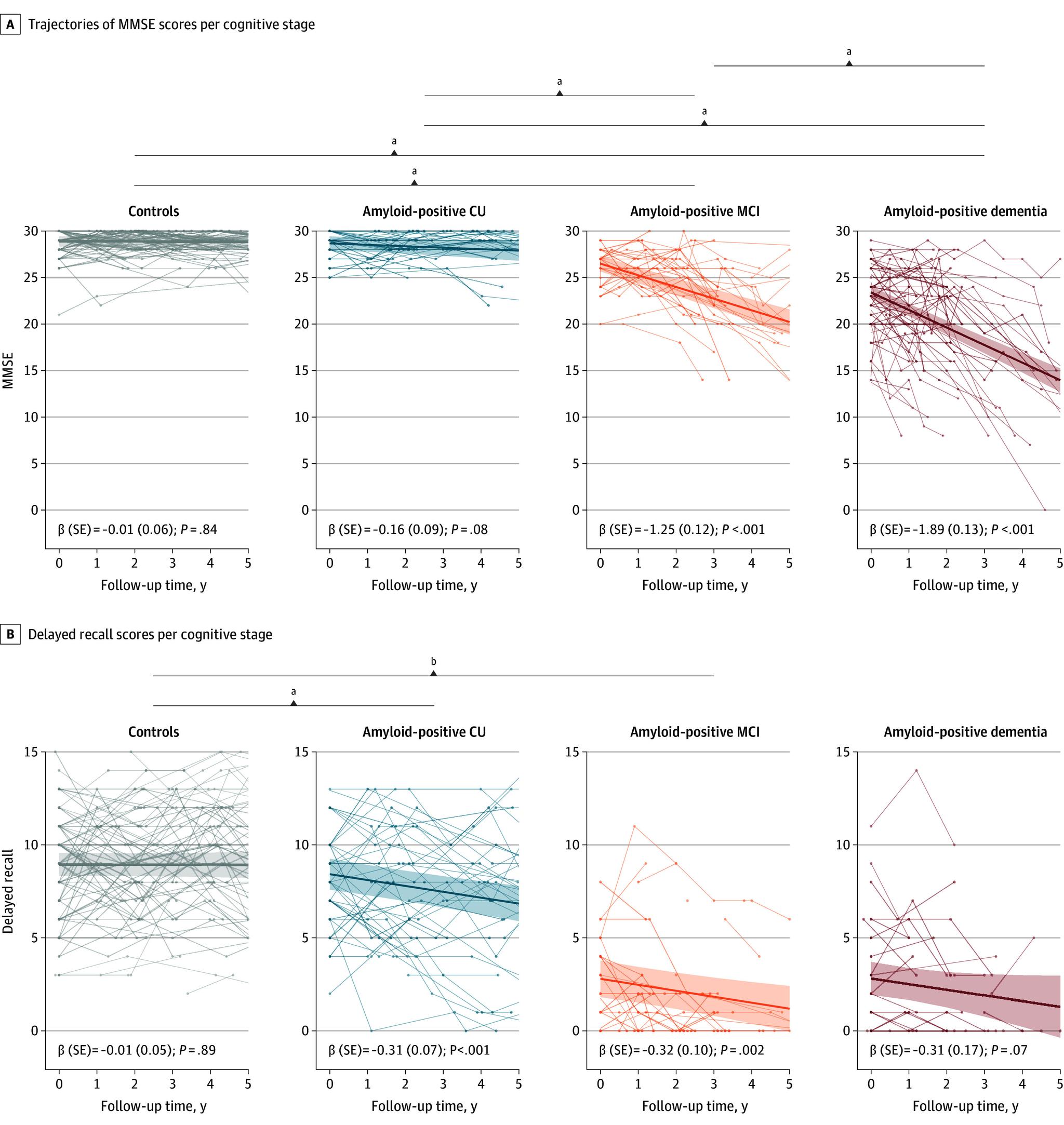
The sample included 197 individuals (103 male [52.3%]), including 83 controls (mean [SD] age, 63 [8] years), 31 individuals with amyloid positivity who were cognitively unimpaired (mean [SD] age, 67 [9] years), 30 individuals with amyloid-positive mild cognitive impairment (MCI; mean [SD] age, 67 [7] years), and 53 individuals with amyloid-positive dementia (mean [SD] age, 65 [8] years). Aβ1-42/1-40 ratios decreased in controls (β [SE] = -8.55 × 10⁻⁴ [1.87 × 10⁻⁴]; P < .001) and the amyloid-positive cognitively unimpaired group (β [SE] = -1.05 × 10⁻³ [3.14 × 10⁻⁴]; P < .001), and remained low in amyloid-positive MCI and dementia groups. There were 10 controls (12.0%) who reached abnormal amyloid over a mean (SD) of 4.8 (3.4) years. In controls, CSF t-tau (β [SE] = 8.49 [2.55] pg/mL per year; P = .002) and p-tau (β [SE] = 1.36 [0.41] pg/mL per year; P = .001) levels increased over time, and levels also increased for those in the amyloid-positive cognitively unimpaired (t-tau: β [SE] = 17.24 [4.58] pg/mL per year; P < .001; p-tau: β [SE] = 3.10 [0.72] pg/mL per year; P < .001) and amyloid-positive MCI (t-tau: β [SE] = 30.80 [5.99] pg/mL per year; P < .001; p-tau: β [SE] = 4.40 [0.93] pg/mL per year; P < .001) groups, with t-tau increasing further in the dementia group (β [SE] = 24.97 [7.80] pg/mL per year; P = .002). Longitudinal increases in p-tau and t-tau were steeper in the amyloid-positive cognitively unimpaired and MCI groups than in controls, with 10 controls (12.0%) reaching abnormal p-tau and 12 controls (14.5%) reaching abnormal t-tau levels. Delayed recall declined most in the amyloid-positive cognitively unimpaired group (β [SE] = -0.31 [0.07]; P < .001) and was associated with CSF amyloid levels (β [SE] = 102.29 [47.30]; P = .03). MMSE scores declined most in individuals with amyloid-positive MCI (β [SE] = -1.25 [0.12]; P < .001) and dementia (β [SE] = -1.89 [0.13]; P < .001).
CONCLUSIONS AND RELEVANCE
In this cohort study, CSF amyloid decreased toward abnormal levels in controls, declined further in the amyloid-positive cognitively unimpaired group , and was concurrent with decline of delayed recall; CSF amyloid stabilized in those with amyloid-positive MCI and dementia, while tau markers became increased (ie, more abnormal) in the amyloid-positive cognitively unimpaired and amyloid-positive MCI groups, suggesting that increase in CSF tau requires abnormal amyloid.
重要性
核心阿尔茨海默病(AD)脑脊液(CSF)生物标志物的变化轨迹以及临床谱系中同时发生的认知变化仍不明确,但对临床试验设计很重要。
目的
绘制AD临床谱系及淀粉样蛋白阴性对照中脑脊液淀粉样蛋白、tau蛋白和认知变化的纵向轨迹。
设计、设置和参与者:这项纵向队列研究纳入了2003年11月至2019年7月期间来自阿姆斯特丹阿尔茨海默中心队列的参与者,这些参与者在AD临床谱系(即首次就诊时淀粉样蛋白水平异常,处于不同临床阶段)中至少有2份脑脊液样本,以及最初脑脊液标志物正常的认知正常对照。最长随访期为19.5年(中位数[四分位间距],2[0 - 3]年)。数据于2024年3月至2025年5月进行分析。
暴露因素
在连续采集的脑脊液中检测到的AD生物标志物(β - 淀粉样蛋白[Aβ]1 - 42与Aβ1 - 40比值、总tau蛋白[t - tau]和磷酸化tau蛋白[p - tau])。
主要结局和测量指标
使用Lumipulse G600II测量脑脊液AD生物标志物。使用简易精神状态检查表(MMSE)和雷伊听觉词语学习测试的延迟记忆回忆部分测量认知。使用线性混合模型进行分析,包括随机截距和斜率,并对年龄、教育水平和性别进行调整。每个模型都包含时间和临床阶段的交互项,以研究特定阶段的斜率。通过比较各次就诊之间的生物标志物状态,研究每个临床阶段的生物标志物转化率。
结果
样本包括197名个体(103名男性[52.3%]),其中包括83名对照(平均[标准差]年龄,63[8]岁)、31名淀粉样蛋白阳性但认知未受损的个体(平均[标准差]年龄,67[9]岁)、30名淀粉样蛋白阳性轻度认知障碍(MCI)个体(平均[标准差]年龄,67[7]岁)和53名淀粉样蛋白阳性痴呆个体(平均[标准差]年龄,65[8]岁)。对照(β[标准误]= - 8.55×10 - 4[1.87×10 - 4];P <.001)和淀粉样蛋白阳性认知未受损组(β[标准误]= - 1.05×10 - 3[3.14×10 - 4];P <.001)中Aβ1 - 42/1 - 40比值下降,而在淀粉样蛋白阳性MCI和痴呆组中保持较低水平。有10名对照(12.0%)在平均(标准差)4.8(3.4)年的时间内淀粉样蛋白达到异常水平。在对照中,脑脊液t - tau(β[标准误]= 8.49[2.55]pg/mL/年;P =.002)和p - tau(β[标准误]= 1.36[0.41]pg/mL/年;P =.001)水平随时间升高,淀粉样蛋白阳性认知未受损组(t - tau:β[标准误]= 17.24[4.58]pg/mL/年;P <.001;p - tau:β[标准误]= 3.10[0.72]pg/mL/年;P <.001)和淀粉样蛋白阳性MCI组(t - tau:β[标准误]= 30.80[5.99]pg/mL/年;P <.001;p - tau:β[标准误]= 4.40[0.93]pg/mL/年;P <.001)中的水平也升高,痴呆组中t - tau进一步升高(β[标准误]= 24.97[7.80]pg/mL/年;P =.002)。淀粉样蛋白阳性认知未受损和MCI组中p - tau和t - tau的纵向升高比对照组更陡峭,有10名对照(12.0%)p - tau达到异常水平,12名对照(14.5%)t - tau达到异常水平。延迟回忆在淀粉样蛋白阳性认知未受损组下降最多(β[标准误]= - 0.31[0.07];P <.001),且与脑脊液淀粉样蛋白水平相关(β[标准误]= 1- 02.29[47.30];P =.03)。MMSE评分在淀粉样蛋白阳性MCI个体(β[标准误]= - 1.25[0.12];P <.001)和痴呆个体(β[标准误]= - 1.89[0.13];P <.001)中下降最多。
结论和相关性
在这项队列研究中,对照中脑脊液淀粉样蛋白向异常水平下降,淀粉样蛋白阳性认知未受损组中进一步下降,并与延迟回忆下降同时发生;淀粉样蛋白阳性MCI和痴呆患者中脑脊液淀粉样蛋白稳定,而淀粉样蛋白阳性认知未受损和淀粉样蛋白阳性MCI组中tau标志物升高(即更异常),提示脑脊液tau升高需要异常淀粉样蛋白。

 Zotero 插件