
“那里发生的事情太多了”:自闭症成年人的非言语交流体验。
"There is just too much going on there": Nonverbal communication experiences of autistic adults.
作者信息
Radford Holly, Reidinger Bronte, Kapp Steven K, de Marchena Ashley
机构信息
School of Psychology, Sport and Health Sciences, University of Portsmouth, Portsmouth, United Kingdom.
Psychology Department, Rowan University, Glassboro, New Jersey, United States of America.
出版信息
PLoS One. 2025 Jul 11;20(7):e0325465. doi: 10.1371/journal.pone.0325465. eCollection 2025.
BACKGROUND
Atypical nonverbal communication is required for a diagnosis of autism, yet little is known about how autistic adults use gestures, facial expressions, and other nonverbal behaviours in social interactions, especially from autistic adults' perspectives. The objectives of this study were to understand: (1) autistic adults' experiences of using nonverbal communication in interactions, (2) how nonverbal communication impacts autistic people's lives, and (3) how autistic adults manage nonverbal communication differences.
METHODS
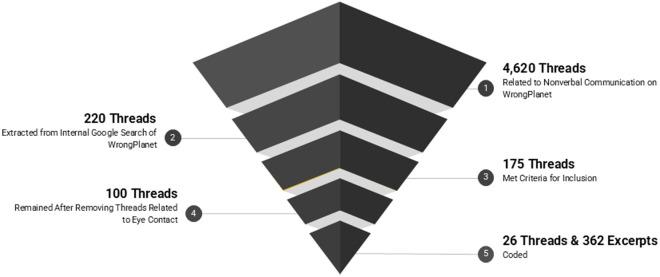
27 threads from the internet discussion forum wrongplanet.net, all containing dialogue focused on nonverbal communication, were subjected to qualitative analysis. Inductive and deductive coding were used to identify excerpts relevant to miscommunication experiences, communication strengths, and compensatory strategies. A total of 362 excerpts were coded (kappa = .79). Coded excerpts were then extracted and examined for themes, using member checking.
RESULTS
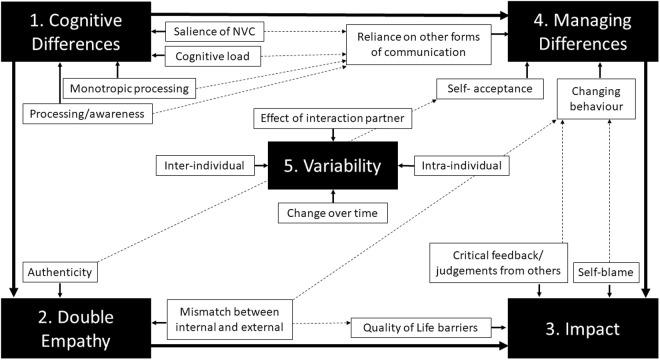
Major themes included: (1) Cognitive differences resulting in autistic adults requiring more time and energy to manage nonverbal communication in interactions; (2) Miscommunication related to nonverbal communication is bilateral; (3) Nonverbal communication differences can negatively impact the lives and wellbeing of autistic adults; (4) autistic adults use a range of skills and strategies to manage nonverbal communication; and (5) Autistic adults demonstrate variability in the production and interpretation of nonverbal cues.
CONCLUSION
Several of our themes, including mutual miscommunication and negative impacts of atypical communication, are consistent with previous qualitative work on communication experiences of autistic adults. The current findings provide new insight into the internal and external factors influencing the nonverbal communication experiences of autistic adults, in particular the cognitive processes involved. We advocate for solutions that shift the responsibility for effective communication onto all members of society. For example, sharing and accepting preferred communication modalities, and checking in about whether a message was received correctly instead of making assumptions.
背景
非典型非言语交流是自闭症诊断的必要条件,但对于自闭症成年人在社交互动中如何使用手势、面部表情及其他非言语行为,我们知之甚少,尤其是从自闭症成年人自身的角度。本研究的目的是了解:(1)自闭症成年人在互动中使用非言语交流的经历;(2)非言语交流如何影响自闭症患者的生活;(3)自闭症成年人如何应对非言语交流差异。
方法
对互联网讨论论坛wrongplanet.net上的27个帖子进行定性分析,所有帖子都包含围绕非言语交流的对话。采用归纳和演绎编码来识别与沟通失误经历、沟通优势及补偿策略相关的段落。共对362个段落进行了编码(卡帕系数=0.79)。然后提取编码后的段落,并通过成员核对来检查主题。
结果
主要主题包括:(1)认知差异导致自闭症成年人在互动中管理非言语交流需要更多时间和精力;(2)与非言语交流相关的沟通失误是双向的;(3)非言语交流差异会对自闭症成年人的生活和幸福产生负面影响;(4)自闭症成年人使用一系列技能和策略来管理非言语交流;(5)自闭症成年人在非言语线索的产生和解读方面存在差异。
结论
我们的几个主题,包括相互沟通失误和非典型交流的负面影响,与之前关于自闭症成年人沟通经历的定性研究一致。当前的研究结果为影响自闭症成年人非言语交流经历的内部和外部因素,特别是其中涉及的认知过程,提供了新的见解。我们倡导将有效沟通的责任转移到社会所有成员身上的解决方案。例如,分享和接受偏好的沟通方式,并核实信息是否被正确接收,而不是进行假设。
 Zotero 插件