
2型糖尿病成人患者的估计肾小球滤过率变异性与心力衰竭发病情况
Estimated Glomerular Filtration Rate Variability and Incident Heart Failure in Adults With Type 2 Diabetes.
作者信息
Kaze Arnaud D, Ndumele Chiadi E, Jaar Bernard G, Santhanam Prasanna, Yeneneh Beeletsega T, Mookadam Farouk, Tung Roderick, Fonarow Gregg C, Crews Deidra C, Echouffo-Tcheugui Justin B
机构信息
Division of Cardiology, Department of Medicine, Banner-University Medical Center Phoenix, The University of Arizona College of Medicine, Phoenix, Arizona, USA.
Division of Cardiology, Department of Medicine, Johns Hopkins University School of Medicine, Baltimore, Maryland, USA; Ciccarone Center for the Prevention of Cardiovascular Disease Johns Hopkins University School of Medicine, Baltimore, Maryland, USA.
出版信息
JACC Adv. 2025 Jul 10;4(8):101903. doi: 10.1016/j.jacadv.2025.101903.
BACKGROUND
Variability in kidney function, as measured by estimated glomerular filtration rate (eGFR), has been proposed as a novel risk factor for adverse cardiovascular outcomes. However, its association with incident heart failure (HF) in adults with type 2 diabetes remains unclear.
OBJECTIVES
The aim of the study was to evaluate the association of eGFR variability with incident HF in a large sample of adults with type 2 diabetes.
METHODS
We included participants who had ≥5 eGFR measurements in the first 24 months of the ACCORD (Action to Control Cardiovascular Risk in Diabetes) study. The visit-to-visit variability of eGFR was estimated using the coefficient of variation (CV), SD, and variability independent of the mean. Cox proportional hazards models were used to estimate adjusted HRs and 95% CIs for incident HF.
RESULTS
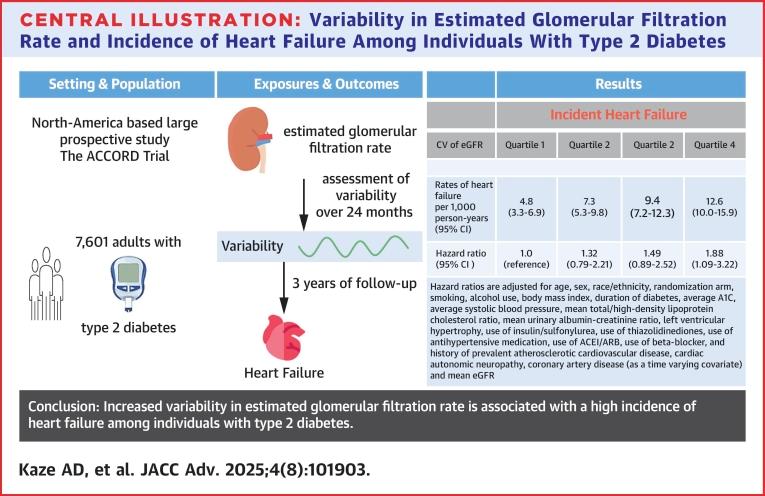
Among 7,601 participants (mean age: 63 ± 6.5 years, 39.1% women, 63% White), 193 developed HF over a median follow-up of 3 years. HF incidence increased across quartiles of eGFR variability. In fully adjusted models, participants in the highest quartile of eGFR CV had an HR of 1.88 (95% CI: 1.09-3.22; P trend = 0.019) compared to the lowest quartile. Per 1-SD increments in all the eGFR variability metrics were associated with increased HF risk (CV: HR: 1.15; 95% CI: 0.99-1.33; SD: HR: 1.16; 95% CI: 1.01-1.33; variability independent of the mean: HR: 1.18; 95% CI: 1.03-1.35).
CONCLUSIONS
Higher variability in eGFR is independently associated with an increased risk of incident HF in adults with type 2 diabetes.
背景
通过估算肾小球滤过率(eGFR)测得的肾功能变异性已被提出作为不良心血管结局的一种新的危险因素。然而,其与2型糖尿病成年患者新发心力衰竭(HF)的关联仍不明确。
目的
本研究的目的是在一大群2型糖尿病成年患者中评估eGFR变异性与新发HF的关联。
方法
我们纳入了在ACCORD(控制糖尿病心血管风险行动)研究的前24个月内有≥5次eGFR测量值的参与者。使用变异系数(CV)、标准差(SD)以及独立于均值的变异性来估算eGFR的就诊间变异性。采用Cox比例风险模型来估算新发HF的校正风险比(HR)和95%置信区间(CI)。
结果
在7601名参与者中(平均年龄:63±6.5岁,39.1%为女性,63%为白人),在中位随访3年期间有193人发生HF。HF发病率随eGFR变异性的四分位数增加而升高。在完全校正模型中,与最低四分位数相比,eGFR CV最高四分位数的参与者的HR为1.88(95%CI:1.09 - 3.22;P趋势 = 0.019)。所有eGFR变异性指标每增加1个标准差均与HF风险增加相关(CV:HR:1.15;95%CI:0.99 - 1.33;SD:HR:1.16;95%CI:1.01 - 1.33;独立于均值的变异性:HR:1.18;95%CI:1.03 - 1.35)。
结论
eGFR的较高变异性与2型糖尿病成年患者新发HF风险增加独立相关。


 Zotero 插件