
探索黎巴嫩大学生的心理健康素养及寻求心理咨询的障碍:一项横断面研究。
Exploring mental health literacy and barriers to seeking counselling among university students in Lebanon: a cross-sectional study.
作者信息
Younes Samar, Ayoub Dana, Baalbaki Racha, Slim Andre, Yassine Leila, Abdelghani Natalie, Rahal Mohamad, Mourad Nisreen
机构信息
School of Pharmacy, Lebanese International University, Bekaa, Lebanon
INSPECT-LB (Institut National de Santé Publique d'Épidémiologie Clinique et de Toxicologie-Liban), Beirut, Lebanon.
出版信息
BMJ Open. 2025 Jul 10;15(7):e098579. doi: 10.1136/bmjopen-2024-098579.
OBJECTIVES
This study aims to assess the level of mental health literacy (MHL) and identify its associated factors among undergraduate university students in Lebanon. A secondary objective is to evaluate the Global Barriers to Counselling scores, their associated factors, and to examine their relationship with MHL.
DESIGN
Cross-sectional study using an online self-administered questionnaire.
SETTING
University-level educational settings in Lebanon, including students from both public and private institutions across multiple regions.
PARTICIPANTS
This study enrolled undergraduate students of all academic disciplines using a convenience sampling technique. Inclusion criteria included being 18 years and above, currently enrolled at university, able to comprehend the English language and consenting to participate.
PRIMARY AND SECONDARY OUTCOME MEASURES
Primary outcomes: MHL scores, using the Mental Health Literacy Scale (MHLS); and Global Barriers to Counselling score, using the Revised Fit, Stigma and Value Scale (RFSV). Secondary analysis examined factors associated with MHLS score and Global Barriers to Counselling scores using multivariable linear regression.
RESULTS
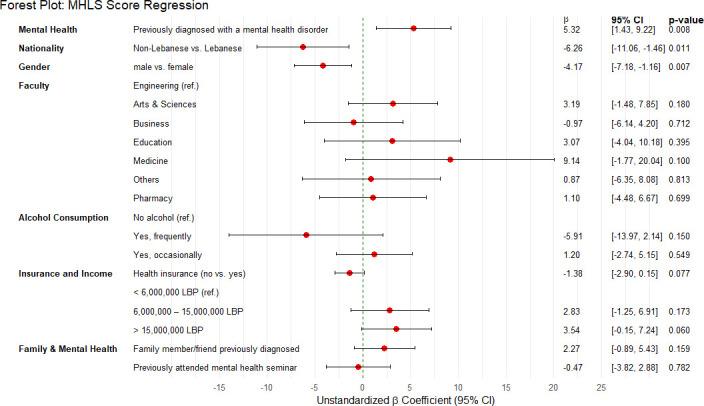
A total of 572 participants (65.0% female; mean age 21.1±3.7 years) were included. Most were Lebanese (87.4%). The median MHLS score was 86 (IQR 77-95), indicating generally good MHL. Factors associated with lower MHLS were male gender (β=-4.17, 95% CI -7.18 to -1.16, p=0.007) and being of non-Lebanese nationality (β=-6.26, 95% CI -11.06 to -1.46, p=0.011). Presence of a previous mental health diagnosis was associated with a higher MHLS score (β=5.32, 95% CI 1.43 to 9.22, p=0.008). The Global Barriers to Counselling score had a median of 28.7 (IQR 23.21-36.21). Male gender was significantly associated with a higher barrier score (β=3.44, 95% CI 4.85 to 5.04, p<0.001). Factors associated with lower barrier score were attending a mental health seminar in the past (β=-2.00, 95% CI -3.91 to -0.09, p=0.04), and having a higher MHLS score (β=-0.14, 95% CI -0.21 to -0.07).
CONCLUSION
This study highlights good overall MHL among undergraduate university students in Lebanon, with variations based on gender, nationality and prior mental health exposure. Higher mental health literacy was associated with fewer perceived barriers to seeking counselling. These findings emphasise the need for tailored mental health initiatives in Lebanese universities that promote literacy, reduce stigma and enhance help-seeking behaviour across diverse student populations.
目的
本研究旨在评估黎巴嫩大学生的心理健康素养水平,并确定其相关因素。第二个目标是评估咨询的全球障碍得分、其相关因素,并检验它们与心理健康素养的关系。
设计
采用在线自填问卷的横断面研究。
背景
黎巴嫩的大学教育环境,包括来自多个地区公立和私立机构的学生。
参与者
本研究采用便利抽样技术招募了所有学科的本科生。纳入标准包括年龄在18岁及以上、目前在大学就读、能够理解英语并同意参与。
主要和次要结局指标
主要结局:使用心理健康素养量表(MHLS)的心理健康素养得分;以及使用修订后的契合、污名和价值观量表(RFSV)的咨询全球障碍得分。二次分析使用多变量线性回归研究与MHLS得分和咨询全球障碍得分相关的因素。
结果
共纳入572名参与者(65.0%为女性;平均年龄21.1±3.7岁)。大多数是黎巴嫩人(87.4%)。MHLS得分中位数为86(四分位间距77 - 95),表明心理健康素养总体良好。与较低MHLS相关的因素是男性(β=-4.17,95%置信区间-7.18至-1.16,p = 0.007)和非黎巴嫩国籍(β=-6.26,95%置信区间-11.06至-1.46,p = 0.011)。既往有心理健康诊断与较高的MHLS得分相关(β=5.32,95%置信区间1.43至9.22,p = 0.008)。咨询全球障碍得分中位数为28.7(四分位间距23.21 - 36.21)。男性与较高的障碍得分显著相关(β=3.44,95%置信区间4.85至5.04,p<0.001)。与较低障碍得分相关的因素是过去参加过心理健康研讨会(β=-2.00,95%置信区间-3.91至-0.09,p = 0.04),以及较高的MHLS得分(β=-0.14,95%置信区间-0.21至-0.07)。
结论
本研究强调黎巴嫩大学生总体心理健康素养良好,但因性别、国籍和既往心理健康经历存在差异。较高的心理健康素养与寻求咨询时较少的感知障碍相关。这些发现强调了在黎巴嫩大学开展针对性心理健康举措的必要性,这些举措应促进素养提升、减少污名并增强不同学生群体的求助行为。

 Zotero 插件