
代谢性减肥手术实施得越早,除体重减轻外的预期临床获益就越好:一项短期随访研究。
The earlier metabolic bariatric surgery is performed, the better expected clinical benefit beyond weight loss: a short-term follow-up study.
作者信息
Gao Wenxing, Li Qian, Zhang Rui, Wu Xiao, Suo Qian, Ji Gang
机构信息
Department of General Surgery, The First Medical Center of Chinese PLA General Hospital, No. 28 Fuxing Road, Beijing, 100853, China.
Department of Gastrointestinal Surgery, The First Affiliated Hospital of Air Force Medical University, No.127 Changle West Road, Xi'an, 710032, China.
出版信息
Eur J Med Res. 2025 Jul 11;30(1):615. doi: 10.1186/s40001-025-02885-w.
BACKGROUND
Obesity is a global public health challenge, which is strongly associated with dozens of diseases. Metabolic bariatric surgery is recognized as a long-term and effective treatment for obesity and obesity-related medical conditions. The aim of this study is to investigate the relationship between the timing of metabolic bariatric surgery and postoperative weight loss along with the clinical remission of obesity-related medical conditions.
METHODS
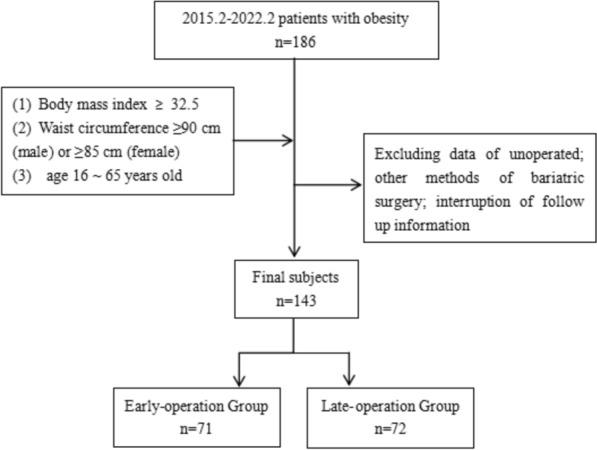
This study examined 143 patients with obesity who underwent laparoscopic sleeve gastrectomy (LSG) from Feb 2015 to Feb 2022. The median time from meeting the criteria for metabolic bariatric surgery to finally undergoing metabolic bariatric surgery for all participants was 5.75 years. Based on this, the participants were divided into two groups: the early operation group (persons with a duration of obesity prior to surgery of less than 5 years) and the late operation group (those with the duration of longer than 5 years). Weight metrics, biochemical indicators and improvements in obesity-related medical conditions of both groups were analyzed before the operation and 1 year after the operation.
RESULTS
All patients completed a postoperative follow-up of at least 1 year. There was no significant variation in weight loss, TWL% (P ≥ 0.05) between the early operation and late operation groups. Whereas patients in the early operation group had better improvements in obesity-related medical conditions 1 year after surgery (P < 0.05). Furthermore, the early operation group showed a more pronounced decrease in related metabolic indices, such as fasting blood glucose and triglyceride (P < 0.01).
CONCLUSIONS
Patients undergoing metabolic bariatric surgery experienced significant weight reduction. Notably, those in the early operation group exhibited better improvement in obesity-related medical conditions and related metabolic indices post-operation.
背景
肥胖是一项全球性的公共卫生挑战,与数十种疾病密切相关。代谢性减重手术被认为是治疗肥胖及肥胖相关病症的一种长期有效的方法。本研究旨在探讨代谢性减重手术的时机与术后体重减轻以及肥胖相关病症临床缓解之间的关系。
方法
本研究对2015年2月至2022年2月期间接受腹腔镜袖状胃切除术(LSG)的143例肥胖患者进行了研究。所有参与者从符合代谢性减重手术标准到最终接受代谢性减重手术的中位时间为5.75年。据此,将参与者分为两组:早期手术组(术前肥胖持续时间少于5年的人)和晚期手术组(肥胖持续时间超过5年的人)。分析两组患者术前及术后1年的体重指标、生化指标以及肥胖相关病症的改善情况。
结果
所有患者均完成了至少1年的术后随访。早期手术组和晚期手术组在体重减轻、体重减轻百分比(TWL%)方面无显著差异(P≥0.05)。然而,早期手术组患者在术后1年肥胖相关病症的改善情况更好(P<0.05)。此外,早期手术组相关代谢指标如空腹血糖和甘油三酯的下降更为明显(P<0.01)。
结论
接受代谢性减重手术的患者体重显著减轻。值得注意的是,早期手术组患者术后肥胖相关病症及相关代谢指标的改善情况更好。
 Zotero 插件