
不进行全身抗真菌预防的肝移植——来自单一中心经验的独特视角。
Liver Transplantation Without Systemic Antifungal Prophylaxis-An Exceptional Perspective from a Single Center Experience.
作者信息
Moral Kenan, Kabaçam Gökhan, Atlı Muzaffer, Cindoruk Mehmet, Bayındır Yaşar, Sardan Yeşim, Karademir Sedat
机构信息
Department of Gastroenterology and Hepatology, Gazi University, Ankara 06560, Turkey.
Department of Gastroenterology and Liver Transplantation, Güven Hospital, Ankara 06540, Turkey.
出版信息
J Clin Med. 2025 Jul 1;14(13):4663. doi: 10.3390/jcm14134663.
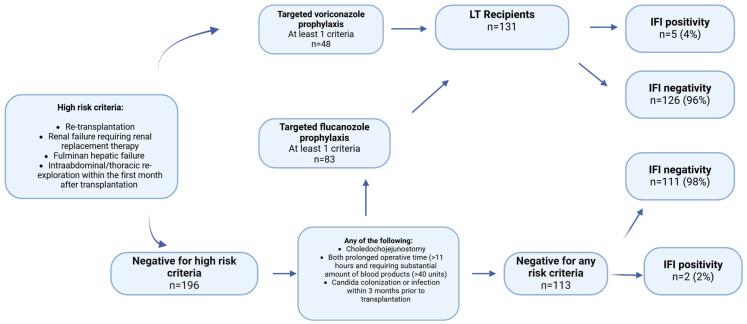
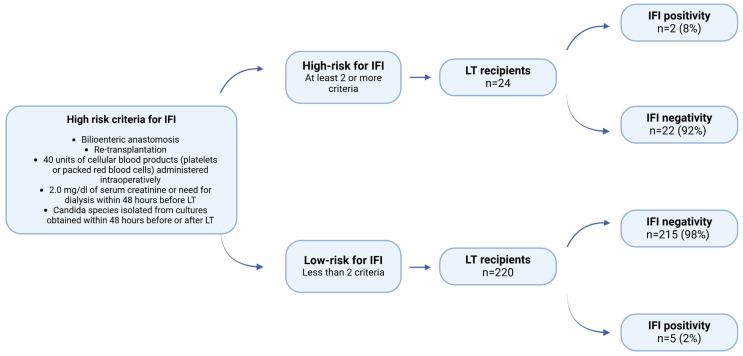
Invasive fungal infections (IFIs) after liver transplantation (LT) remain a concern. No universal protocol for antifungal prophylaxis in LT exists. Antifungal prophylaxis varies across European centers. Studies suggest risk stratification for prophylaxis. This study assessed IFI frequency and outcomes in adult LT recipients without antifungal prophylaxis and evaluated risk stratification for predicting IFIs. A retrospective analysis of clinical and microbiological data from 244 liver transplant patients focused on IFI within 100 days post-transplantation. Of these, 225 (92%) had right liver transplants from living donors. We assessed two risk stratification models for predicting IFI: one categorizes patients into low- and high-risk groups, and the other divides patients into three categories, with two eligible for prophylaxis and one not. Of 244 patients, 3% (seven individuals) developed invasive fungal infections (IFI), including two aspergillosis and five candidiasis. IFI occurred in 8% of high-risk and 2% of low-risk patients in the first stratification, with no significant difference between groups ( = 0.144). In the second stratification, IFI was found in 4% of the target and 2% of non-target groups, without a significant difference ( = 0.455). Patients with IFI showed higher mean MELD scores of 21.71 ± 2.35 versus 17.04 ± 6.48 in those without IFI ( < 0.05). This study evaluated IFI outcomes without systemic antifungal prophylaxis in LT recipients. Limited antifungal use in a major living liver donor transplantation (LDLT) group, with low MELD scores and immunosuppression protocols, could be feasible. Future multicenter studies can improve understanding and develop prophylaxis algorithms for LT settings.
肝移植(LT)后的侵袭性真菌感染(IFI)仍是一个令人担忧的问题。目前尚无针对肝移植抗真菌预防的通用方案。欧洲各中心的抗真菌预防措施各不相同。研究表明需要进行预防的风险分层。本研究评估了未接受抗真菌预防的成年肝移植受者中IFI的发生率和结局,并评估了预测IFI的风险分层。对244例肝移植患者的临床和微生物学数据进行回顾性分析,重点关注移植后100天内的IFI情况。其中,225例(92%)接受了来自活体供体的右肝移植。我们评估了两种预测IFI的风险分层模型:一种将患者分为低风险和高风险组,另一种将患者分为三类,其中两类符合预防条件,一类不符合。在244例患者中,3%(7例)发生了侵袭性真菌感染(IFI),包括2例曲霉病和5例念珠菌病。在第一种分层中,高风险患者中IFI的发生率为8%,低风险患者中为2%,两组之间无显著差异(P = 0.144)。在第二种分层中,目标组中IFI的发生率为4%,非目标组中为2%,无显著差异(P = 0.455)。发生IFI的患者平均终末期肝病模型(MELD)评分更高,为21.71±2.35,而未发生IFI的患者为17.04±6.48(P < 0.05)。本研究评估了肝移植受者未进行全身抗真菌预防时IFI的结局。在主要的活体肝供体移植(LDLT)组中,MELD评分较低且免疫抑制方案下有限的抗真菌药物使用可能是可行的。未来的多中心研究可以增进了解并制定肝移植环境下的预防算法。
 Zotero 插件