
2型糖尿病患者心外膜脂肪组织与新型炎症及心力衰竭生物标志物的关联:代谢控制的影响
Association of Epicardial Adipose Tissue with Novel Inflammation and Heart Failure Biomarkers in Type 2 Diabetes Patients: Effect of Metabolic Control.
作者信息
Gil-Millan Pedro, Rives José, Viladés David, García-Osuna Álvaro, Genua Idoia, Miñambres Inka, Grau-Agramunt Margarita, Gich Ignasi, Camacho Mercedes, Benitez Sonia, Julve Josep, Sánchez-Quesada José Luis, Pérez Antonio
机构信息
Endocrinology Department, Hospital de la Santa Creu i Sant Pau, 08041 Barcelona, Spain.
Department of Medicine, Universitat Autònoma de Barcelona, 08193 Barcelona, Spain.
出版信息
J Clin Med. 2025 Jul 2;14(13):4687. doi: 10.3390/jcm14134687.
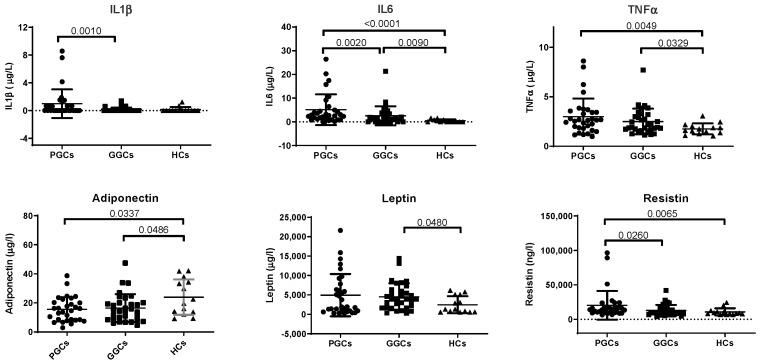
: Type 2 diabetes (T2D patients) have a 74% increased risk of heart failure (HF), but traditional HF biomarkers lack sensitivity in early disease detection. Increased epicardial adipose tissue volume (EATv) is associated with cardiovascular risk in T2D, and novel biomarkers such as growth differentiation factor 15 (GDF15), Galectin-3, and soluble suppression of tumorigenicity 2 (sST2) are inflammation biomarkers linked to HF. : We investigated associations between EATv, inflammation biomarkers, and the effect of metabolic control in 14 healthy controls (HCs) and 36 newly diagnosed T2D patients both before (poor glycemic control, PGC) and after 12 months of glycemic optimization (good glycemic control, GGC). EATv indexed to body surface area (iEATv) was quantified by multidetector computed tomography, and biomarker levels were measured by immunoassays. : PGC patients had higher iEATv (59.53 ± 21.67 vs. 36.84 ± 16.57 cm/m, = 0.0017) and elevated GDF15, Galectin-3, and sST2 levels (all < 0.05) than HC subjects. The glycemic optimization reduced iEATv ( = 0.0232) and sST2 ( = 0.048), while GDF15 and Galectin-3 remained unchanged. Multivariable analysis confirmed independent associations between iEATv, GDF15 (β = 0.27, = 0.027) and sST2 (β = 0.29, = 0.02). : These results support the link between systemic inflammation, EAT expansion, and cardiac dysfunction, and they point to the role of epicardial fat in early HF risk of T2D patients.
2型糖尿病(T2D患者)发生心力衰竭(HF)的风险增加74%,但传统的HF生物标志物在疾病早期检测中缺乏敏感性。心外膜脂肪组织体积(EATv)增加与T2D患者的心血管风险相关,而新型生物标志物如生长分化因子15(GDF15)、半乳糖凝集素-3和可溶性肿瘤抑制因子2(sST2)是与HF相关的炎症生物标志物。:我们调查了14名健康对照者(HCs)和36名新诊断的T2D患者在血糖控制不佳(PGC)之前和血糖优化12个月后(血糖控制良好,GGC)时EATv、炎症生物标志物之间的关联以及代谢控制的影响。通过多排螺旋计算机断层扫描对根据体表面积校正的EATv(iEATv)进行定量,并通过免疫测定法测量生物标志物水平。:PGC患者的iEATv(59.53±21.67 vs. 36.84±16.57 cm/m,P = 0.0017)以及GDF15、半乳糖凝集素-3和sST2水平均高于HC受试者(均P < 0.05)。血糖优化降低了iEATv(P = 0.0232)和sST2(P = 0.048),而GDF15和半乳糖凝集素-3保持不变。多变量分析证实iEATv、GDF15(β = 0.27,P = 0.027)和sST2(β = 0.29,P = 0.02)之间存在独立关联。:这些结果支持全身炎症、EAT扩张与心脏功能障碍之间的联系,并指出心外膜脂肪在T2D患者早期HF风险中的作用。

 Zotero 插件