
口腔癌病变的转录组图谱:一项关于福尔马林固定石蜡包埋组织切片的概念验证性初步研究。
Transcriptomic Profile of Oral Cancer Lesions: A Proof-of-Concept Pilot Study of FFPE Tissue Sections.
作者信息
Richards Madison E, Beckman Micaela F, Martinez Duarte Ernesto, Napenas Joel J, Brennan Michael T, Bahrani Mougeot Farah, Mougeot Jean-Luc C
机构信息
Department of Oral Medicine/Oral and Maxillofacial Surgery, Atrium Health Carolinas Medical Center, Charlotte, NC 28203, USA.
Translational Research Laboratories, Cannon Research Center & Oral Medicine, Atrium Health Carolinas Medical Center, Charlotte, NC 28203, USA.
出版信息
Int J Mol Sci. 2025 Jun 28;26(13):6263. doi: 10.3390/ijms26136263.
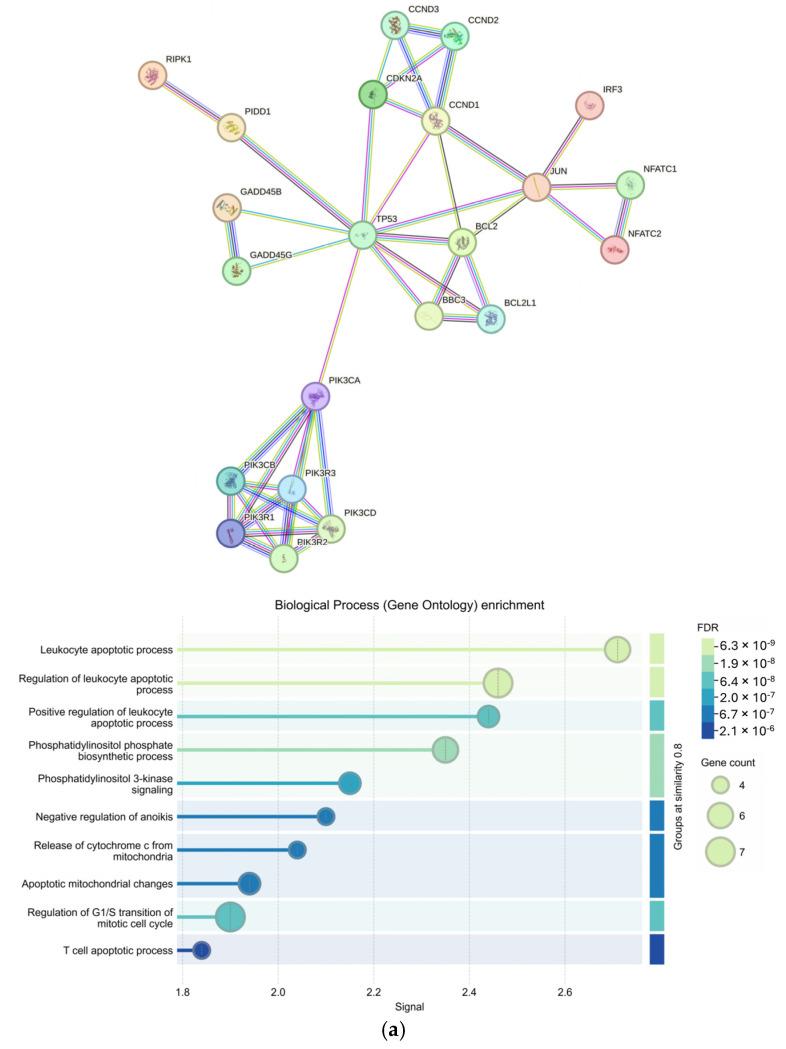
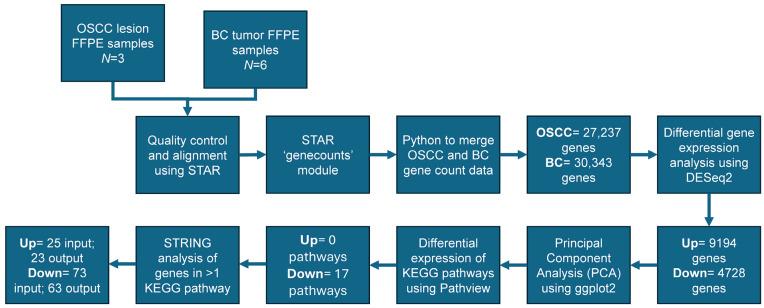
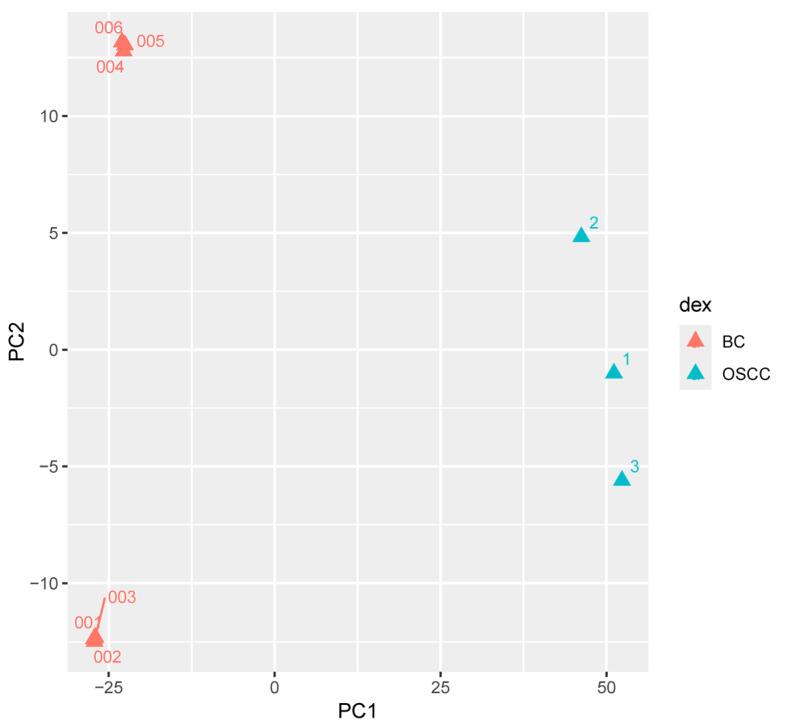
Oral squamous cell carcinoma (OSCC) is a malignancy that affects the oral mucosa and is characterized by indurated oral lesions. The RNAseq of formalin-fixed, paraffin-embedded (FFPE) samples is readily available in clinical settings. Such samples have long-term preservation and can provide highly accurate transcriptomic information regarding gene fusions, isoforms, and allele-specific expression. We determined differentially expressed genes using the transcriptomic profiles of oral potentially malignant disorder (OPMD) FFPE oral lesion samples of patients who developed OSCC over years. A technical comparison was completed comparing breast cancer (BC) FFPE publicly available data in this proof-of-concept pilot study. OSCC FFPE samples were collected from patients ( = 3) who developed OSCC 3 to 5 years following OPMD diagnosis ( = 3) and were analyzed using RNAseq. RNAseq sequences from the FFPE OSCC samples and publicly available FFPE samples of BC patients ( = 6) (Gene Expression Omnibus Database, GSE58135) aligned to human reference (GRCh38.p13). Genes were counted using the Spliced Transcripts Alignment to a Reference (STARv2.7.9a) software. Differential expression was determined in R using DESeq2v1.40.2 comparing OSCC to BC samples. Principal component analysis (PCA) plots were completed. Differential Kyoto Encyclopedia of Genes and Genomes (KEGG) pathways were determined via the Pathviewv.1.40.0 program. STRING v12.0 was used to determine protein-protein interactions between genes represented in more than one KEGG pathway. STARv2.7.9a identified 27,237 and 30,343 genes among the OSCC and BC groups, respectively. DESeq2v1.40.2 determined 9194 differentially expressed genes (DEPs), 4466 being upregulated (OSCC > BC) and 4728 being downregulated (BC > OSCC) (padj < 0.05). Most significant genes included , , and (5- to 10-fold change range; padj < 10 × 10-100). PCA showed that BC and OSCC samples clustered as separate groups. Pathviewv.1.40.0 identified 17 downregulated KEGG pathways in OSCC compared to the BC group. No upregulated KEGG pathways were identified. STRINGv12.0 determined Gene Ontology Biological Process enrichments for leukocytes and apoptosis in upregulated KEGG genes including multiple genes and NIK/NF-kappaB signaling and metabolic responses from lipopolysaccharides in downregulated KEGG genes including and . Using FFPE samples, we determined DEPs characteristic of OSCC and distinct from BC. -family genes and lipopolysaccharide producing periodontal pathogens may be further investigated for their involvement in the OPMD to OSCC transition.
口腔鳞状细胞癌(OSCC)是一种影响口腔黏膜的恶性肿瘤,其特征为硬结性口腔病变。在临床环境中,福尔马林固定、石蜡包埋(FFPE)样本的RNA测序很容易获得。此类样本具有长期保存性,并且可以提供有关基因融合、异构体和等位基因特异性表达的高度准确的转录组信息。我们使用多年后发展为OSCC的患者的口腔潜在恶性疾病(OPMD)FFPE口腔病变样本的转录组谱来确定差异表达基因。在这项概念验证性初步研究中,完成了一项技术比较,将乳腺癌(BC)FFPE的公开可用数据进行了对比。从OPMD诊断后3至5年发展为OSCC的患者(n = 3)中收集OSCC FFPE样本,并使用RNA测序进行分析。来自FFPE OSCC样本和BC患者(n = 6)的公开可用FFPE样本(基因表达综合数据库,GSE58135)的RNA测序序列与人参考基因组(GRCh38.p13)比对。使用比对到参考序列的剪接转录本(STARv2.7.9a)软件对基因进行计数。在R中使用DESeq2v1.40.2确定差异表达,将OSCC样本与BC样本进行比较。完成了主成分分析(PCA)图。通过Pathviewv.1.40.0程序确定差异京都基因与基因组百科全书(KEGG)通路。使用STRING v12.0确定在多个KEGG通路中出现的基因之间的蛋白质-蛋白质相互作用。STARv2.7.9a在OSCC组和BC组中分别鉴定出27,237个和30,343个基因。DESeq2v1.40.2确定了9194个差异表达基因(DEP),其中4466个上调(OSCC > BC),4728个下调(BC > OSCC)(padj < 0.05)。最显著的基因包括 、 和 (变化范围为5至10倍;padj < 10×10 - 100)。PCA显示BC和OSCC样本聚为不同的组。与BC组相比,Pathviewv.1.40.0在OSCC中鉴定出17条下调的KEGG通路。未鉴定出上调的KEGG通路。STRINGv12.0确定了上调的KEGG基因中白细胞和凋亡的基因本体生物学过程富集,包括多个 基因以及NIK/NF-κB信号传导;在下调的KEGG基因中包括 和 ,确定了来自脂多糖的代谢反应。使用FFPE样本,我们确定了OSCC特有的且与BC不同的DEP。 -家族基因和产生脂多糖的牙周病原体可能因其参与OPMD向OSCC的转变而需要进一步研究。

 Zotero 插件