
经胸超声心动图与脓毒症相关性急性肾损伤的死亡率:基于MIMC-IV数据库的分析
Transthoracic echocardiography and mortality in sepsis-associated acute kidney injury: An analysis based on MIMC-IV database.
作者信息
Zhang Qian, Zhu Runying, Li Bo, Zhang Xujie, Li Jiali, Xin Yan, Liu Lixia, Hu Zhenjie, Huo Yan
机构信息
Department of Intensive Care Unit, The Fourth Hospital of Hebei Medical University, Shi Jiazhuang, Hebei, China.
Department of Intensive Care Unit, Panzhihua Municipal Central Hospital, Pan ZhihuaSichuan, China.
出版信息
Sci Rep. 2025 Jul 12;15(1):25196. doi: 10.1038/s41598-025-10776-7.
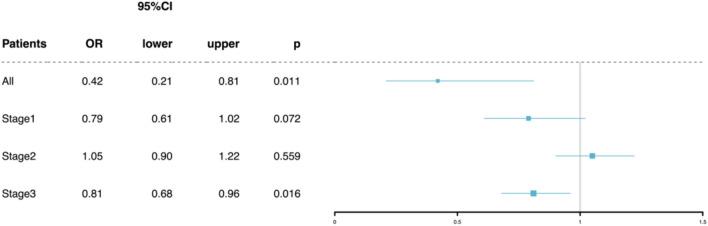
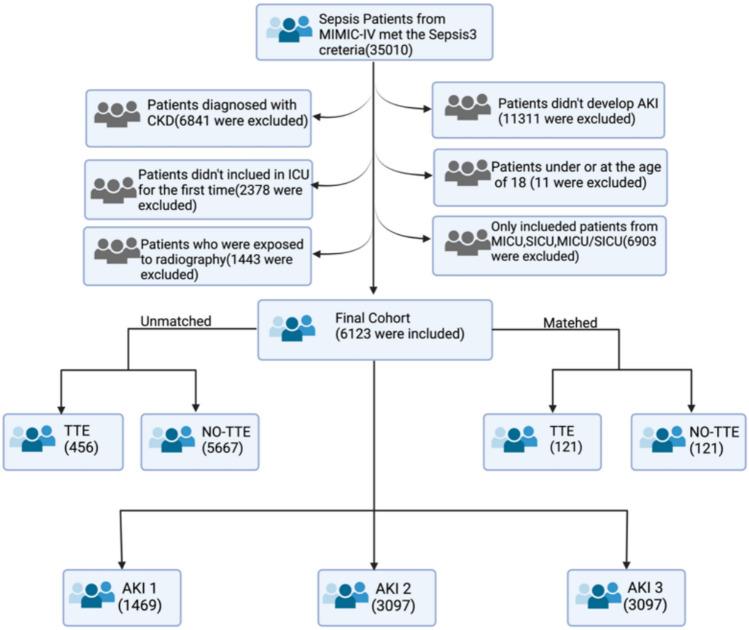
Transthoracic echocardiography (TTE) has become an essential tool for hemodynamic evaluation. However, its effect on outcomes in sepsis-associated acute kidney injury (SA-AKI) remains unclear. This study aims to explore the association of TTE with the 28-day mortality in SA-AKI patients. MIMIC-IV database was used to identify patients with Sepsis whether they underwent TTE evaluation within 24 h of sepsis diagnosis. Propensity score matching (PSM) was employed to minimize confounding, and subgroup analyses were conducted to assess the impact of TTE across different AKI severity grades. Following PSM, 121 patients were included in each group (TTE vs. no TTE). The TTE group showed improved 28-day survival compared to the no TTE group (odds ratio = 0.80, 95% CI 0.21-0.81, p = 0.011). A subgroup analysis based on different AKI stages showed no significant association between TTE and the 28-day mortality in KIDGO stage 1 or 2 patients. However, for patients with KIDGO stage 3, those who underwent TTE evaluation had a significantly lower 28-day mortality rate (OR 0.81, 95% CI 0.68-0.96, p < 0.05). Patients with SA-AKI who underwent TTE had an improvement in 28-day mortality, with this effect being more pronounced in patients with KIDGO stage 3.
经胸超声心动图(TTE)已成为血流动力学评估的重要工具。然而,其对脓毒症相关急性肾损伤(SA-AKI)患者预后的影响尚不清楚。本研究旨在探讨TTE与SA-AKI患者28天死亡率之间的关联。利用MIMIC-IV数据库识别脓毒症患者,无论其在脓毒症诊断后24小时内是否接受了TTE评估。采用倾向评分匹配(PSM)以尽量减少混杂因素,并进行亚组分析以评估TTE对不同AKI严重程度分级患者的影响。PSM后,每组纳入121例患者(TTE组与非TTE组)。与非TTE组相比,TTE组的28天生存率有所提高(优势比=0.80,95%可信区间0.21-0.81,p=0.011)。基于不同AKI分期的亚组分析显示,在KIDGO 1期或2期患者中,TTE与28天死亡率之间无显著关联。然而,对于KIDGO 3期患者,接受TTE评估的患者28天死亡率显著较低(OR 0.81,95%可信区间0.68-0.96,p<0.05)。接受TTE检查的SA-AKI患者28天死亡率有所改善,这种效果在KIDGO 3期患者中更为明显。

 Zotero 插件