
父母接触全氟和多氟烷基物质(PFAS)与出生结局:一项多国队列研究。
Paternal and maternal exposures to per- and polyfluoroalkyl substances (PFAS) and birth outcomes: a multi-country cohort study.
作者信息
Guo Pengfei, Luo Jiajun, Zhang Jie, Bonde Jens Peter, Struciński Paweł, Ohniev Viktor, Arah Onyebuchi A, Deziel Nicole C, Warren Joshua L, Toft Gunnar, Liew Zeyan
机构信息
Department of Environmental Health Sciences, Yale School of Public Health, 60 College Street, CT, 06510, New Haven, USA.
Yale Center for Perinatal, Pediatric, and Environmental Epidemiology, Yale School of Public Health, New Haven, CT, USA.
出版信息
Environ Health. 2025 Jul 12;24(1):48. doi: 10.1186/s12940-025-01199-y.
BACKGROUND
Maternal prenatal exposures to per- and polyfluoroalkyl substances (PFAS) have been linked to adverse birth outcomes. However, few investigations have considered paternal PFAS exposure. We estimated the parent-specific associations of prenatal PFAS exposures with adverse birth outcomes.
METHODS
This study included 498 couples from the INUENDO cohort recruited at antenatal care visits in Greenland, Poland, and Ukraine during 2002-2004. We measured five major types of PFAS in parental serum during pregnancy. We analyzed three birth outcomes ascertained from medical records, including gestational age, birth weight, and birth length. We used weighted least squares linear regression to evaluate parent-specific associations of serum PFAS with the birth outcomes, adjusting for parental co-exposures and covariates. We also used quantile g-computation for mixture modeling of the birth outcomes of paternal and/or maternal exposures to multiple PFAS.
RESULTS
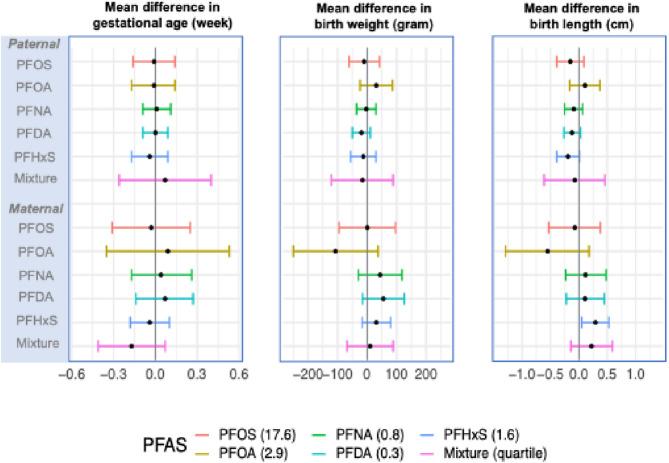
No associations were found between maternal and paternal PFAS exposures and gestational age. However, after adjusting for paternal PFOA, a higher level of maternal serum perfluorooctanoate (PFOA) was linked to a tendency towards lower birth weight and shorter birth length. Paternal exposure to several PFAS was also associated with a tendency for shorter birth length, but the estimated effect sizes were small. We found no joint exposure effects in the mixture analyses.
CONCLUSIONS
While the evidence was inconclusive, maternal PFOA and paternal PFAS exposures seemed to be associated with lower offspring birth weight and shorter birth length, respectively. Parent-specific effects of PFAS exposures on offspring growth and development warrant further research.
背景
孕妇孕期暴露于全氟和多氟烷基物质(PFAS)与不良出生结局有关。然而,很少有研究考虑父亲的PFAS暴露情况。我们估计了孕期PFAS暴露与不良出生结局的父母特异性关联。
方法
本研究纳入了2002 - 2004年期间在格陵兰、波兰和乌克兰产前检查时招募的INUENDO队列中的498对夫妇。我们在孕期测量了父母血清中五种主要类型的PFAS。我们分析了从医疗记录中确定的三种出生结局,包括孕周、出生体重和出生身长。我们使用加权最小二乘线性回归来评估血清PFAS与出生结局的父母特异性关联,并对父母共同暴露和协变量进行了调整。我们还使用分位数g计算法对父亲和/或母亲暴露于多种PFAS的出生结局进行混合建模。
结果
未发现母亲和父亲的PFAS暴露与孕周之间存在关联。然而,在调整了父亲的全氟辛酸(PFOA)后,母亲血清中较高水平的全氟辛酸(PFOA)与出生体重降低和出生身长缩短的趋势有关。父亲暴露于几种PFAS也与出生身长缩短的趋势有关,但估计的效应大小较小。我们在混合分析中未发现联合暴露效应。
结论
虽然证据尚无定论,但母亲的PFOA暴露和父亲的PFAS暴露似乎分别与后代出生体重降低和出生身长缩短有关。PFAS暴露对后代生长发育的父母特异性影响值得进一步研究。
 Zotero 插件