
与焦虑症的诊断特异性方案相比,情绪障碍跨诊断治疗统一方案的三年随访。
The Unified Protocol for Transdiagnostic Treatment of Emotional Disorders compared with diagnosis-specific protocols for anxiety disorders: A three-year follow-up.
作者信息
Bullis Jacqueline R, Eustis Elizabeth H, Curreri Andrew J, Cardona Nicole D, Woods Brittany K, Rosellini Anthony J, Barlow David H, Farchione Todd J
机构信息
McLean Hospital/Harvard Medical School, 115 Mill St, Belmont, MA 02478, USA.
Center for Anxiety and Related Disorders, Boston University, 900 Commonwealth Ave, Boston 02215, MA USA.
出版信息
J Mood Anxiety Disord. 2023 Sep 16;3:100024. doi: 10.1016/j.xjmad.2023.100024. eCollection 2023 Oct.
OBJECTIVE
Compare the long-term efficacy of diagnosis-specific and transdiagnostic cognitive-behavioral therapies (CBT) from a randomized equivalence trial for the treatment of heterogenous anxiety disorders.
METHOD
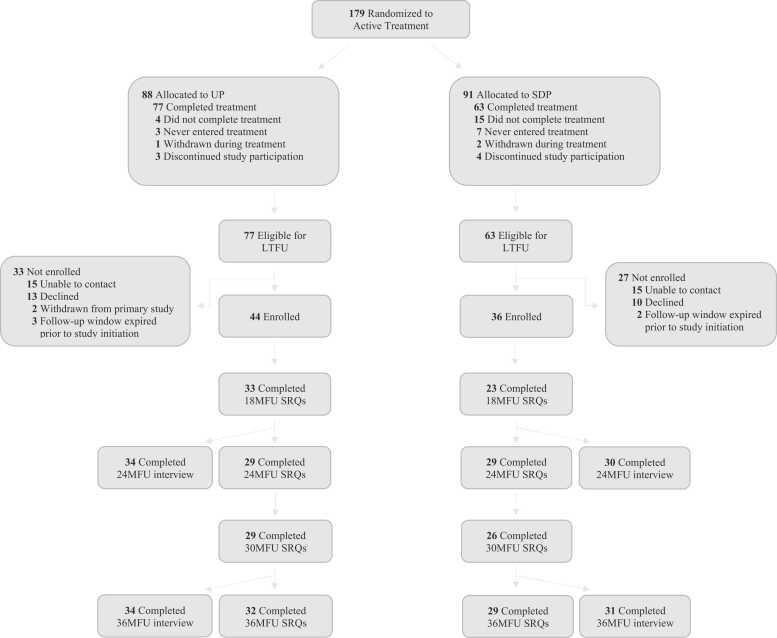
Participants were treatment completers (N = 80; 58.8% female) from the parent equivalence trial treated with either the Unified Protocol (UP; = 44) or the single-disorder CBT protocol (SDP; = 36) for their primary anxiety disorder. Clinical interviews were conducted at 24- and 36-month follow-up and self-report questionnaire batteries were completed at 18-, 24-, 30-, and 36-month follow-up. With-in condition effect sizes were calculated to determine maintenance of treatment gains in each treatment condition over time and potential differences between treatment conditions were evaluated using the principal diagnosis clinician severity rating (CSR) from the Anxiety Disorder Interview Schedule (ADIS); additional outcomes included anxiety, depression, and functional impairment.
RESULTS
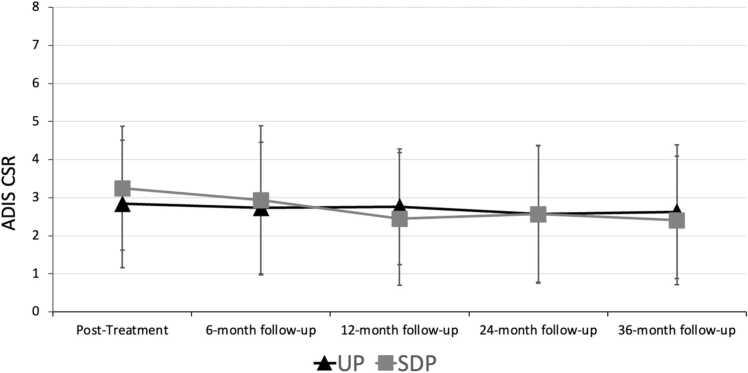
Treatment gains within each condition were largely maintained at three years post-treatment, with small fluctuations in subclinical symptoms. At 36-month follow-up, the UP and SDP treatment conditions remained comparable on the principal diagnosis ADIS CSR. Although there were some differences on secondary outcomes favoring the SDP condition at intermediate time points, there were no significant differences between the UP and SDP conditions on ADIS CSR or any secondary outcomes at 36-month follow-up.
CONCLUSIONS
Results further support the utility of the UP as a single intervention that produces durable treatment effects for the most commonly occurring psychological disorders through demonstration of outcomes commensurate with current first-line SDPs.
目的
从一项治疗多种焦虑症的随机等效性试验中比较针对特定诊断和跨诊断认知行为疗法(CBT)的长期疗效。
方法
参与者为来自母等效性试验的治疗完成者(N = 80;58.8%为女性),他们因原发性焦虑症接受了统一方案(UP;n = 44)或单病症CBT方案(SDP;n = 36)治疗。在24个月和36个月随访时进行临床访谈,并在18个月、24个月、30个月和36个月随访时完成自我报告问卷组。计算组内效应量以确定每种治疗条件下治疗效果随时间的维持情况,并使用焦虑症访谈量表(ADIS)中的主要诊断临床医生严重程度评分(CSR)评估治疗条件之间的潜在差异;其他结果包括焦虑、抑郁和功能损害。
结果
每种条件下的治疗效果在治疗后三年基本保持,亚临床症状有小的波动。在36个月随访时,UP和SDP治疗条件在主要诊断ADIS CSR上仍具有可比性。尽管在中间时间点的次要结果上存在一些有利于SDP条件的差异,但在36个月随访时,UP和SDP条件在ADIS CSR或任何次要结果上没有显著差异。
结论
结果进一步支持了UP作为一种单一干预措施的效用,即通过证明与当前一线SDP相当的结果,对最常见的心理障碍产生持久的治疗效果。
 Zotero 插件