
台湾成人支气管扩张症中呼吸道细菌和分枝杆菌分离株的临床意义
Clinical significance of respiratory bacteria and mycobacteria isolates in adult bronchiectasis in Taiwan.
作者信息
Chang Chia-Ling, Sheu Chau-Chyun, Wang Ping-Huai, Hsieh Meng-Heng, Hsu Wu-Huei, Chen Ming-Tsung, Ou Wei-Fan, Wei Yu-Feng, Yang Tsung-Ming, Lan Chou-Chin, Wang Cheng-Yi, Lin Chih-Bin, Lin Ming-Shian, Wang Yao-Tung, Lin Ching-Hsiung, Liu Shih-Feng, Cheng Meng-Hsuan, Chen Yen-Fu, Cheng Wen-Chien, Peng Chung-Kan, Chan Ming-Cheng, Chen Ching-Yi, Jao Lun-Yu, Wang Ya-Hui, Chen Chi-Jui, Chen Shih-Pin, Tsai Yi-Hsuan, Cheng Shih-Lung, Lin Horng-Chyuan, Chien Jung-Yien, Wang Hao-Chien
机构信息
Department of Internal Medicine, National Taiwan University Hospital Hsin-Chu Branch, Hsin-Chu, Taiwan.
Graduate Institute of Clinical Medicine, College of Medicine, National Taiwan University, Taipei, Taiwan.
出版信息
ERJ Open Res. 2025 Jul 14;11(4). doi: 10.1183/23120541.00865-2024. eCollection 2025 Jul.
BACKGROUND
The clinical impact of bacterial and mycobacterial isolates on bronchiectasis remains uncertain.
METHODS
Patients with bronchiectasis at 16 hospitals in Taiwan were recruited with a 1-year follow-up. The patients were classified into six groups: Group 1, ; Group 2, ; Group 3, other bacteria; Group 4, non-tuberculous mycobacteria (NTM); Group 5, daily sputum without bacterial or NTM colonisation; and Group 6, dry bronchiectasis.
RESULTS
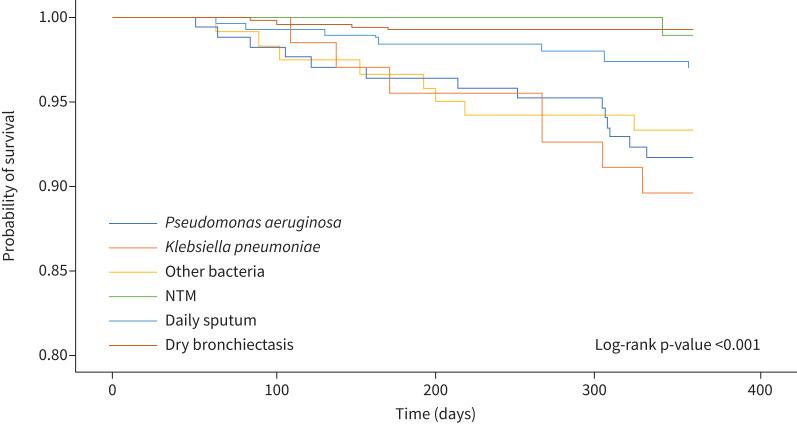
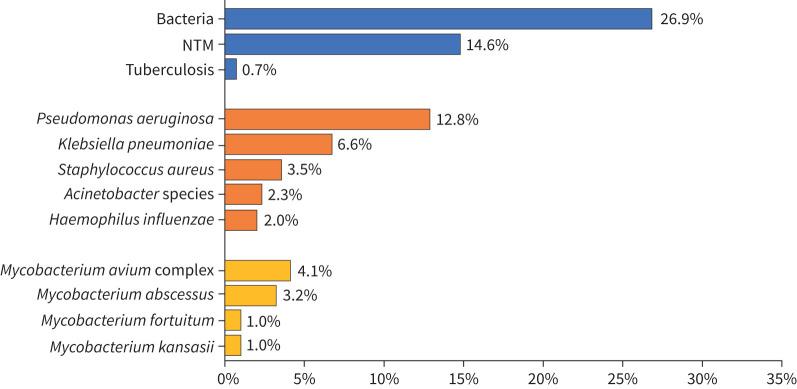
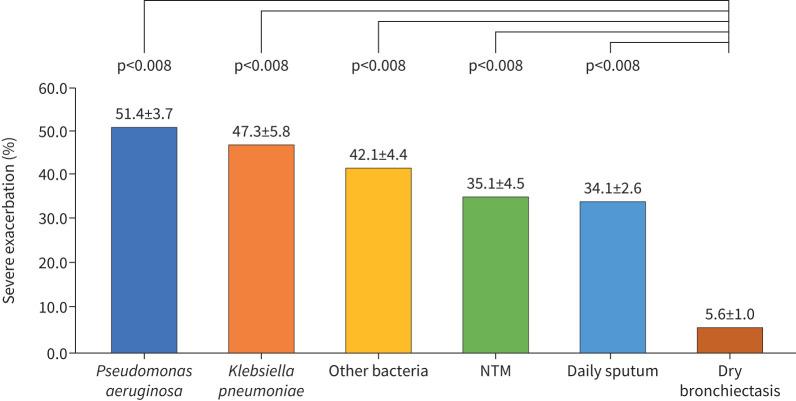
In total, 1416 patients (mean age 67 years; 43% males) were included. The mean modified Reiff score was 5 (range 1-18). 59% (829 patients) had sputum, whereas the remaining did not. The proportions of bacteria and NTM cultured from sputum within 1 year of observation were 27% (381/1416) and 15% (202/1416), respectively. The most common bacterial isolate was (13%), followed by (7%). 26% of the patients experienced severe exacerbations at least once within the year. The 1-year all-cause mortality rate was 3%. Patients with sputum exhibited a higher rate of severe exacerbations compared to patients with dry bronchiectasis, regardless of the presence of bacteria or NTM (p<0.001). Patients with bacterial colonisation had a higher mortality rate (p<0.001). Further, the highest mortality rate was observed among those with colonisation (hazard ratio (HR) 8.39 (95% CI 2.39-29.49)), followed by individuals colonised with other bacteria (HR 8.04 (95% CI 2.36-27.38)) and (HR 7.83 (95% CI 2.45-25.03)). Additionally, old age was an independent risk factor (HR 2.72 (95% CI 1.19-6.18)).
CONCLUSION
was more frequently isolated from patients with bronchiectasis in Taiwan compared to Western countries and was associated with unfavourable clinical outcomes.
背景
细菌和分枝杆菌分离株对支气管扩张的临床影响仍不确定。
方法
招募台湾16家医院的支气管扩张患者并进行为期1年的随访。患者分为六组:第1组, ;第2组, ;第3组,其他细菌;第4组,非结核分枝杆菌(NTM);第5组,每日咳痰但无细菌或NTM定植;第6组,干性支气管扩张。
结果
共纳入1416例患者(平均年龄67岁;43%为男性)。改良Reiff评分平均为5分(范围1 - 18分)。59%(829例患者)有咳痰,其余患者无咳痰。观察1年内从痰液中培养出细菌和NTM的比例分别为27%(381/1416)和15%(202/1416)。最常见的细菌分离株是 (13%),其次是 (7%)。26%的患者在该年内至少经历一次严重加重。1年全因死亡率为3%。无论有无细菌或NTM,咳痰患者的严重加重发生率均高于干性支气管扩张患者(p<0.001)。细菌定植患者的死亡率更高(p<0.001)。此外, 定植患者的死亡率最高(风险比(HR)8.39(95%置信区间2.39 - 29.49)),其次是其他细菌定植者(HR 8.04(95%置信区间2.36 - 27.38))和 (HR 7.83(95%置信区间2.45 - 25.03))。此外,老年是一个独立危险因素(HR 2.72(95%置信区间1.19 - 6.18))。
结论
与西方国家相比,台湾支气管扩张患者中 分离更为频繁,且与不良临床结局相关。
 Zotero 插件