
评估甲胎蛋白和维生素K缺乏或拮抗剂-II诱导蛋白对肝细胞癌的联合诊断效能。
Evaluating the combined diagnostic power of alpha-fetoprotein and protein induced by vitamin K absence or antagonist-II for hepatocellular carcinoma.
作者信息
Zhang Shangdi, Gao Caiyan, Wang Yubin, Chen Linmei, Gao Shan
机构信息
Laboratory Medical Center, Second Hospital of Lanzhou University, Lanzhou, China.
Department of Clinical Nutrition, Second Hospital of Lanzhou University, Lanzhou, China.
出版信息
J Gastrointest Oncol. 2025 Jun 30;16(3):1157-1175. doi: 10.21037/jgo-2024-863. Epub 2025 Jun 27.
BACKGROUND
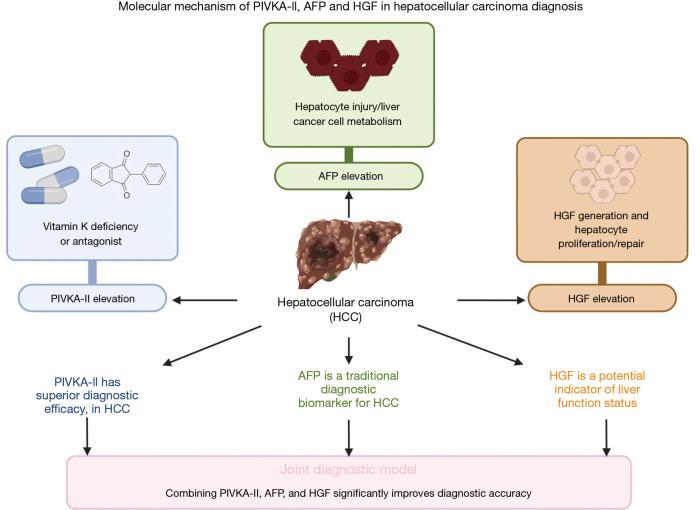
Hepatocellular carcinoma (HCC) is one of the leading causes of cancer-related deaths globally, largely due to delayed diagnosis. Alpha-fetoprotein (AFP), a traditional biomarker for HCC, suffers from limited sensitivity and specificity, particularly in early-stage disease. Protein induced by vitamin K absence or antagonist-II (PIVKA-II) has emerged as a promising complementary marker. This study aimed to evaluate the diagnostic performance of AFP and PIVKA-II, individually and in combination, in HCC detection.
METHODS
A total of 210 HCC patients and 270 chronic hepatitis B (CHB) patients were enrolled between June 2021 and February 2023. Additionally, 91 HCC patients and 88 CHB patients were included as a validation cohort. Serum levels of AFP and PIVKA-II were measured, and their diagnostic efficacy was assessed using receiver operating characteristic (ROC) curve analysis. A multivariate logistic regression model incorporating clinical features and biomarkers was developed and validated. A meta-analysis of relevant studies was also conducted to further confirm the diagnostic value of AFP.
RESULTS
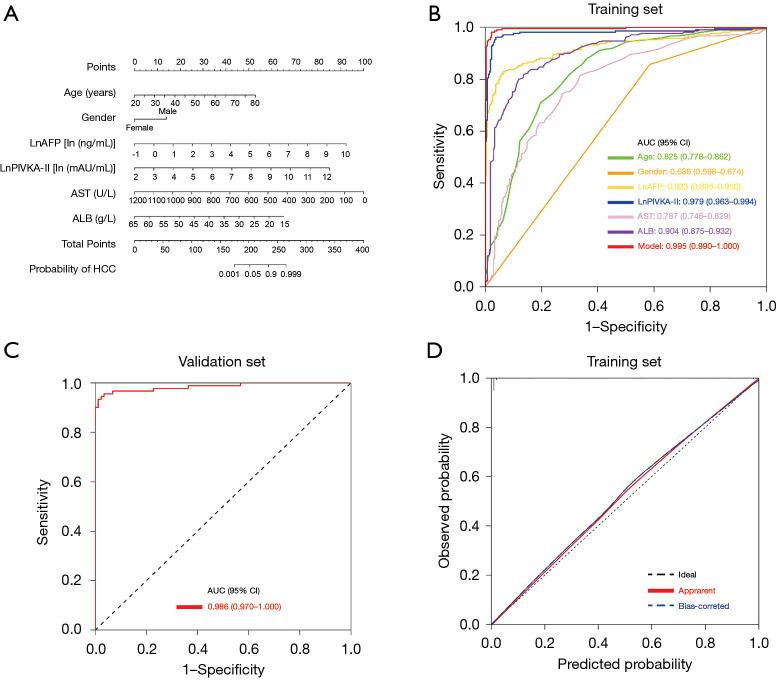
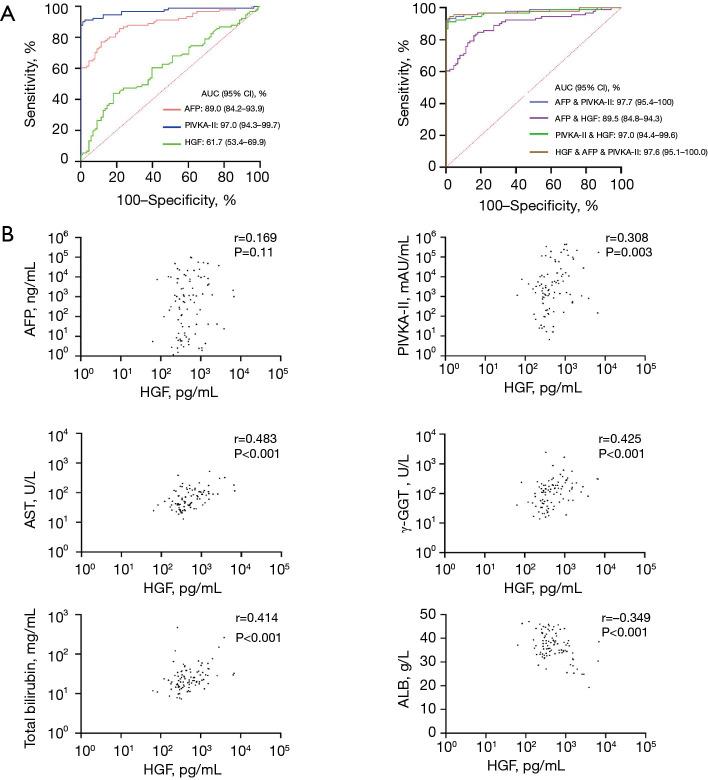
PIVKA-II levels were significantly higher in HCC patients compared to CHB controls and showed superior diagnostic performance [area under the curve (AUC) =0.970] compared to AFP (AUC =0.890). The combination of AFP and PIVKA-II significantly improved sensitivity (98.6%) and specificity (91.1%). A predictive model integrating AFP, PIVKA-II, age, sex, aspartate aminotransferase (AST), and albumin (ALB) demonstrated excellent diagnostic accuracy (AUC =0.995) and was successfully validated (AUC =0.986). Meta-analysis supported AFP as a reliable biomarker for HCC, although with heterogeneity across studies. PIVKA-II was also effective in monitoring treatment response, with postoperative levels markedly decreasing in patients undergoing hepatectomy.
CONCLUSIONS
PIVKA-II offers superior diagnostic accuracy for HCC and complements AFP to enhance early detection, especially in AFP-insensitive cases. The combined biomarker strategy and predictive model provide a robust framework for clinical screening and early intervention. Integration of PIVKA-II into routine diagnostic workflows could improve patient outcomes and reduce diagnostic delays in HCC.
背景
肝细胞癌(HCC)是全球癌症相关死亡的主要原因之一,主要是由于诊断延迟。甲胎蛋白(AFP)作为一种传统的HCC生物标志物,其敏感性和特异性有限,尤其是在疾病早期。维生素K缺乏或拮抗剂-II诱导蛋白(PIVKA-II)已成为一种有前景的补充标志物。本研究旨在评估AFP和PIVKA-II单独及联合检测在HCC诊断中的性能。
方法
2021年6月至2023年2月共纳入210例HCC患者和270例慢性乙型肝炎(CHB)患者。此外,91例HCC患者和88例CHB患者被纳入验证队列。检测血清AFP和PIVKA-II水平,并使用受试者工作特征(ROC)曲线分析评估其诊断效能。建立并验证了一个纳入临床特征和生物标志物的多变量逻辑回归模型。还对相关研究进行了荟萃分析,以进一步确认AFP的诊断价值。
结果
与CHB对照相比,HCC患者的PIVKA-II水平显著更高,且与AFP(曲线下面积[AUC]=0.890)相比,显示出更高的诊断性能(AUC=0.970)。AFP和PIVKA-II联合使用显著提高了敏感性(98.6%)和特异性(91.1%)。整合AFP、PIVKA-II、年龄、性别、天冬氨酸转氨酶(AST)和白蛋白(ALB)的预测模型显示出优异的诊断准确性(AUC=0.995),并成功得到验证(AUC=0.986)。荟萃分析支持AFP作为HCC的可靠生物标志物,尽管各研究存在异质性。PIVKA-II在监测治疗反应方面也有效,肝切除术后患者的术后水平显著下降。
结论
PIVKA-II对HCC具有更高的诊断准确性,并补充AFP以提高早期检测率,尤其是在AFP不敏感的病例中。联合生物标志物策略和预测模型为临床筛查和早期干预提供了一个强大的框架。将PIVKA-II纳入常规诊断工作流程可改善患者预后并减少HCC的诊断延迟。




 Zotero 插件