
钠-葡萄糖协同转运蛋白2抑制剂对心律失常的长期影响:一项系统评价和荟萃分析。
Long-term effects of SGLT2 inhibitors on arrhythmias: a systematic review and meta-analysis.
作者信息
Li Peipei, Chen Weiwei, Chen Rui, Zhang Hanmo, Yu Zhixi, Yan Hongyu, Du Beibei, Yang Ping
机构信息
Department of Cardiology, Jilin Provincial Cardiovascular Research Institute, China-Japan Union Hospital of Jilin University, Changchun, China.
Cardiovascular Hospital, The First Affiliated Hospital of Zhengzhou University, Zhengzhou University, Zhengzhou, China.
出版信息
Front Pharmacol. 2025 Jul 2;16:1558367. doi: 10.3389/fphar.2025.1558367. eCollection 2025.
AIMS
Sodium-glucose co-transporter 2 (SGLT2) inhibitors are novel oral hypoglycemic agents strongly endorsed in the treatment guidelines for heart failure due to their cardioprotective benefits. However, their specific impact of SGLT2 inhibitors on arrhythmias incompletely understood. This systematic review and meta-analysis aimed to comprehensively evaluate the long-term effects of SGLT2 inhibitors on various arrhythmia types.
METHODS
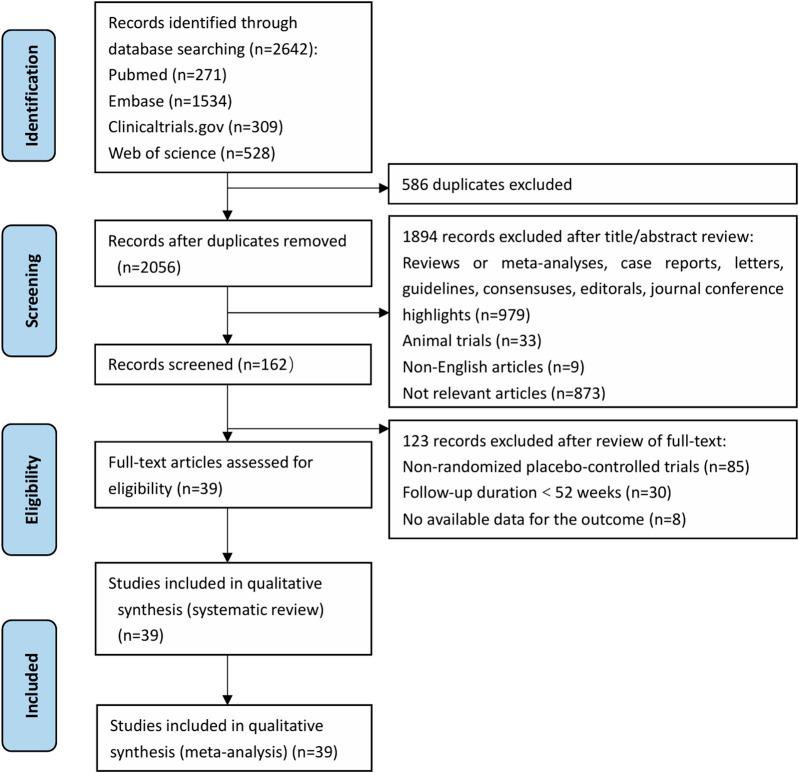
We systematically searched PubMed, Embase, Web of Science, and ClinicalTrials.gov from database inception to 30 June 2024, to identify randomized controlled clinical trials (RCTs) with a follow-up duration of at least 52 weeks. The primary outcome of the meta-analysis was atrial fibrillation (AF) or atrial flutter (AFL), and the secondary outcomes included ventricular tachycardia (VT), ventricular fibrillation (VF), and sinus bradycardia. The pooled risk ratios (RRs) with 95% confidence intervals (CIs) were used to estimate the incidence of arrhythmias.
RESULTS
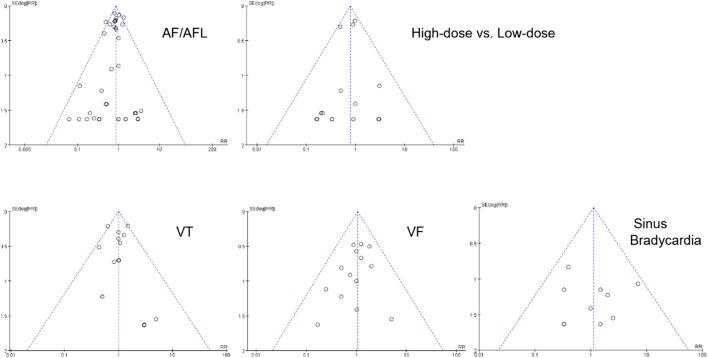
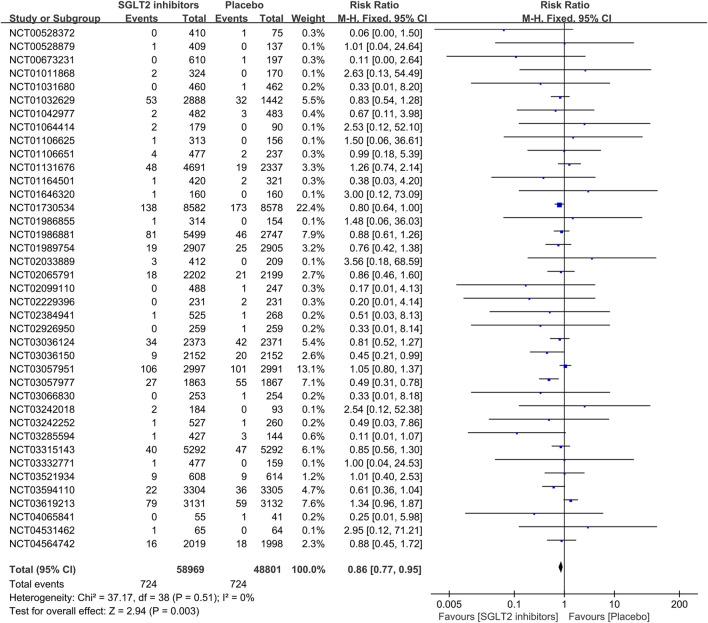
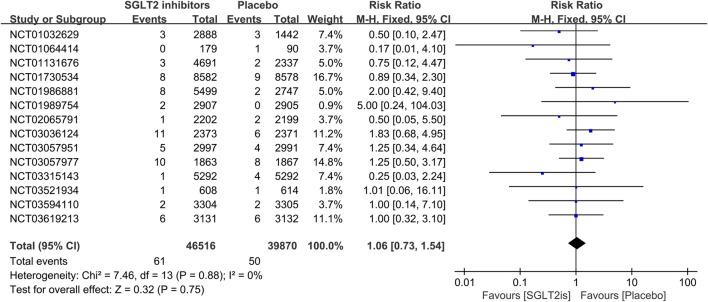
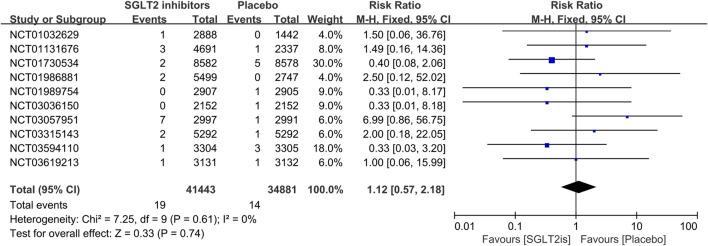
Thirty-nine RCTs involving 107,770 participants were included. The results of meta-analysis revealed that patients treated with SGLT2 inhibitors had a reduced risk of AF/AFL compared with placebo (RR 0.86; 95%CI, 0.77-0.95; I = 0%; P = 0.003). There was no significant difference in the risk of AF/AFL between the high-dose SGLT2 inhibitors group and the low-dose SGLT2 inhibitors group (RR 0.78; 95%CI, 0.60-1.02; I = 0%; P = 0.07), although a decreasing trend in the high-dose group was noted. Similarly, no significant differences were found for VT (RR 0.99; 95%CI, 0.81-1.22; I = 0%; P = 0.96), VF (RR 1.06; 95%CI, 0.73-1.54; I = 0%; P = 0.75) or sinus bradycardia (RR 1.12; 95%CI, 0.57-2.18; I = 0%; P = 0.74) between the SGLT2 inhibitors and placebo groups.
CONCLUSION
SGLT2 inhibitors significantly reduce the risk of AF/AFL but have no notable impact on the risk of VT, VF, and sinus bradycardia. Additionally, different doses of SGLT2 inhibitors did not statistically influence AF/AFL incidence.
SYSTEMATIC REVIEW REGISTRATION
https://www.crd.york.ac.uk/PROSPERO/home, identifier PROSPERO:CRD42022371089.
目的
钠-葡萄糖协同转运蛋白2(SGLT2)抑制剂是新型口服降糖药物,因其对心脏的保护作用而在心力衰竭治疗指南中得到大力推荐。然而,SGLT2抑制剂对心律失常的具体影响尚不完全清楚。本系统评价和荟萃分析旨在全面评估SGLT2抑制剂对各种心律失常类型的长期影响。
方法
我们系统检索了从数据库建立至2024年6月30日的PubMed、Embase、Web of Science和ClinicalTrials.gov,以识别随访时间至少为52周的随机对照临床试验(RCT)。荟萃分析的主要结局是心房颤动(AF)或心房扑动(AFL),次要结局包括室性心动过速(VT)、室性颤动(VF)和窦性心动过缓。采用合并风险比(RR)及95%置信区间(CI)来估计心律失常的发生率。
结果
纳入了39项涉及107770名参与者的RCT。荟萃分析结果显示,与安慰剂相比,接受SGLT2抑制剂治疗的患者发生AF/AFL的风险降低(RR 0.86;95%CI,0.77-0.95;I² = 0%;P = 0.003)。高剂量SGLT2抑制剂组和低剂量SGLT2抑制剂组之间AF/AFL风险无显著差异(RR 0.78;95%CI,0.60-1.02;I² = 0%;P = 0.07),尽管高剂量组有下降趋势。同样,SGLT2抑制剂组和安慰剂组之间在VT(RR 0.99;95%CI,0.81-1.22;I² = 0%;P = 0.96)、VF(RR 1.06;95%CI,0.73-1.54;I² = 0%;P = 0.75)或窦性心动过缓(RR 1.12;95%CI,0.57-2.18;I² = 0%;P = 0.74)方面均无显著差异。
结论
SGLT2抑制剂可显著降低AF/AFL风险,但对VT、VF和窦性心动过缓风险无显著影响。此外,不同剂量的SGLT2抑制剂对AF/AFL发生率无统计学影响。
系统评价注册
https://www.crd.york.ac.uk/PROSPERO/home,标识符PROSPERO:CRD42022371089


 Zotero 插件