
2岁以内极早产儿的认知、语言和运动发育模式:一种描述性方法。
Cognitive, language and motor developmental patterns of extremely preterm children up to 2 years of age: a descriptive approach.
作者信息
Jurišová Erika, Ráczová Lucia, Zaťková Marta, Romanová Martina
机构信息
Department of Psychological Sciences, Faculty of Social Sciences and Health Care, Constantine the Philosopher University in Nitra, Nitra, Slovakia.
Institute of Applied Psychology, Faculty of Social Sciences and Health Care, Constantine the Philosopher University in Nitra, Nitra, Slovakia.
出版信息
Front Psychol. 2025 Jul 2;16:1599390. doi: 10.3389/fpsyg.2025.1599390. eCollection 2025.
BACKGROUND
Advancements in technology and pharmacology over the past 15 years have increased the survival rates of extremely low gestational age newborns to over 80%. However, these medical achievements are often accompanied by significant challenges in their early and long-term developmental competencies. This longitudinal descriptive study aimed to examine the neurodevelopmental patterns, prevalence of developmental delays, and associated risk factors -gestational age (GA) and birth weight (BW)-in Slovak children born at extremely low gestational age (ELGA), from 7 to 8 months of corrected age to 24-25 months of chronological age, focusing on cognitive, motor, and language development.
METHODS
The study included 7 female and 10 male ELGA children with a mean GA of 26.0 weeks ( = 1.2; range = 24-28) and mean BW of 875.8 grams ( = 171.2; range = 560-1,150). The Bayley Scales of Infant and Toddler Development, Third Edition (Bayley-III) was administered to assess cognitive, language, and motor development. The developmental functioning of cognitive, linguistic, and motor skills was analyzed using a descriptive approach, based on the average composite scores attained in each domain, in comparison with the normative group defined by the Bayley-III. The developmental patterns of cognitive, linguistic, and motor skills in the observed ELGA children were constructed based on the level of composite scores at two time points: the 7th or 8th month of corrected age (initial assessment) and the 24th or 25th month of chronological age (final assessment). These performance values were classified according to the 'cut-off' criteria for developmental delay in the Bayley-III. The degree of delay at these two time points determined the type of developmental pattern.
RESULTS
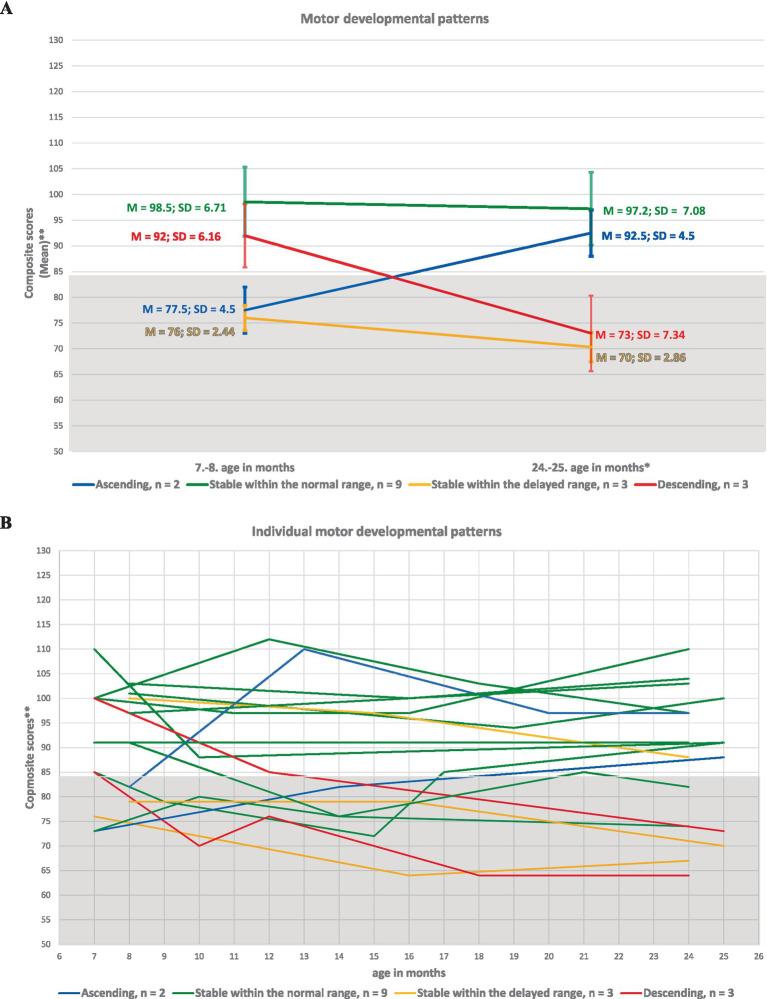
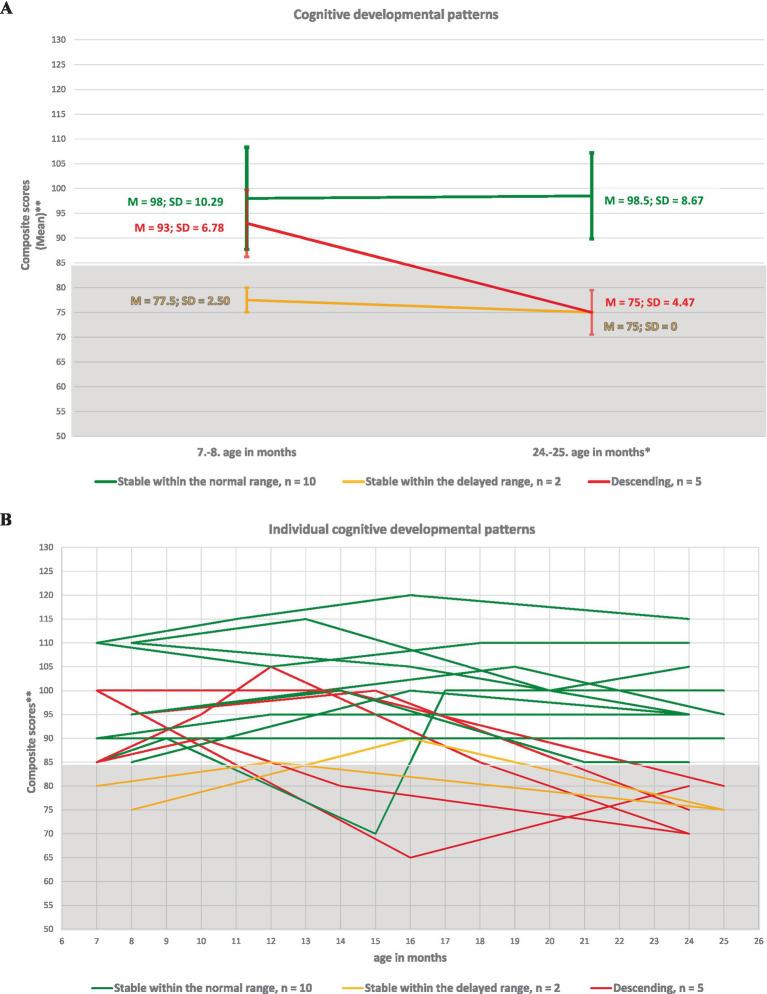
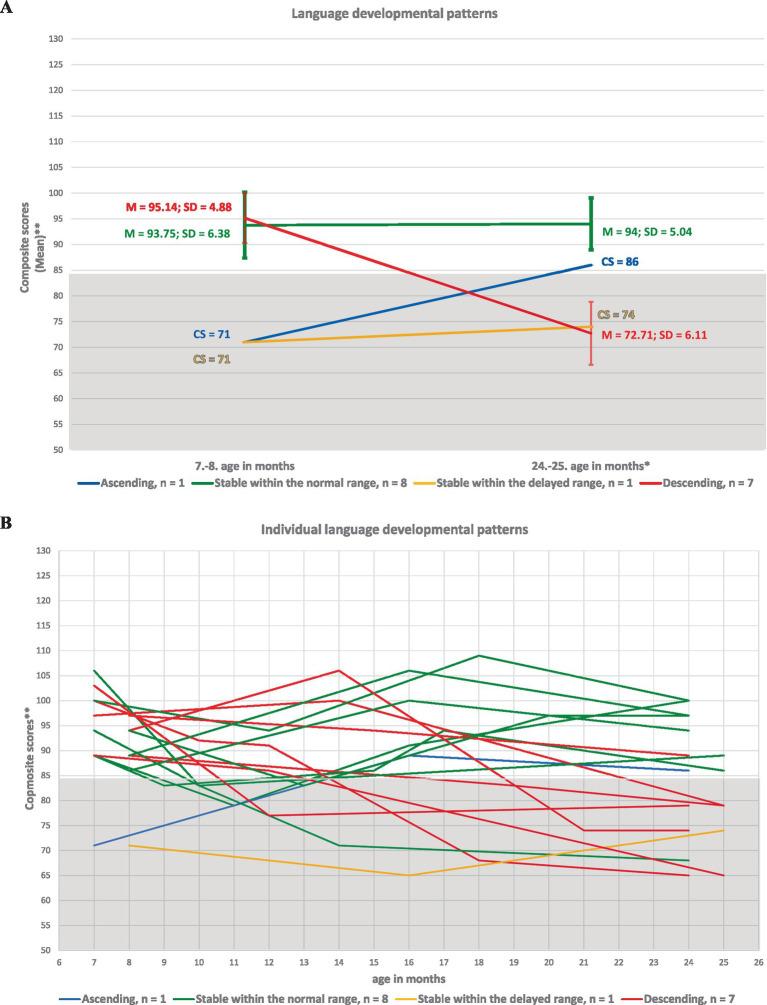
The developmental functioning of cognitive, language, and motor skills in the sample of ELGA children studied at the 7th or 8th month of corrected age was within the average range. However, the average scores of ELGA children were 5 to 10 points lower than those of the normative population across domains. At this time point, only 30% of the ELGA children exhibited developmental delay in at least one domain, exclusively at the level of mild to moderate delay (< -1 SD). The prevalence of mild to moderate delay (< -1 SD) was as follows: cognition: 11.7%, language: 11.7%, motor: 29.4%. In the studied sample, we observed a decline in cognitive, language, and motor functioning to the low-average range at 2 years of chronological age. The average scores of ELGA children were 12 to 17 points lower than those of the normative population across domains. At this point, up to 58.9% of the ELGA children exhibited developmental delay in at least one domain. The prevalence of developmental delay was as follows: mild to moderate delay (< -1 SD) was observed in 29.4% of children for cognition, 29.4% for language, and 17.6% for motor skills. Severe delay (< -2 SD) was present in 11.7% of children for cognition, 17.6% for language, and 17.6% for motor skills. In the sample of children with ELGA, we observed declining developmental trends in cognitive and motor skills; however, the values of developmental functioning remained within the range of typical development without developmental delay. Regarding language skills, we observed the most pronounced decline during the first 2 years of development, shifting from typical development to a mild-to-moderate delay (< -1 SD). Within individual domains, we identified four types of developmental patterns in cognitive, language, and motor skills among ELGA children. These patterns were as follows: (1) ascending into the normal range: 0, 5.8, and 11.7%, respectively; (2) stable pattern within the normal range: 58.8, 47.0, and 52.9%; (3) stable pattern within the delayed range: 11.7, 5.8, and 17.6%; (4) descending into the delayed range: 29.4, 41.1, and 17.6%. Findings indicate a higher incidence of developmentally risky patterns in children born at low gestational age (24-25 weeks) and in children with birth weight below 750 grams and lower. Developmental functioning without delay in all three domains (cognitive, language, and motor) was observed in 41.1% of the ELGA children during their second year. The limitation of the study was the small sample size and the absence of Slovak standards for Bayley-III.
CONCLUSION
The results demonstrate significant the need for early and long-term monitoring of developmental trends in this high-risk population, as well as the need to identify a broader range of health and non-health risk factors and their interactions that contribute to their final developmental outcomes.
背景
在过去15年中,技术和药理学的进步使极低孕周新生儿的存活率提高到了80%以上。然而,这些医学成就往往伴随着早期和长期发育能力方面的重大挑战。这项纵向描述性研究旨在调查斯洛伐克极低孕周(ELGA)出生儿童从矫正年龄7至8个月到实际年龄24至25个月期间的神经发育模式、发育迟缓的患病率以及相关风险因素——孕周(GA)和出生体重(BW),重点关注认知、运动和语言发育。
方法
该研究纳入了7名女性和10名男性ELGA儿童,平均孕周为26.0周(标准差=1.2;范围=24 - 28周),平均出生体重为875.8克(标准差=171.2;范围=560 - 1150克)。采用贝利婴幼儿发展量表第三版(Bayley - III)评估认知、语言和运动发育。基于每个领域获得的平均综合得分,采用描述性方法分析认知、语言和运动技能的发育功能,并与Bayley - III定义的常模组进行比较。根据两个时间点的综合得分水平构建观察到的ELGA儿童的认知、语言和运动技能发育模式:矫正年龄第7或8个月(初始评估)和实际年龄第24或25个月(最终评估)。这些表现值根据Bayley - III中发育迟缓的“临界值”标准进行分类。这两个时间点的延迟程度决定了发育模式的类型。
结果
在矫正年龄第7或8个月研究的ELGA儿童样本中,认知、语言和运动技能的发育功能处于平均范围内。然而,ELGA儿童在各个领域的平均得分比常模人群低5至10分。在这个时间点,只有30%的ELGA儿童在至少一个领域表现出发育迟缓,且仅为轻度至中度迟缓(< -1标准差)。轻度至中度迟缓(< -1标准差)的患病率如下:认知:11.7%,语言:11.7%,运动:29.4%。在研究样本中,我们观察到在实际年龄2岁时,认知、语言和运动功能下降到低平均范围。ELGA儿童在各个领域的平均得分比常模人群低12至17分。此时,高达58.9%的ELGA儿童在至少一个领域表现出发育迟缓。发育迟缓的患病率如下:认知方面,29.4%的儿童有轻度至中度迟缓(< -1标准差),语言方面为29.4%,运动技能方面为17.6%。认知方面11.7%的儿童、语言方面17.6%的儿童和运动技能方面17.6%的儿童存在严重迟缓(< -2标准差)。在ELGA儿童样本中,我们观察到认知和运动技能的发育趋势下降;然而,发育功能值仍在典型发育范围内,无发育迟缓。关于语言技能,我们观察到在发育的前两年下降最为明显,从典型发育转变为轻度至中度迟缓(< -1标准差)。在各个领域内,我们在ELGA儿童的认知、语言和运动技能中确定了四种发育模式。这些模式如下:(1)上升至正常范围:分别为0%、5.8%和11.7%;(2)在正常范围内稳定模式:分别为58.8%、47.0%和52.9%;(3)在延迟范围内稳定模式:分别为11.7%、5.8%和17.6%;(4)下降至延迟范围:分别为29.4%、41.1%和17.6%。研究结果表明,孕周较低(24 - 25周)出生的儿童以及出生体重低于750克及更低的儿童中,发育风险模式的发生率更高。在第二年,41.1%的ELGA儿童在所有三个领域(认知、语言和运动)的发育功能均无延迟。该研究的局限性在于样本量小以及缺乏Bayley - III的斯洛伐克标准。
结论
结果表明,对这一高危人群的发育趋势进行早期和长期监测具有重要意义,同时也需要识别更广泛的健康和非健康风险因素及其相互作用关系,这些因素会影响他们最终的发育结果。

 Zotero 插件