
从机制到应用:纳米医学驱动的癌症治疗中的程序性细胞死亡途径
From mechanism to application: programmed cell death pathways in nanomedicine-driven cancer therapies.
作者信息
Zhang Zhan, Wu Yuanzhen, Liu Yanchen, Zhang Jingyu, Zhang Yan, Dai Yunlu, Liu Caigang
机构信息
Department of Oncology, Shengjing Hospital of China Medical University, Shenyang, China.
Cancer Stem Cell and Translational Medicine Laboratory, Shengjing Hospital of China Medical University, Shenyang, China.
出版信息
Bioact Mater. 2025 Jul 1;52:773-809. doi: 10.1016/j.bioactmat.2025.06.052. eCollection 2025 Oct.
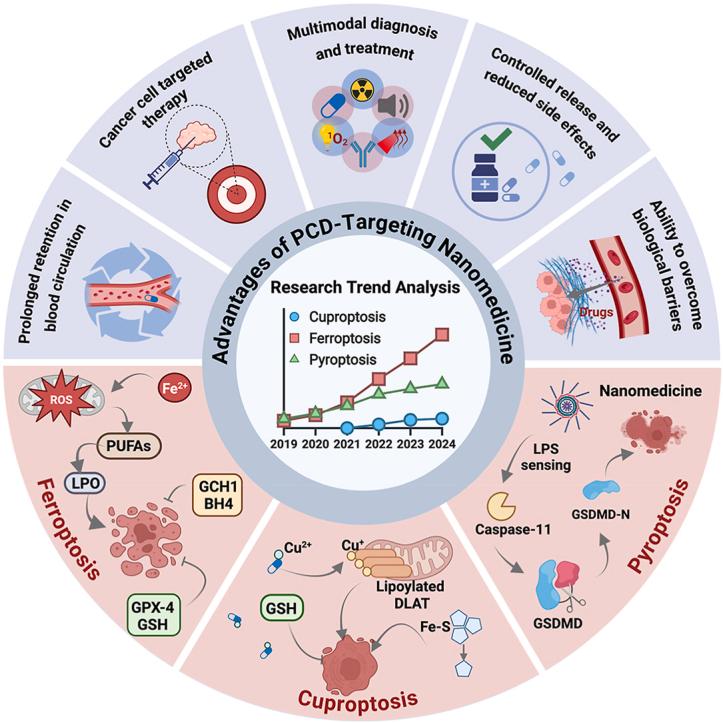
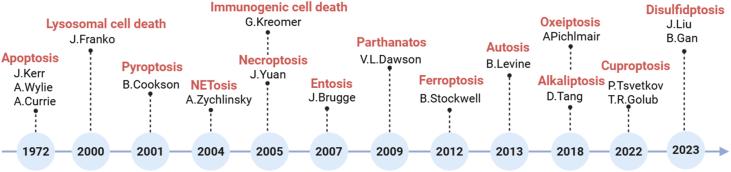
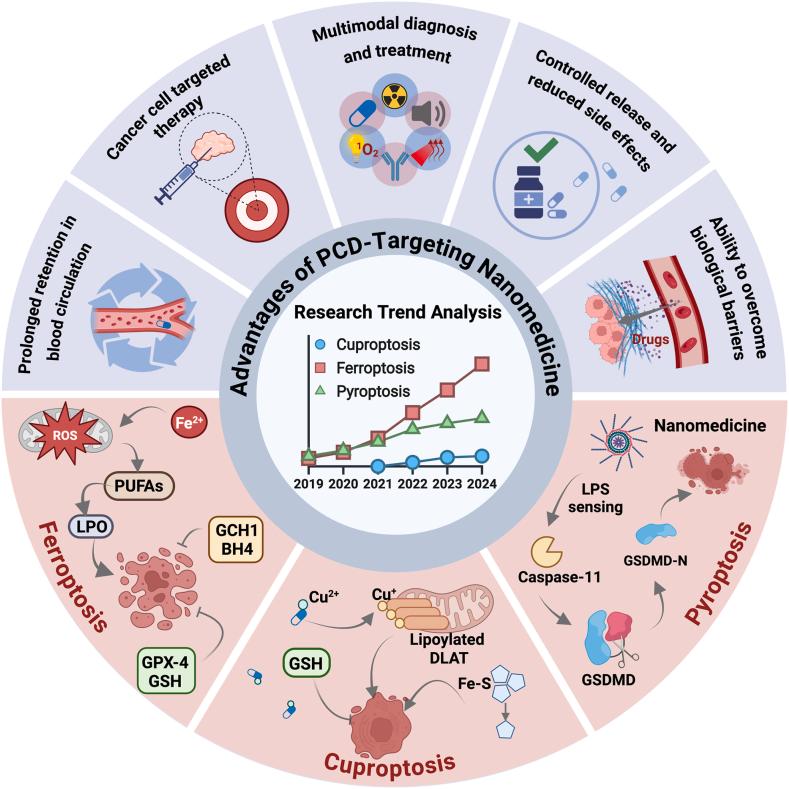
Programmed cell death (PCD) plays a crucial role in preventing cancer initiation and progression. Among the diverse PCD pathways, cuproptosis, pyroptosis, and ferroptosis have garnered attention for their unique mechanisms, which not only directly eliminate tumor cells but also enhance anti-tumor immunity. However, the therapeutic efficacy of PCD inducers is often compromised by rapid compensatory pathways in tumor cells, accelerated drug metabolism, and a lack of specificity, which can result in severe side effects. Engineered nanomedicines offer distinct advantages by leveraging nanoscale physicochemical properties to optimize pharmacokinetics, efficacy, and safety in cancer therapy. These nanomedicines enable precise targeting of tumor cells while enhancing drug stability. Moreover, they can simultaneously activate multiple PCD pathways and integrate with conventional therapies to further amplify anti-tumor effects. This review systematically examines the pathophysiological roles, mechanisms, and therapeutic implications of cuproptosis, pyroptosis, and ferroptosis in cancer treatment, with an emphasis on their modulation by nanomedicines. It also explores the potential interactions among these PCD pathways and highlights recent advancements in nanomedicine-based combination therapies targeting multiple PCD mechanisms. Finally, the challenges, limitations, and prospects for the clinical translation and application of PCD-targeting nanomedicines are discussed.
程序性细胞死亡(PCD)在预防癌症的起始和进展中起着至关重要的作用。在多种PCD途径中,铜死亡、焦亡和铁死亡因其独特的机制而受到关注,这些机制不仅能直接消除肿瘤细胞,还能增强抗肿瘤免疫力。然而,PCD诱导剂的治疗效果常常受到肿瘤细胞中快速补偿途径、加速的药物代谢以及缺乏特异性的影响,这可能导致严重的副作用。工程纳米药物通过利用纳米级物理化学性质来优化癌症治疗中的药代动力学、疗效和安全性,具有明显的优势。这些纳米药物能够精确靶向肿瘤细胞,同时提高药物稳定性。此外,它们可以同时激活多种PCD途径,并与传统疗法相结合,进一步放大抗肿瘤效果。本综述系统地研究了铜死亡、焦亡和铁死亡在癌症治疗中的病理生理作用、机制和治疗意义,重点关注它们被纳米药物调节的情况。它还探讨了这些PCD途径之间的潜在相互作用,并强调了基于纳米药物的针对多种PCD机制的联合疗法的最新进展。最后,讨论了靶向PCD的纳米药物临床转化和应用面临的挑战、局限性和前景。







 Zotero 插件