
口服溶瘤趋磁细菌可引发抗结直肠癌免疫并重塑微生物群代谢。
Oral oncolytic magnetotactic bacteria elicit anti-colorectal tumor immunity and reprogram microbiota metabolism.
作者信息
Jiang Aodi, Li Baoyi, Zu Menghang, Chen Li, Zhao Chan, Tian Jiesheng, Reis Rui L, Kundu Subhas C, Xiao Bo, Shi Xiaoxiao
机构信息
State Key Laboratory of Resource Insects, College of Sericulture, Textile, and Biomass Sciences, Southwest University, Chongqing 400715, China.
Department of Pharmacy, Personalized Drug Therapy Key Laboratory of Sichuan Province, Sichuan Academy of Medical Sciences & Sichuan Provincial People's Hospital, School of Medicine, University of Electronic Science and Technology of China, Chengdu, 610054, China.
出版信息
Bioact Mater. 2025 Jun 29;51:909-923. doi: 10.1016/j.bioactmat.2025.06.046. eCollection 2025 Sep.
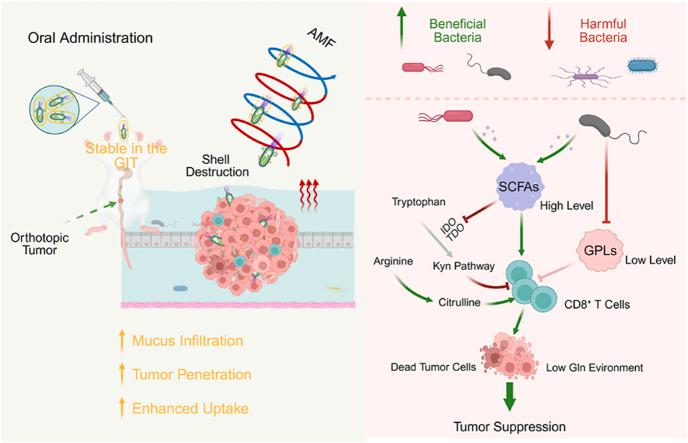
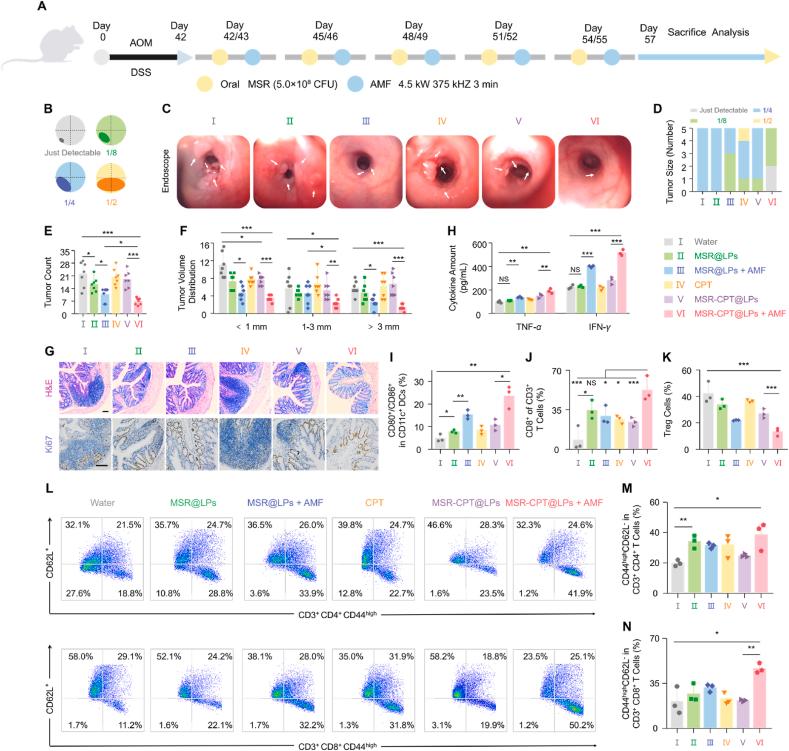
Therapeutic outcomes of colorectal cancer (CRC) are influenced by intestinal microbiota and metabolites. To leverage the tumor-tropism and microbiota-regulating properties of bacteria, we developed oncolytic magnetotactic bacteria (MSR-CPT/APPs) loaded with camptothecin (CPT) and anti-PD-L1 peptide (APP) for targeted chemo-magnetothermal immunotherapy of CRC. To further achieve oral delivery, MSR-CPT/APPs were coated with mulberry leaf lipids and Pluronic F127 (LPs). When exposed to an alternating magnetic field, MSR-CPT/APP@LPs penetrated colonic mucus and reached deep-seated tumors. They elevated proinflammatory cytokine secretion, prolonged T cell recruitment, and reduced immunosuppressive cell proportions by activating the cGAS-STING pathway, inducing immunogenic cell death, and facilitating macrophage polarization to M1 phenotype. Oral MSR-CPT/APP@LPs increased the relative abundances of crucial commensal microorganisms (., family and ) and influenced their metabolites, like elevating beneficial metabolites (short-chain fatty acids and citrulline) levels and decreasing harmful metabolites (l-glutamine and kynurenic acid) amounts, thereby remodeling the tumor immune microenvironment. Overall, MSR-CPT/APP@LPs foster a supportive intestinal environment and mitigate immunosuppression, achieving the eradication of both primary and distant colorectal tumors.
结直肠癌(CRC)的治疗结果受肠道微生物群和代谢产物的影响。为了利用细菌的肿瘤靶向性和微生物群调节特性,我们开发了负载喜树碱(CPT)和抗PD-L1肽(APP)的溶瘤趋磁细菌(MSR-CPT/APPs),用于CRC的靶向化学-磁热免疫治疗。为了进一步实现口服给药,MSR-CPT/APPs用桑叶脂质和普朗尼克F127(LPs)进行了包被。当暴露于交变磁场时,MSR-CPT/APP@LPs穿透结肠黏液并到达深部肿瘤。它们通过激活cGAS-STING途径、诱导免疫原性细胞死亡和促进巨噬细胞极化为M1表型,提高促炎细胞因子分泌,延长T细胞募集,并降低免疫抑制细胞比例。口服MSR-CPT/APP@LPs增加了关键共生微生物(如 科和 科)的相对丰度,并影响其代谢产物,如提高有益代谢产物(短链脂肪酸和瓜氨酸)水平和降低有害代谢产物(L-谷氨酰胺和犬尿酸)含量,从而重塑肿瘤免疫微环境。总体而言,MSR-CPT/APP@LPs营造了一个有利的肠道环境并减轻免疫抑制,实现了对原发性和远处结直肠癌肿瘤的根除。




 Zotero 插件