
2000年至2021年50岁及以上涉及大麻的物质使用治疗入院情况的变化及其相关因素。
Changes in and correlates of cannabis-involved substance use treatment admissions age 50 and older, 2000-2021.
作者信息
Choi Namkee G, Marti C Nathan, Choi Bryan Y
机构信息
Steve Hicks School of Social Work, University of Texas at Austin, Austin, TX, United States.
Department of Emergency Medicine, Philadelphia College of Osteopathic Medicine and Bayhealth, Dover, DE, United States.
出版信息
Front Public Health. 2025 Jul 3;13:1592551. doi: 10.3389/fpubh.2025.1592551. eCollection 2025.
BACKGROUND AND AIMS
Cannabis use among U.S. older adults has risen rapidly over the past two decades. This study examined the changes in and correlates of cannabis-involved substance use treatment admissions among this demographic.
METHODS
Using the 2000-2021 concatenated Treatment Episode Data Set-Admissions (TEDS-A) age 50+ (=5,593,004), we fitted joinpoint regression models to examine changes in the percent of cannabis-involved admissions of all substance use admissions. We used multinomial and binary logistic regression models to examine the demographic and treatment-related correlates of cannabis-primary admissions and cannabis-secondary/tertiary admissions.
RESULTS
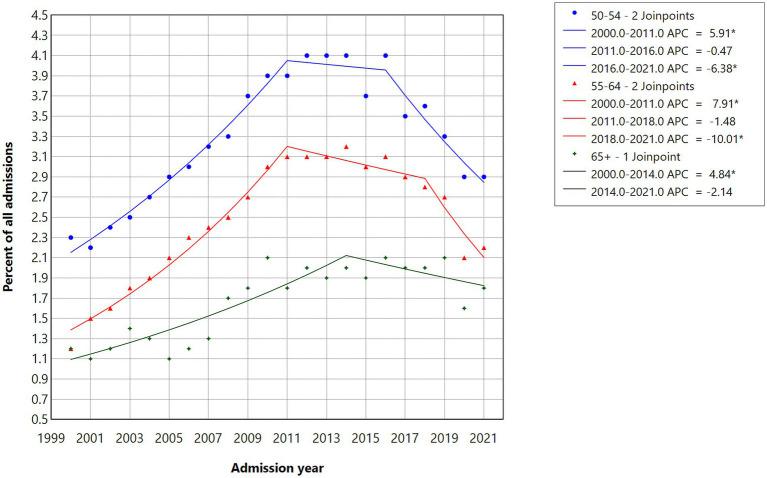
During the study period, the number of cannabis-involved admissions increased substantially, while their share of all admissions increased and then decreased as other drug-related admissions increased. The annual percentage changes (APC) show that the shares of cannabis-involved admissions of all admissions between 2000 and 2012 increased for the 50-64 age group and then decreased between 2012 and 2021. In the 65+ age group, the shares increased between 2000 and 2016 (APC=5.2) and then plateaued. Compared to no-cannabis admissions, the likelihood (relative risk ratio) of all cannabis-involved admissions was higher among males, black people, residents of states where medical or recreational cannabis use was legal, and referrals from healthcare providers and court/criminal legal systems. The likelihood (adjusted odds ratio [AOR]) of cannabis-primary admissions was higher among those age 65+ (aOR=1.04, 95%CI=1.00-1.08), black people (aOR=1.34, 95% CI=1.32-1.36), Hispanic people (aOR=1.26, 95% CI=1.23-1.29), residents of states with medical cannabis laws, and those who were referred by healthcare providers and legal systems.
IMPLICATIONS
Cannabis-involved admissions are projected to continue to increase as cannabis use continues to increase. More effective regulations and enforcement of delta-9-tetrahydrocannabinol potency and research on cannabis harms and poly-substance use are needed to protect the health of older adults who turn to cannabis for its purported health benefits. Increased availability and accessibility of treatment infrastructure are also needed.
背景与目的
在过去二十年中,美国老年人使用大麻的情况迅速增加。本研究调查了该人群中涉及大麻的物质使用治疗入院情况的变化及其相关因素。
方法
利用2000 - 2021年合并的50岁及以上治疗事件数据集入院部分(TEDS - A,n = 5,593,004),我们拟合了连接点回归模型,以研究所有物质使用入院中涉及大麻的入院百分比的变化。我们使用多项和二元逻辑回归模型来研究大麻为主的入院以及大麻为辅/第三类入院的人口统计学和治疗相关因素。
结果
在研究期间,涉及大麻的入院人数大幅增加,而其在所有入院中的占比随着其他与毒品相关的入院人数增加先上升后下降。年度百分比变化(APC)显示,2000年至2012年期间,50 - 64岁年龄组中所有入院中涉及大麻的入院占比增加,然后在2012年至2021年期间下降。在65岁及以上年龄组中,2000年至2016年期间占比增加(APC = 5.2),然后趋于平稳。与未涉及大麻的入院相比,所有涉及大麻的入院的可能性(相对风险比)在男性、黑人、医疗或娱乐用大麻合法的州的居民以及来自医疗保健提供者和法院/刑事法律系统的转诊患者中更高。大麻为主的入院的可能性(调整后的优势比[AOR])在65岁及以上人群中更高(aOR = 1.04,95%CI = 1.00 - 1.08)、黑人(aOR = 1.34,95%CI = 1.32 - 1.36)、西班牙裔(aOR = 1.26,95%CI = 1.23 - 1.29)、有医用大麻法律的州的居民以及那些由医疗保健提供者和法律系统转诊的人群中更高。
启示
随着大麻使用的持续增加,预计涉及大麻的入院人数将继续上升。需要对δ-9-四氢大麻酚效力进行更有效的监管和执法,并对大麻危害和多物质使用进行研究,以保护那些因所谓的健康益处而转向大麻的老年人的健康。还需要增加治疗基础设施的可用性和可及性。

 Zotero 插件