
新辅助卡瑞利珠单抗联合化疗或阿帕替尼用于可切除的IIA-IIIA期非小细胞肺癌:一项多中心、双臂、II期探索性试验。
Neoadjuvant camrelizumab plus chemotherapy or apatinib for resectable stage IIA-IIIA NSCLC: a multicenter, two-arm, phase II exploratory trial.
作者信息
Ji Shuyu, Sheng Zhenxin, Bian Dongliang, Bao Minwei, Jin Kaiqi, Zhang Wentian, Zhu Xinsheng, Sun Fenghuan, Xia Haoran, Zhang Han, Shen Ziyun, Yu Huansha, Zhang Lele, Huang Jie, Peng Zhang, Song Nan, Wang Haifeng, Qian Biyun, Zhu Yuming
机构信息
Department of Thoracic Surgery, Shanghai Pulmonary Hospital, Tongji University School of Medicine, Shanghai, 200433, China.
Experimental Animal Center, Shanghai Pulmonary Hospital, Tongji University School of Medicine, Shanghai, 200433, China.
出版信息
BMC Med. 2025 Jul 18;23(1):429. doi: 10.1186/s12916-025-04250-4.
BACKGROUND
This study aimed to evaluate the efficacy and safety of camrelizumab, an anti-PD-1 antibody, combined with either chemotherapy or apatinib, a VEGFR-2 inhibitor, as neoadjuvant treatment for stage IIA-IIIA NSCLC.
METHODS
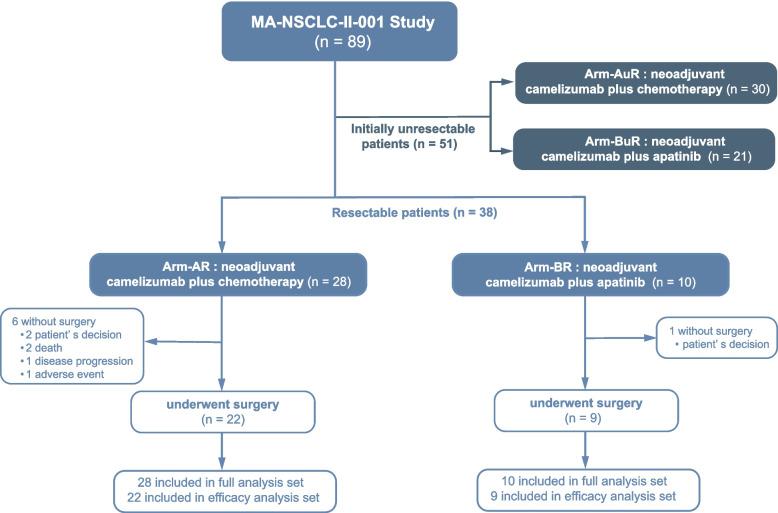
This prospective, multicenter, dual-arm, non-randomized phase II trial enrolled participants from four hospitals in China between September 2020 and March 2022. Patients received 2-4 cycles of neoadjuvant treatment followed by surgery. Arm-AR (n = 28) included patients treated with camrelizumab (200 mg every 3 weeks) plus platinum-based chemotherapy, regardless of PD-L1 status. Arm-BR (n = 10) included PD-L1-positive patients treated with camrelizumab (200 mg every 3 weeks) plus apatinib (250 mg daily). The primary endpoint was the major pathological response (MPR) rate. Secondary endpoints included pathological complete response (pCR) rate, objective response rate (ORR), disease control rate (DCR), event-free survival (EFS), overall survival (OS), and safety profiles.
RESULTS
In the ITT population, MPR rates were 25.0% (95% CI 10.7-44.9) in arm-AR and 60.0% (95% CI 26.2-87.8) in arm-BR. The 24-month EFS rates were 53.6% and 70.0%, respectively, after a median follow-up of 30.5 months. Grade 3 or higher treatment-related adverse events (TRAEs) occurred in 25% of arm-AR patients and 10% of arm-BR patients.
CONCLUSIONS
Camrelizumab combined with platinum-based chemotherapy demonstrated promising efficacy and tolerability for resectable IIA-IIIA NSCLC, regardless of PD-L1 status. In PD-L1-positive patients, camrelizumab plus apatinib showed improved safety and effectiveness, highlighting a potential treatment option for this subgroup.
TRIAL REGISTRATION
NCT04379739, initiated on July 26, 2020.
背景
本研究旨在评估抗PD-1抗体卡瑞利珠单抗联合化疗或VEGFR-2抑制剂阿帕替尼作为IIA-IIIA期非小细胞肺癌(NSCLC)新辅助治疗的疗效和安全性。
方法
这项前瞻性、多中心、双臂、非随机的II期试验于2020年9月至2022年3月在中国的四家医院招募参与者。患者接受2-4个周期的新辅助治疗后进行手术。AR组(n = 28)包括接受卡瑞利珠单抗(每3周200mg)加铂类化疗的患者,无论PD-L1状态如何。BR组(n = 10)包括接受卡瑞利珠单抗(每3周200mg)加阿帕替尼(每日250mg)治疗的PD-L1阳性患者。主要终点是主要病理缓解(MPR)率。次要终点包括病理完全缓解(pCR)率、客观缓解率(ORR)、疾病控制率(DCR)、无事件生存期(EFS)、总生存期(OS)和安全性。
结果
在意向性治疗(ITT)人群中,AR组的MPR率为25.0%(95%CI 10.7-44.9),BR组为60.0%(95%CI 26.2-87.8)。在中位随访30.5个月后,24个月的EFS率分别为53.6%和70.0%。3级或更高等级的治疗相关不良事件(TRAEs)在AR组25%的患者和BR组10%的患者中发生。
结论
卡瑞利珠单抗联合铂类化疗对可切除的IIA-IIIA期NSCLC显示出有前景的疗效和耐受性,无论PD-L1状态如何。在PD-L1阳性患者中,卡瑞利珠单抗加阿帕替尼显示出更好的安全性和有效性,突出了该亚组的一种潜在治疗选择。
试验注册
NCT04379739,于2020年7月26日启动。

 Zotero 插件