
新型tau抗体在多种模式下用于阿尔茨海默病评估的性能
Performance of novel tau antibodies across multiple modalities for Alzheimer's disease assessment.
作者信息
Trivedi Poonam, Forrest Katrina, Fisher Daniel W, Winstone Joanna K, McMillan Pamela J, Valentine Madeline, Postupna Nadia, Wilson Angela, Bajwa Tejas, MacCoss Michael J, Keene C Dirk, Darvas Martin, Kraemer Brian C, Hoofnagle Andrew N, Latimer Caitlin S
机构信息
Department of Laboratory Medicine and Pathology, University of Washington, Seattle, Washington, USA.
Department of Psychiatry and Behavioral Sciences, University of Washington, Seattle, Washington, USA.
出版信息
Alzheimers Dement. 2025 Jul;21(7):e70481. doi: 10.1002/alz.70481.
INTRODUCTION
Epitope-specific antibodies are crucial for accurately identifying pathologic forms of proteins like hyperphosphorylated tau in Alzheimer's disease (AD).
METHODS
We developed monoclonal antibodies targeting phosphorylated tau (p-tau) at sites pT181, pT217, and pT231 using peptide immunogens. Antibody performance was assessed using peptide immunoprecipitation-mass spectrometry, western blot, and quantitative immunohistochemistry in brain, and single-molecule array immunoassay in cerebrospinal fluid (CSF).
RESULTS
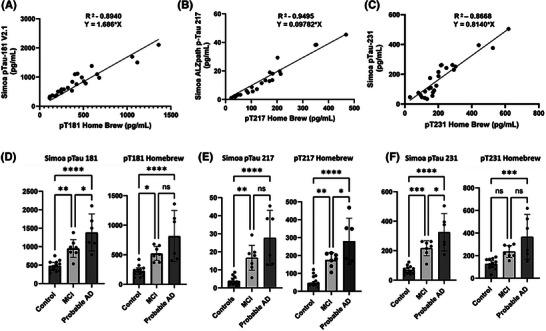
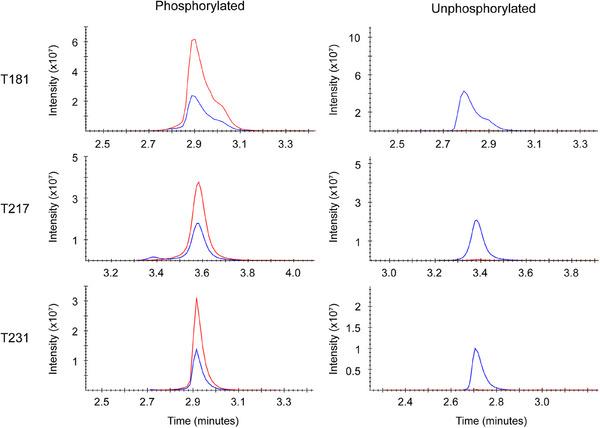
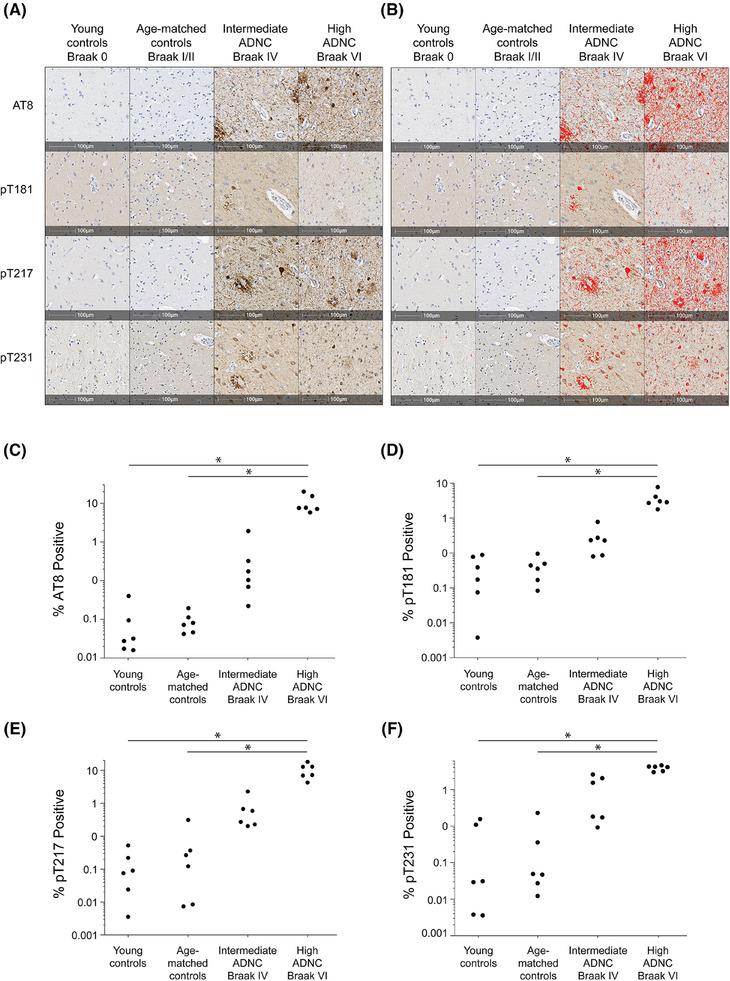
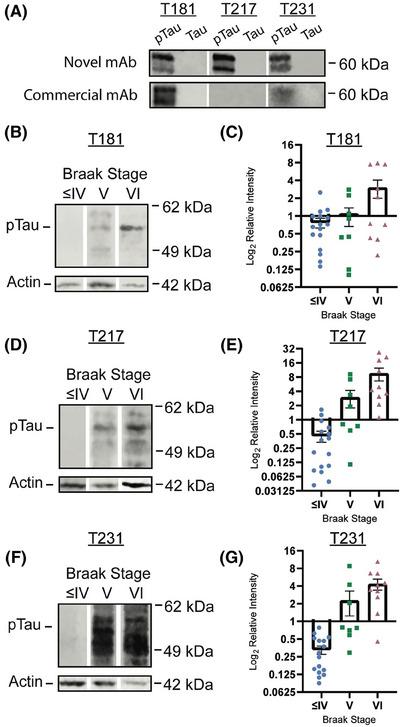
These antibodies demonstrated specific immunoprecipitation of phosphorylated peptides in phosphate-buffered saline, CSF, and plasma. Quantitative immunostaining in brain tissue highlighted neuronal tau pathology and were negative in control tissues (P < 0.01 for mice; P < 0.001 for humans). Western blotting with recombinant p-tau and post mortem AD brain tissue samples provided further validation. In a pilot CSF immunoassay these antibodies performed similarly to commercial antibodies (R> 0.997) and similarly differentiated probable AD from controls (P < 0.01).
DISCUSSION
Overall, our work contributes new reagents for AD research, specifically anti-p-tau antibodies, for the scientific community.
HIGHLIGHTS
Novel phosphorylated tau pT181, pT217, and pT231 antibodies are sensitive and specific. The antibodies perform well across multiple modalities for diagnosis and research. The cerebrospinal fluid assay with these antibodies is similar to a commercial assay (Quanterix). The antibodies are freely accessible from the Developmental Studies Hybridoma Bank.
引言
表位特异性抗体对于准确识别蛋白质的病理形式至关重要,如阿尔茨海默病(AD)中的高磷酸化tau蛋白。
方法
我们使用肽免疫原开发了靶向磷酸化tau(p-tau)在pT181、pT217和pT231位点的单克隆抗体。使用肽免疫沉淀-质谱、蛋白质印迹和脑内定量免疫组织化学以及脑脊液(CSF)中的单分子阵列免疫测定来评估抗体性能。
结果
这些抗体在磷酸盐缓冲盐水、脑脊液和血浆中显示出对磷酸化肽的特异性免疫沉淀。脑组织中的定量免疫染色突出了神经元tau病理,在对照组织中呈阴性(小鼠P < 0.01;人类P < 0.001)。用重组p-tau和死后AD脑组织样本进行的蛋白质印迹提供了进一步验证。在一项脑脊液免疫测定试点中,这些抗体的表现与商业抗体相似(R> 0.997),并且同样能区分可能的AD与对照(P < 0.01)。
讨论
总体而言,我们的工作为AD研究贡献了新试剂,特别是抗p-tau抗体,供科学界使用。
要点
新型磷酸化tau pT181、pT217和pT231抗体灵敏且特异。这些抗体在多种诊断和研究方法中表现良好。使用这些抗体的脑脊液检测与商业检测(Quanterix)相似。这些抗体可从发育研究杂交瘤库免费获取。

 Zotero 插件