
探索帕金森病患者的运动行为、动机及障碍
Exploring behavior, motivation, and barriers to exercise in Parkinson disease.
作者信息
Haussler Allison M, Baudendistel Sidney T, Tueth Lauren E, Earhart Gammon M
机构信息
Washington University in St. Louis School of Medicine, Program in Physical Therapy, United States.
Washington University in St. Louis School of Medicine, Department of Neurology, United States.
出版信息
Clin Park Relat Disord. 2025 Jun 28;13:100362. doi: 10.1016/j.prdoa.2025.100362. eCollection 2025.
INTRODUCTION
Despite extensive evidence for its numerous benefits, many people with Parkinson's disease (PwPD) do not meet recommended exercise guidelines. Past work investigated motivators and barriers to exercise generally. The purpose of this study was to synthesize motivator and barrier data to individual forms of exercise to better assess what participants are willing and able to do.
METHODS
PwPD were recruited to complete a remote survey, selecting exercise forms they engage in, are unwilling to engage in, and rate their level of agreement with pre-determined motivator and barrier statements. Specific exercises and motivator and barrier statements were adapted from the literature; however, participants were able to respond with an exercise or motivator/barrier not listed.
RESULTS
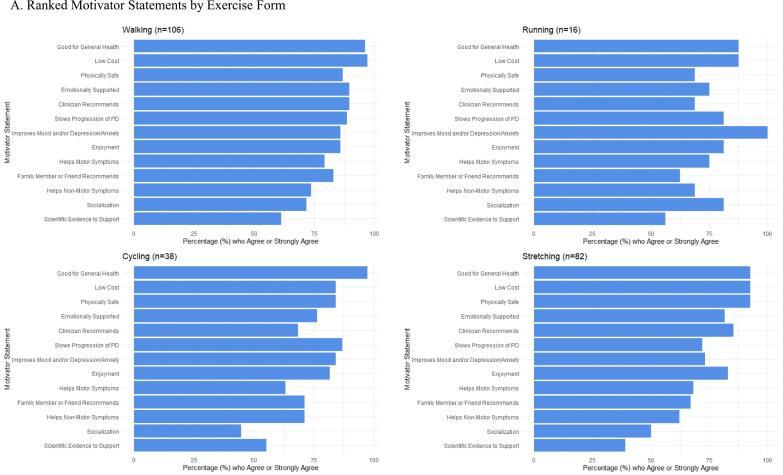
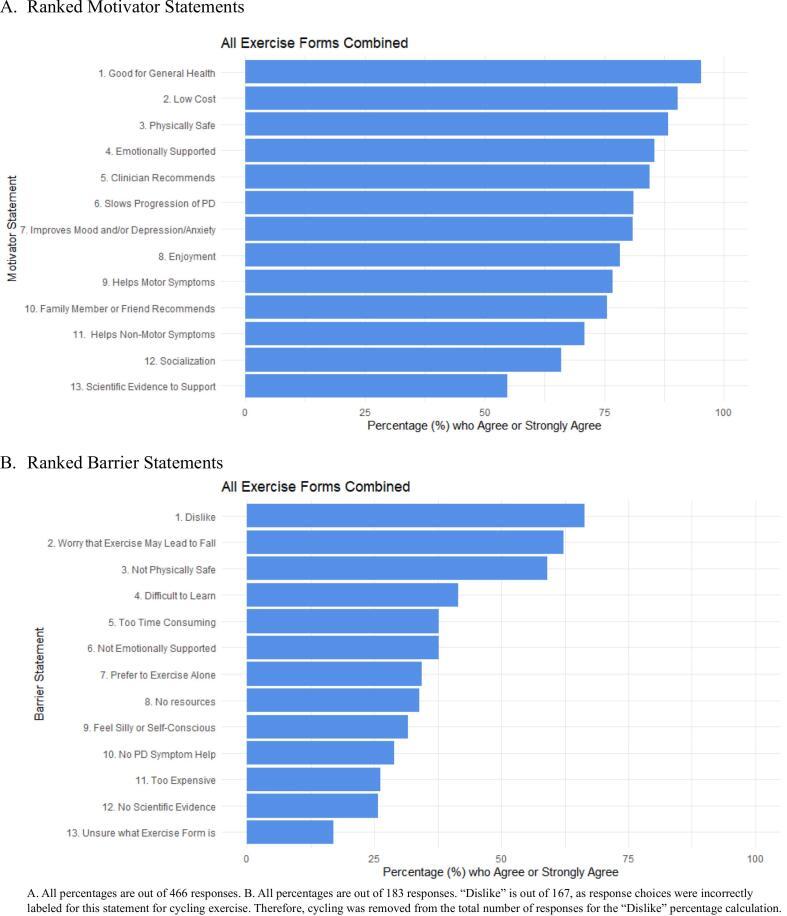
PwPD (n = 147) completed the survey and were included in analyses. Eighty-eight percent of participants agreed exercise is important for managing PD symptoms. Walking was the most popular exercise individuals engaged in (n = 106); dance was the least (n = 4). Belief that exercise was beneficial for general health was the top motivator; dislike and fear of falling were top barriers. Belief that there is scientific evidence was the least common motivator across exercises, except for boxing.
CONCLUSION
Clinicians can utilize these results to educate PwPD on the importance of exercise for fall prevention and other aspects of care. Additionally, scientific evidence may best be disseminated in clinician-patient interactions, as "recommendation from a clinician" was a high ranked motivator. It is important to assess motivators and barriers to individual exercise forms to develop more personal, effective exercise plans.
引言
尽管有大量证据表明运动对帕金森病患者(PwPD)有诸多益处,但许多帕金森病患者并未达到推荐的运动指南要求。过去的研究一般调查了运动的动机和障碍。本研究的目的是综合个体运动形式的动机和障碍数据,以更好地评估参与者愿意且能够进行的运动。
方法
招募帕金森病患者完成一项远程调查,选择他们参与的运动形式、不愿意参与的运动形式,并对预先确定的动机和障碍陈述的认同程度进行评分。具体的运动以及动机和障碍陈述均改编自文献;然而,参与者能够回答未列出的运动或动机/障碍。
结果
147名帕金森病患者完成了调查并纳入分析。88%的参与者认同运动对控制帕金森病症状很重要。步行是参与者最常进行的运动(n = 106);舞蹈是最少进行的运动(n = 4)。认为运动对总体健康有益是首要动机;不喜欢和害怕跌倒则是主要障碍。除拳击外,认为有科学证据是各类运动中最不常见的动机。
结论
临床医生可利用这些结果,向帕金森病患者宣传运动对预防跌倒及其他护理方面的重要性。此外,由于“临床医生的推荐”是排名靠前的动机,科学证据最好在临床医生与患者的互动中进行传播。评估个体运动形式的动机和障碍对于制定更个性化、有效的运动计划很重要。
 Zotero 插件