
肠道微生物群饮食指数与血浆致动脉粥样硬化指数之间的非线性关联:一项横断面研究的见解
Non-linear association between the dietary index for gut microbiota and the atherogenic index of plasma: insights from a cross-sectional study.
作者信息
Liu Tian-Ding, Zheng Yang-Yang, Zhang Jin-Ying
机构信息
Department of Cardiology, The First Affiliated Hospital of Zhengzhou University, Zhengzhou, China.
Department of General Surgery, National Center of Gerontology, Beijing Hospital, Institute of Geriatric Medicine, Chinese Academy of Medical Sciences & Peking Union Medical College, Beijing, China.
出版信息
Front Cardiovasc Med. 2025 Jul 4;12:1556650. doi: 10.3389/fcvm.2025.1556650. eCollection 2025.
INTRODUCTION
The gut microbiota plays a crucial role in the development of atherosclerosis. The Dietary Index for Gut Microbiota (DI-GM) assesses the impact of diet on gut microbiota, and the Atherogenic Index of Plasma (AIP) serves as a key marker for evaluating atherosclerosis. However, studies exploring the association between DI-GM and AIP remain limited.
METHODS
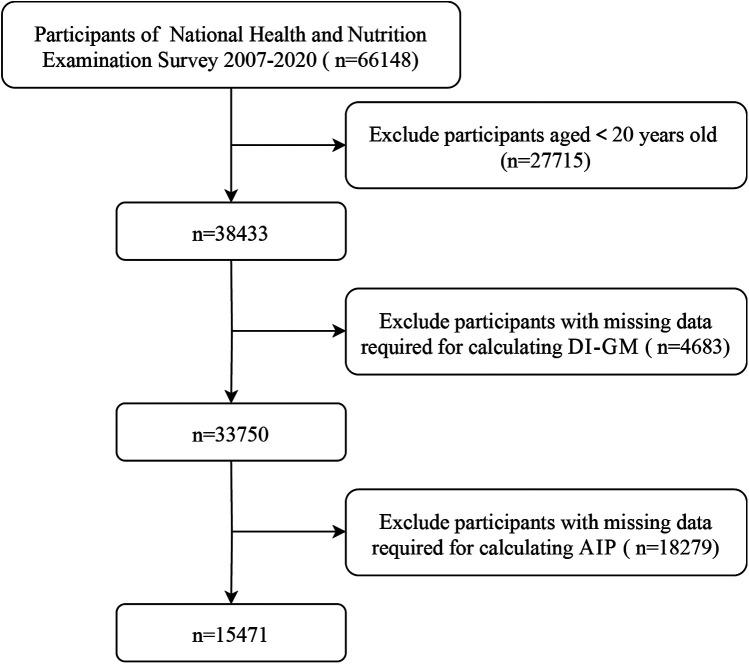
Data from the 2007-2020 National Health and Nutrition Examination Survey (NHANES) were analyzed, including 15,471 participants. Weighted multivariate linear regression models were employed to evaluate the linear association between DI-GM and AIP, while restricted cubic splines (RCS) were used to assess potential nonlinear relationships.
RESULTS
After adjusting for confounding factors, multivariate linear regression analysis demonstrated a significant negative correlation between DI-GM levels and AIP. Each one-point increase in DI-GM was associated with a 0.007-point reduction in AIP (95% CI: -0.012 to -0.002). Categorical analysis further revealed that participants in the DI-GM ≥6 group had significantly lower AIP levels compared to those in lower DI-GM groups ( = -0.038, 95% CI: -0.059 to -0.017; P for trend = 0.007). Restricted cubic spline (RCS) analysis identified a significant non-linear dose-response relationship ( for non-linearity = 0.018) with a threshold at DI-GM = 3.467. Below this threshold, the association was nonsignificant; however, above it, each unit increase in DI-GM corresponded to a 0.011 decrease in AIP ( < 0.001). Subgroup analyses indicated that the relationship between DI-GM and AIP was significantly moderated by age, race/ethnicity, hypertension, and diabetes ( for interaction < 0.05).
CONCLUSION
This study demonstrated a non-linear dose-response relationship between DI-GM levels and AIP, with a significant threshold effect at DI-GM = 3.467. Beyond this threshold, higher DI-GM levels were linked to lower AIP, moderated by age, race/ethnicity, hypertension, and diabetes.
引言
肠道微生物群在动脉粥样硬化的发展中起着至关重要的作用。肠道微生物群饮食指数(DI-GM)评估饮食对肠道微生物群的影响,而血浆致动脉粥样硬化指数(AIP)是评估动脉粥样硬化的关键指标。然而,探索DI-GM与AIP之间关联的研究仍然有限。
方法
分析了2007 - 2020年美国国家健康与营养检查调查(NHANES)的数据,包括15471名参与者。采用加权多元线性回归模型评估DI-GM与AIP之间的线性关联,同时使用受限立方样条(RCS)来评估潜在的非线性关系。
结果
在调整混杂因素后,多元线性回归分析表明DI-GM水平与AIP之间存在显著的负相关。DI-GM每增加1分,AIP降低0.007分(95%置信区间:-0.012至-0.002)。分类分析进一步显示,DI-GM≥6组的参与者的AIP水平显著低于DI-GM较低组的参与者(=-0.038,95%置信区间:-0.059至-0.017;趋势P值=0.007)。受限立方样条(RCS)分析确定了一种显著的非线性剂量反应关系(非线性P值=0.018),阈值为DI-GM = 3.467。低于该阈值,关联不显著;然而,高于该阈值,DI-GM每增加一个单位,AIP降低0.011(<0.001)。亚组分析表明,年龄、种族/民族、高血压和糖尿病显著调节了DI-GM与AIP之间的关系(交互作用P值<0.05)。
结论
本研究证明了DI-GM水平与AIP之间存在非线性剂量反应关系,在DI-GM = 3.467时具有显著的阈值效应。超过该阈值,较高的DI-GM水平与较低的AIP相关,年龄、种族/民族、高血压和糖尿病起调节作用。

 Zotero 插件