
中国肺癌患者的社会支持与士气低落:自我效能感和症状困扰的调节中介模型
Social support and demoralization among patients with lung cancer in China: A moderated mediation model of self-efficacy and symptom distress.
作者信息
Ping Zhiheng, He Chunyan, Liu Shuhui, Tan Rong, Hu Deying
机构信息
Department of Nursing, Union Hospital, Tongji Medical College, Huazhong University of Science and Technology, Wuhan, China.
School of Nursing, Tongji Medical College, Huazhong University of Science and Technology, Wuhan, China.
出版信息
Asia Pac J Oncol Nurs. 2025 Jun 30;12:100749. doi: 10.1016/j.apjon.2025.100749. eCollection 2025 Dec.
OBJECTIVE
To investigate whether the relationship between social support and demoralization in Chinese patients with lung cancer is mediated.
METHODS
Between January and June of 2024, a comprehensive cross-sectional investigation was carried out at three top-tier hospitals in Hubei Province, China. A grand total of 418 individuals diagnosed with lung cancer participated in the research by filling out confidential self-assessment questionnaires. To gauge the mediating and moderating influences, the bootstrapping technique was applied for regression analysis.
RESULTS
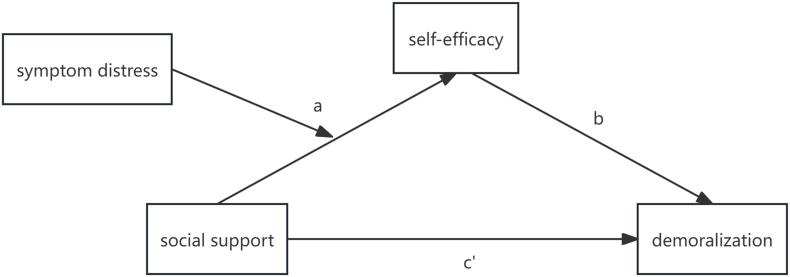
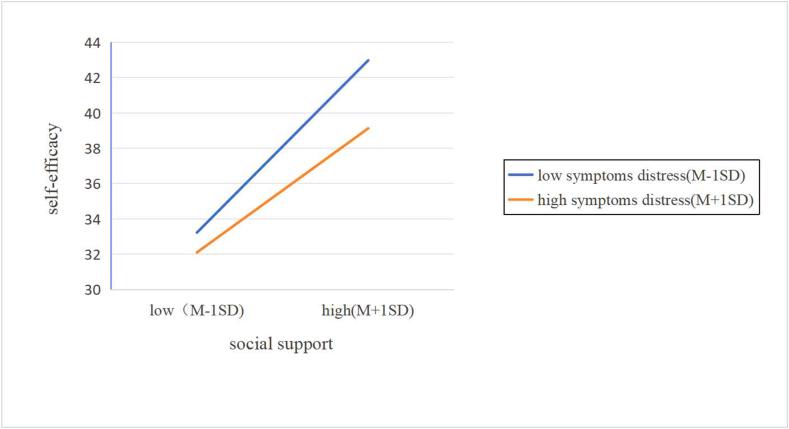
Among 418 patients with cancer, demoralization was negatively correlated with both social support ( = 0.638, < 0.01) and self-efficacy ( = -0.749, < 0.01). Social support significantly predicted self-efficacy (B = 0.334, < 0.01), which in turn was strongly associated with reduced demoralization (B = -1.130, < 0.001). Additionally, symptom distress moderated the effect of social support on self-efficacy (B = -0.003, < 0.05), with higher distress weakening the positive impact of social support on self-efficacy.
CONCLUSIONS
Social support plays a crucial role in enhancing self-efficacy, which subsequently contributes to the reduction of demoralization. However, it is important to note that symptom distress significantly undermines these beneficial effects, leading to heightened feelings of helplessness and hopelessness.
目的
探讨中国肺癌患者社会支持与士气低落之间的关系是否存在中介作用。
方法
2024年1月至6月期间,在中国湖北省的三家顶级医院开展了一项全面的横断面调查。共有418名被诊断为肺癌的个体通过填写保密的自我评估问卷参与了该研究。为衡量中介和调节影响,采用了自抽样技术进行回归分析。
结果
在418名癌症患者中,士气低落与社会支持(r = 0.638,p < 0.01)和自我效能感(r = -0.749,p < 0.01)均呈负相关。社会支持显著预测自我效能感(B = 0.334,p < 0.01),而自我效能感又与降低的士气低落密切相关(B = -1.130,p < 0.001)。此外,症状困扰调节了社会支持对自我效能感的影响(B = -0.003,p < 0.05),症状困扰程度越高,社会支持对自我效能感的积极影响就越弱。
结论
社会支持在增强自我效能感方面起着关键作用,进而有助于降低士气低落。然而,需要注意的是,症状困扰会显著削弱这些有益影响,导致无助感和绝望感加剧。

 Zotero 插件