
工作场所中优势手与颈部/肩部疼痛的关系:一项前瞻性队列研究。
The relationship between the dominant hand and neck/shoulder pain in the workplace: a prospective cohort study.
作者信息
Ogawa Yukiko, Nagata Tomohisa, Odagami Kiminori, Ebara Takeshi, Nakatani Junko, Mori Koji
机构信息
Department of Occupational Health Nursing, School of Occupational Health Science, University of Occupational and Environmental Health, Japan, Kitakyushu, Japan.
Department of Occupational Health Practice and Management, Institute of Industrial Ecological Sciences, University of Occupational and Environmental Health, Japan, Kitakyushu, Japan.
出版信息
J Occup Health. 2025 Jan 7;67(1). doi: 10.1093/joccuh/uiaf042.
BACKGROUND
To date, no studies have investigated the relationship between one's dominant hand and neck/shoulder pain. The aim of this prospective cohort study was to explore the relationship between one's dominant hand and the severity of neck/shoulder pain. We also examined the relationship between the dominant hand and the onset of neck/shoulder pain at follow-up among workers without neck/shoulder pain at baseline.
METHODS
We conducted a prospective cohort study of 9451 workers. The dominant hand was measured by 10 items from the Japanese version of the Flanders Questionnaire at the baseline survey. We assessed neck/shoulder pain using a numeric rating scale. We calculated the unstandardized coefficient (B) using multiple regression analysis and the incidence rate ratio (IRR) for neck/shoulder pain using modified Poisson regression among workers who were free of neck/shoulder pain at baseline.
RESULTS
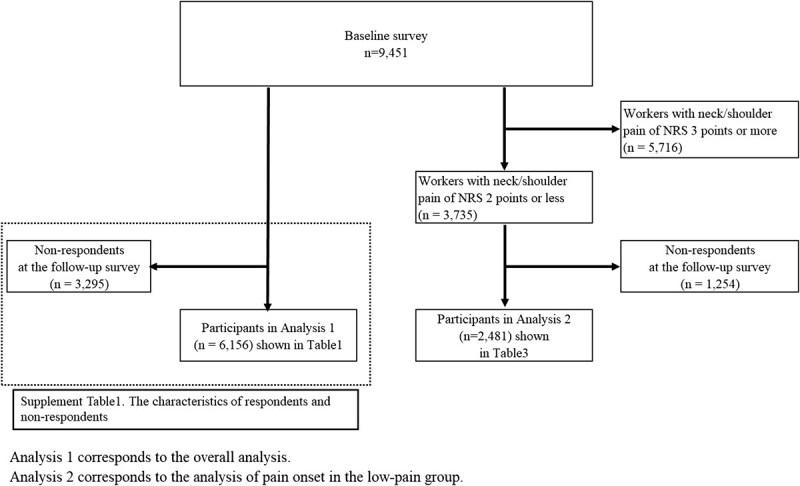
Among the 9451 respondents for the baseline survey, 6156 responded to the follow-up survey (response rate: 65.1%). Mixed-handed workers reported a higher degree of neck/shoulder pain than right-handed workers (B, 0.33; 95% CI, 0.09-0.58). Among 2481 participants, mixed-handed workers also had a higher IRR for neck/shoulder pain (IRR, 1.27; 95% CI, 1.01-1.61). There was no difference in any of the left-handers compared with the right-handers.
CONCLUSIONS
The study found that mixed-handed workers had higher levels of neck/shoulder pain than right-handed workers, and the incidence rate was also higher among mixed-handed workers. Employers should consider these findings when designing work environments, managing tasks, and providing occupational health training to optimize worker comfort and safety.
背景
迄今为止,尚无研究调查惯用手与颈部/肩部疼痛之间的关系。这项前瞻性队列研究的目的是探讨惯用手与颈部/肩部疼痛严重程度之间的关系。我们还研究了在基线时无颈部/肩部疼痛的工人中,惯用手与随访时颈部/肩部疼痛发作之间的关系。
方法
我们对9451名工人进行了一项前瞻性队列研究。在基线调查中,使用日本版佛兰德斯问卷中的10个项目来测量惯用手。我们使用数字评分量表评估颈部/肩部疼痛。我们通过多元回归分析计算未标准化系数(B),并使用修正泊松回归计算基线时无颈部/肩部疼痛的工人中颈部/肩部疼痛的发病率比(IRR)。
结果
在9451名参与基线调查的受访者中,有6156人回复了随访调查(回复率:65.1%)。双手并用的工人报告的颈部/肩部疼痛程度高于惯用右手的工人(B,0.33;95%CI,0.09 - 0.58)。在2481名参与者中,双手并用的工人颈部/肩部疼痛的IRR也更高(IRR,1.27;95%CI,1.01 - 1.61)。与惯用右手的工人相比,左撇子在任何方面都没有差异。
结论
该研究发现,双手并用的工人颈部/肩部疼痛水平高于惯用右手的工人,且双手并用工人的发病率也更高。雇主在设计工作环境、管理任务和提供职业健康培训时应考虑这些发现,以优化工人的舒适度和安全性。
 Zotero 插件