
全氟己基辛烷(PFHO)治疗睑板腺功能障碍(MGD)所致干眼症(DED)患者的疗效和安全性:系统评价与荟萃分析
Efficacy and safety of perfluorohexyloctane (PFHO) in patients with dry eye disease (DED) due to meibomian gland dysfunction (MGD): Systematic review and meta-analysis.
作者信息
Munsab Rabbia, Zafar Rabia, Fatima Anoosha, Taj Javeria, Usman Muhammad, Anjum Muhammad Umair, Hasanain Muhammad, Bhattarai Pratik
机构信息
Dow Medical College, Karachi, Pakistan.
Manipal College of Medical Sciences, Pokhara, Nepal.
出版信息
Medicine (Baltimore). 2025 Jul 18;104(29):e43026. doi: 10.1097/MD.0000000000043026.
BACKGROUND
Dry eye disease (DED) associated with meibomian gland dysfunction lacks a conclusive treatment, placing existing solutions under the burden of side effects and limitations. This study seeks to assess the efficacy and safety of perfluorohexyloctane (PFHO) in treating DED associated with meibomian gland dysfunction.
METHODS
A thorough search encompassing Medline, Cochrane Central Register, and Google Scholar was conducted until September 15, 2023. Four randomized controlled trials were assessed for PFHO's safety and efficacy. Studies were managed with EndNote and Excel for dual-phase screening by reviewers. Bias risk was evaluated with the risk of bias 2.0 Cochrane tool, and comparative outcomes were synthesized using RevMan software.
RESULTS
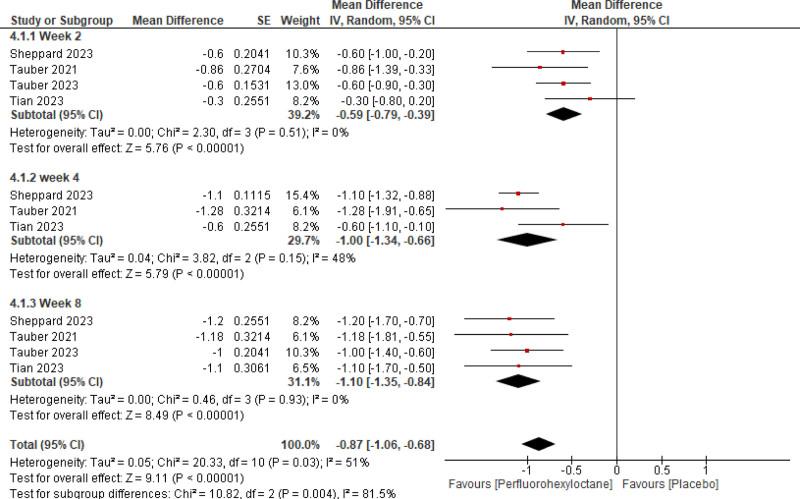
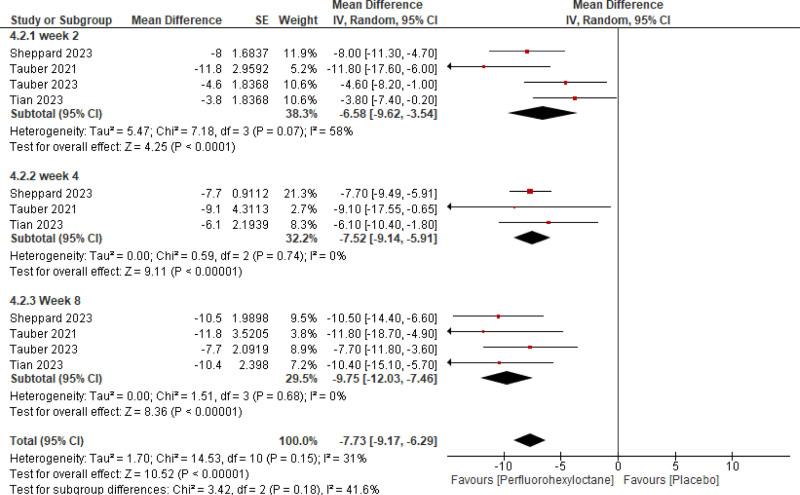
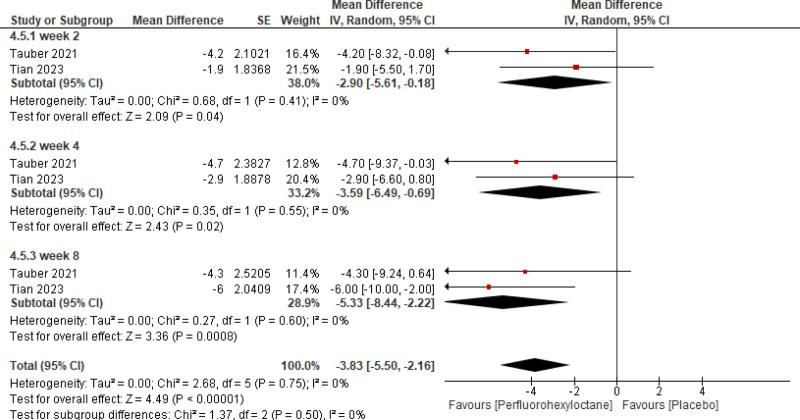
In this meta-analysis, we pooled data from 4 randomized controlled trials involving 1754 patients. Significant reductions were observed in total corneal fluorescein staining score mean difference = -0.87 (95% CI -1.06, -0.68, P < .00001), eye dryness score mean difference = -7.73 (95% CI -9.17, -6.29, P < .00001), and central Corneal Fluorescein Staining score risk ratios (RR) = 5.11 (95% CI: 1.75-14.93, P = .003). Subgroup analysis highlighted increasing differences over time, notably at week 8. Safety analysis showed decreased risk of eye pain RR = 0.70 (95% CI: 0.27, 1.80, P = .46) and blurred vision RR = 5.11 (95% CI: 1.75, 14.93, P = .003) with PFHO. There was no significant difference noted in serious adverse events RR = 1.38 (95% CI: 0.25, 7.60, P = .71), ocular TEAS RR = 1.05 (95% CI: 0.81, 1.37, P = .69) and non-ocular TEAS RR = 1.02 (95% CI: 0.75, 1.40, P = .89).
CONCLUSION
PFHO marks a novel treatment for DED, targeting tear evaporation with its unique water-free, preservative-free preparation. It has proved to be highly effective in alleviating eye dryness and associated symptoms. While minor side effects are seen in a small subset of patients, the overall safety is promising. Further long-term and larger sample size studies will offer a more thorough understanding of this new drug.
背景
与睑板腺功能障碍相关的干眼症缺乏确凿的治疗方法,现有解决方案存在副作用和局限性的负担。本研究旨在评估全氟己基辛烷(PFHO)治疗与睑板腺功能障碍相关的干眼症的疗效和安全性。
方法
截至2023年9月15日,全面检索了Medline、Cochrane中央注册库和谷歌学术。评估了四项随机对照试验中PFHO的安全性和疗效。研究由EndNote和Excel管理,供评审人员进行双阶段筛选。使用Cochrane偏倚风险2.0工具评估偏倚风险,并使用RevMan软件综合比较结果。
结果
在这项荟萃分析中,我们汇总了4项涉及1754例患者的随机对照试验的数据。观察到总角膜荧光素染色评分平均差显著降低= -0.87(95%CI -1.06,-0.68,P <.00001),眼干评分平均差= -7.73(95%CI -9.17,-6.29,P <.00001),中央角膜荧光素染色评分风险比(RR)= 5.11(95%CI:1.75 - 14.93,P =.003)。亚组分析突出了随时间推移差异的增加,尤其是在第8周。安全性分析显示,PFHO使眼痛风险降低RR = 0.70(95%CI:0.27,1.80,P =.46),视力模糊RR = 5.11(95%CI:1.75,14.93,P =.003)。严重不良事件RR = 1.38(95%CI:0.25,7.60,P =.71)、眼部TEAS RR = 1.05(95%CI:0.81,1.37,P =.69)和非眼部TEAS RR = 1.02(95%CI:0.75,1.40,P =.89)方面未观察到显著差异。
结论
PFHO是一种治疗干眼症的新方法,其独特的无水、无防腐剂制剂可针对泪液蒸发。它已被证明在缓解眼干及相关症状方面非常有效。虽然一小部分患者出现了轻微副作用,但总体安全性良好。进一步的长期和更大样本量研究将更全面地了解这种新药。





 Zotero 插件