
通过孟德尔随机化在1400种代谢物与前列腺炎之间发现的谷氨酰胺/前列腺炎循环的负反馈
The Negative Feedback of the Glutamine/Prostatitis Loop Identified Among 1400 Metabolites and Prostatitis via Mendelian Randomization.
作者信息
Wang Yi, Ji Hao, Chen Yingfei, Zhu Bingye, Peng Yongming, Xing Qianwei
机构信息
Department of Urology, Affiliated Hospital of Nantong University, Nantong 226001, Jiangsu Province, China.
Department of Urology, Shanghai General Hospital, Shanghai Jiao Tong University School of Medicine, Shanghai 200080, China.
出版信息
Mediators Inflamm. 2025 Jul 15;2025:9648279. doi: 10.1155/mi/9648279. eCollection 2025.
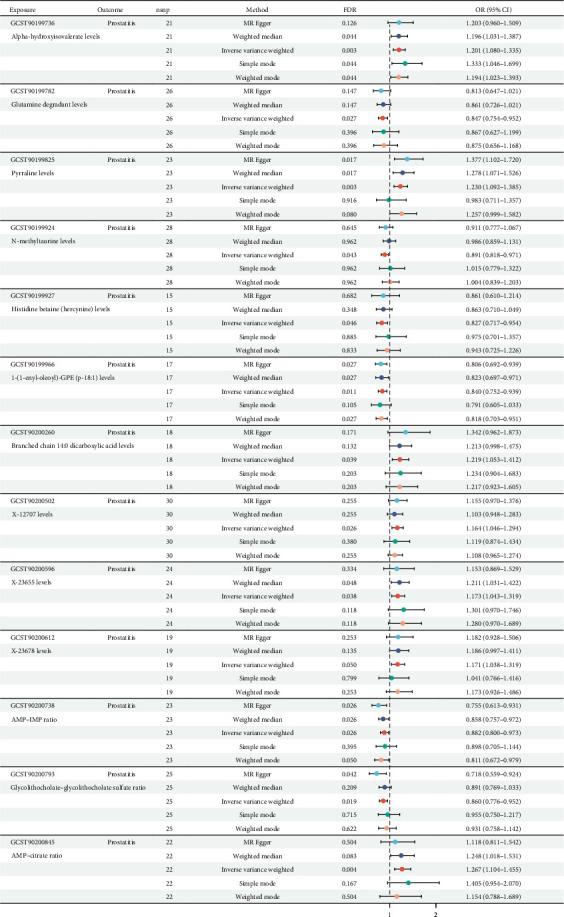
Prostatitis remains a clinically tricky problem due to its enigmatic etiologies, low cure rates, and relatively high recurrence rates. Therefore, we first employed Mendelian randomization to disclose the causal relationships among 1400 metabolites and prostatitis for a better understanding of the etiologies of prostatitis and thus identifying effective therapeutic targets. Prostatitis or metabolite-related data were derived from the online FinnGen or genome-wide association study (GWAS) Catalog datasets. Two-sample Mendelian randomization was employed, and sensitivity analyses, including heterogeneity, pleiotropy, and leave-one-out analysis, were applied to evaluate its stability. Four potentially metabolic etiologies were identified for prostatitis, including glutamine degradant levels, adenosine 5'-monophosphate (AMP)-inosine 5'-monophosphate (IMP) ratio, glycolithocholate-glycolithocholate sulfate ratio, and AMP-citrate ratio. Therein, genetic susceptibility to the glutamine degradant levels, the AMP-IMP ratio, or the glycolithocholate-glycolithocholate sulfate ratio could decrease, while the AMP to citrate ratio might increase the risks of prostatitis. Moreover, two potential metabolic phenotypes of prostatitis were also identified, containing glutamine degradant levels and histidine betaine (hercynine) levels, indicating that genetic susceptibility to prostatitis could increase the risks of these two metabolites. Interestingly, we unexpectedly identified the negative feedback of the glutamine/prostatitis loop, showing that not only genetic susceptibility to glutamine degradant levels could decrease the risks of prostatitis but also genetic susceptibility to prostatitis could increase the risks of glutamine degradant levels. Four metabolic etiologies, two metabolic phenotypes, and the glutamine/prostatitis negative feedback loop were first identified by us for prostatitis in the European population to better understand its etiologies and offer novel treatment targets.
前列腺炎仍然是一个临床棘手的问题,因为其病因不明、治愈率低且复发率相对较高。因此,我们首先采用孟德尔随机化方法来揭示1400种代谢物与前列腺炎之间的因果关系,以便更好地理解前列腺炎的病因,从而确定有效的治疗靶点。前列腺炎或代谢物相关数据来自在线FinnGen或全基因组关联研究(GWAS)目录数据集。采用两样本孟德尔随机化方法,并应用敏感性分析,包括异质性、多效性和留一法分析,来评估其稳定性。确定了前列腺炎的四种潜在代谢病因,包括谷氨酰胺降解产物水平、腺苷5'-单磷酸(AMP)-肌苷5'-单磷酸(IMP)比值、甘氨石胆酸-甘氨石胆酸硫酸盐比值和AMP-柠檬酸盐比值。其中,对谷氨酰胺降解产物水平、AMP-IMP比值或甘氨石胆酸-甘氨石胆酸硫酸盐比值的遗传易感性可能降低,而AMP与柠檬酸盐的比值可能增加前列腺炎的风险。此外,还确定了前列腺炎的两种潜在代谢表型,包括谷氨酰胺降解产物水平和组氨酸甜菜碱(肌肽)水平,表明对前列腺炎的遗传易感性可能增加这两种代谢物的风险。有趣的是,我们意外地发现了谷氨酰胺/前列腺炎循环的负反馈,表明不仅对谷氨酰胺降解产物水平的遗传易感性可以降低前列腺炎的风险,而且对前列腺炎的遗传易感性也可以增加谷氨酰胺降解产物水平的风险。我们首次在欧洲人群中为前列腺炎确定了四种代谢病因、两种代谢表型和谷氨酰胺/前列腺炎负反馈循环,以更好地理解其病因并提供新的治疗靶点。



 Zotero 插件