
优化婴儿呼吸道合胞病毒预防干预措施的时机
Optimizing Timing for Respiratory Syncytial Virus Prevention Interventions for Infants.
作者信息
Nguyen Danielle, Lee Haeseon, Pavia Andrew T, Nelson Richard E, Samore Matthew, Chaiyakunapruk Nathorn
机构信息
Department of Pharmacotherapy, College of Pharmacy, University of Utah, Salt Lake City.
Division of Pediatric Infectious Diseases, University of Utah, Salt Lake City.
出版信息
JAMA Netw Open. 2025 Jul 1;8(7):e2522779. doi: 10.1001/jamanetworkopen.2025.22779.
IMPORTANCE
The Advisory Committee on Immunization Practices and the Centers for Disease Control and Prevention recommend seasonal administration of maternal vaccine (MV) or nirsevimab to protect infants in the first year of life from respiratory syncytial virus (RSV) infections. Differences in uptake, costs, and efficacy between these agents may affect cost-effectiveness depending on the timing of administration.
OBJECTIVE
To evaluate the clinical outcomes and cost-effectiveness of no intervention, MV, and nirsevimab administration during the entire RSV season and separately for each monthly birth cohort from October through February.
DESIGN, SETTING, AND PARTICIPANTS: This economic evaluation used a Markov model to analyze cost-effectiveness from a societal perspective, applying a willingness-to-pay threshold of $150 000 per quality-adjusted life-year (QALY). Participants included infants born in the US during the RSV season. Data were accrued from October 2023 to June 2024 and analyzed from July 2024 to May 2025.
INTERVENTIONS
MV, nirsevimab administration, or no intervention.
MAIN OUTCOMES AND MEASURES
The primary outcome was the incremental cost-effectiveness ratio (cost per QALY gained). Clinical outcomes included the number of hospitalizations, outpatient infections, and deaths averted. Probabilistic sensitivity analyses were conducted.
RESULTS
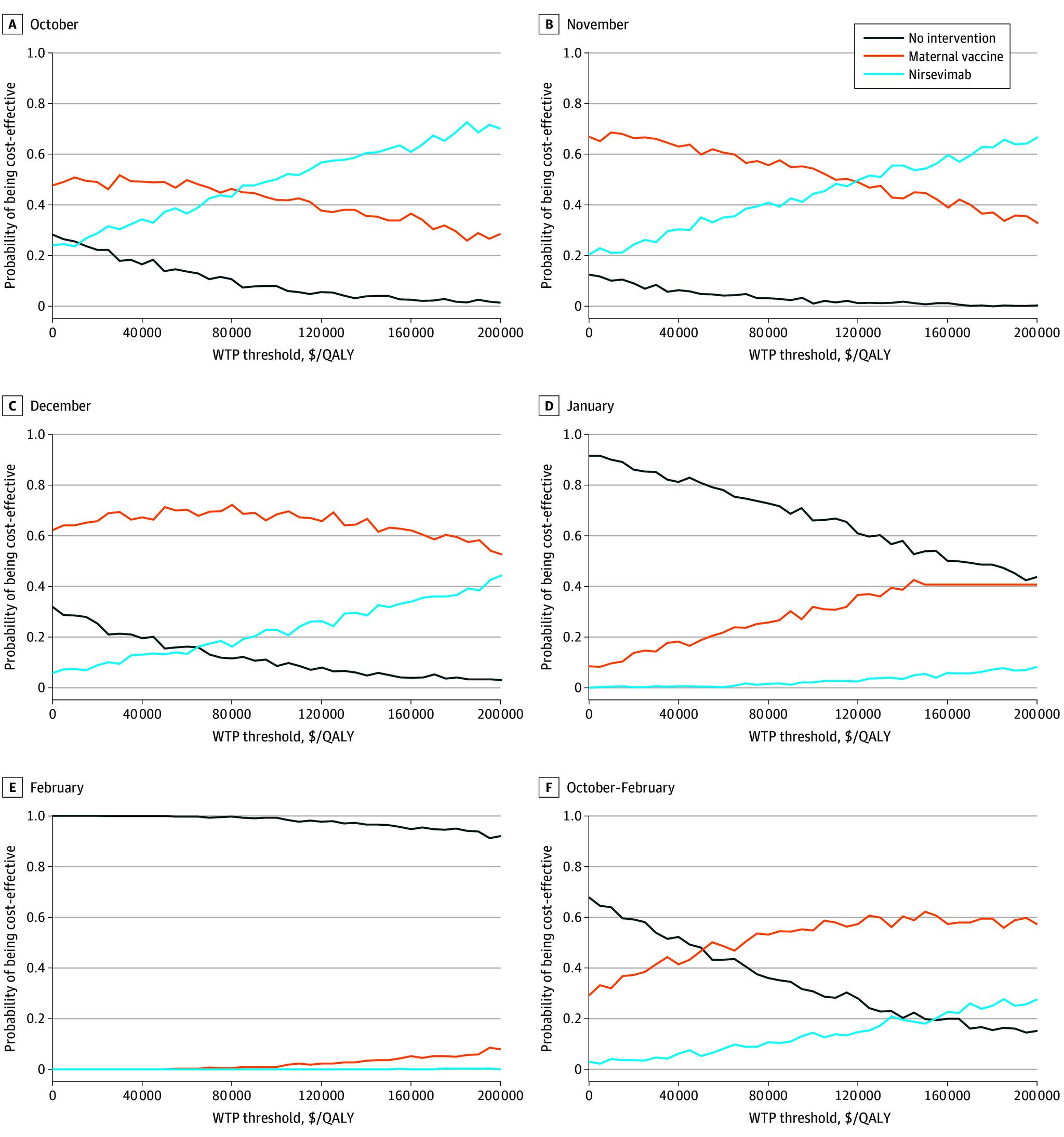
An estimated monthly birth cohort of 299 277 infants was included in the analysis. Compared with no intervention, MV was cost-saving for infants in the October, November, and December cohorts and cost-effective in the January but not the February cohorts ($504 517/QALY). For infants born in the combined cohort (October-February), MV was cost-effective at $19 562/QALY. Compared with MV, nirsevimab was cost-effective only in October ($67 178/QALY) and November ($88 531/QALY). During the RSV season, MV was projected to avert 45 558 outpatient visits, 7154 hospitalizations, and 12 deaths; nirsevimab was projected to avert 92 265 outpatient visits, 11 893 hospitalizations, and 19 deaths. The probability of no intervention being cost-effective during the RSV season was 19.8%; MV, 62.2%; and nirsevimab, 18.0%.
CONCLUSIONS AND RELEVANCE
In this economic evaluation of RSV prevention interventions, administration of MV in the first 4 months of and throughout the viral season could be cost-effective. Across the entire RSV season, nirsevimab was cost-effective compared with MV only in October and November. Intervention use may be optimized by restricting administration to select months. Further study is needed to assess transmission dynamics to refine cost-effectiveness outcomes.
重要性
免疫实践咨询委员会和疾病控制与预防中心建议季节性接种母体疫苗(MV)或尼塞韦单抗,以保护出生后第一年的婴儿免受呼吸道合胞病毒(RSV)感染。这些药物在接种率、成本和疗效方面的差异可能会根据给药时间影响成本效益。
目的
评估在整个RSV季节以及从10月到2月每个月出生队列中不进行干预、接种MV和使用尼塞韦单抗的临床结果和成本效益。
设计、设置和参与者:这项经济评估使用马尔可夫模型从社会角度分析成本效益,应用每质量调整生命年(QALY)150,000美元的支付意愿阈值。参与者包括RSV季节在美国出生的婴儿。数据收集于2023年10月至2024年6月,并于2024年7月至2025年5月进行分析。
干预措施
接种MV、使用尼塞韦单抗或不进行干预。
主要结果和衡量指标
主要结果是增量成本效益比(每获得一个QALY的成本)。临床结果包括住院次数、门诊感染次数和避免的死亡人数。进行了概率敏感性分析。
结果
分析中纳入了估计每月出生队列的299,277名婴儿。与不进行干预相比,MV对10月、11月和12月出生队列的婴儿具有成本节约效果,对1月出生队列具有成本效益,但对2月出生队列不具有成本效益(504,517美元/QALY)。对于综合队列(10月至2月)出生的婴儿,MV的成本效益为19,562美元/QALY。与MV相比,尼塞韦单抗仅在10月(67,178美元/QALY)和11月(88,531美元/QALY)具有成本效益。在RSV季节期间,预计MV可避免45,558次门诊就诊、7154次住院和12例死亡;尼塞韦单抗预计可避免92,265次门诊就诊、11,893次住院和19例死亡。在RSV季节不进行干预具有成本效益的概率为19.8%;MV为62.2%;尼塞韦单抗为18.0%。
结论和相关性
在这项对RSV预防干预措施的经济评估中,在病毒季节的前4个月及整个季节接种MV可能具有成本效益。在整个RSV季节,尼塞韦单抗仅在10月和11月与MV相比具有成本效益。通过将给药限制在特定月份,干预措施的使用可能会得到优化。需要进一步研究以评估传播动态,以完善成本效益结果。

 Zotero 插件