
数字孪生技术在推进嵌合抗原受体T细胞(CAR-T)疗法方面的潜在应用。
The Potential Use of Digital Twin Technology for Advancing CAR-T Cell Therapy.
作者信息
Aghamiri Sara Sadat, Amin Rada
机构信息
Center for Brain, Biology and Behavior, University of Nebraska, Lincoln, NE 68503, USA.
Department of Biochemistry, University of Nebraska, Lincoln, NE 68503, USA.
出版信息
Curr Issues Mol Biol. 2025 Apr 30;47(5):321. doi: 10.3390/cimb47050321.
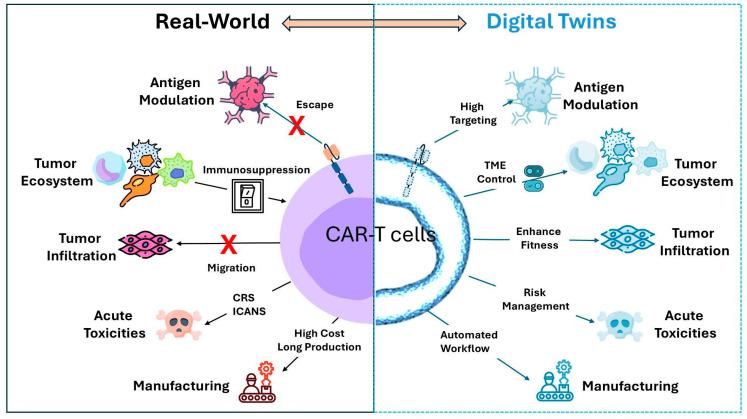
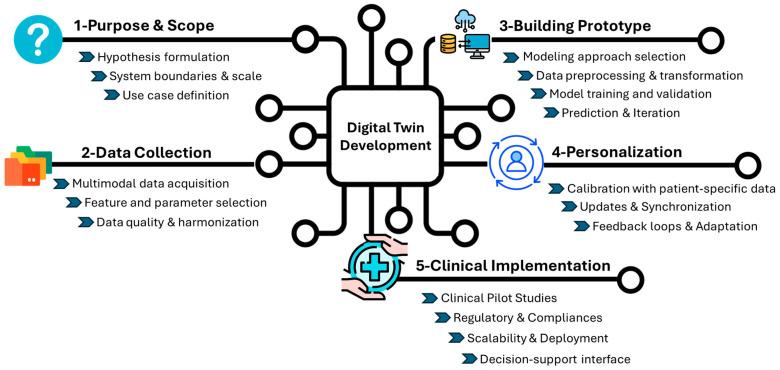
CAR-T cell therapy is a personalized immunotherapy that has shown promising results in treating hematologic cancers. However, its therapeutic efficacy in solid cancers is often limited by tumor evasion mechanisms, resistance pathways, and an immunosuppressive tumor microenvironment. These challenges highlight the need for advanced predictive models to better capture the intricate interactions between CAR-T cells and tumors to enhance their potential. Digital Twins represent a transformative approach for optimizing CAR-T cell therapy by providing a virtual representation of the therapy-tumor trajectory using high-dimensional patient data. In this review, we first define Digital Twins and outline the fundamental steps in their development. We then explore the critical parameters required for designing CAR-T-specific Digital Twins. We examine published case studies demonstrating a few applications of Digital Twins in addressing key challenges in CAR-T cell therapy, including their impact on clinical trials and manufacturing processes. Finally, we discuss the limitations associated with integrating Digital Twins into CAR-T therapy. As Digital Twin technology continues to evolve, the potential to enhance CAR-T therapy through precision modeling and real-time adaptation could redefine the landscape of personalized cancer treatment.
嵌合抗原受体T细胞(CAR-T)疗法是一种个性化免疫疗法,在治疗血液系统癌症方面已显示出有前景的结果。然而,其在实体癌中的治疗效果常常受到肿瘤逃逸机制、耐药途径和免疫抑制性肿瘤微环境的限制。这些挑战凸显了需要先进的预测模型,以更好地捕捉CAR-T细胞与肿瘤之间复杂的相互作用,从而增强其潜力。数字孪生代表了一种变革性方法,通过使用高维患者数据提供治疗-肿瘤轨迹的虚拟表示,来优化CAR-T细胞疗法。在本综述中,我们首先定义数字孪生并概述其开发的基本步骤。然后,我们探讨设计CAR-T特异性数字孪生所需的关键参数。我们研究已发表的案例研究,这些研究展示了数字孪生在应对CAR-T细胞疗法关键挑战中的一些应用,包括它们对临床试验和制造过程的影响。最后,我们讨论将数字孪生整合到CAR-T疗法中所涉及的局限性。随着数字孪生技术不断发展,通过精确建模和实时调整来增强CAR-T疗法的潜力可能会重新定义个性化癌症治疗的格局。
 Zotero 插件