
美国老年人中应激负荷与多种疾病并存之间的纵向关系。
The Longitudinal Relationship Between Allostatic Load and Multimorbidity Among Older Americans.
作者信息
Mira Rolla, Newton Jonathon Timothy, Sabbah Wael
机构信息
Faculty of Dentistry, Oral & Craniofacial Sciences, King's College London, Bessemer Road, Denmark Hill, London SE5 9RS, UK.
出版信息
Geriatrics (Basel). 2025 Jun 26;10(4):84. doi: 10.3390/geriatrics10040084.
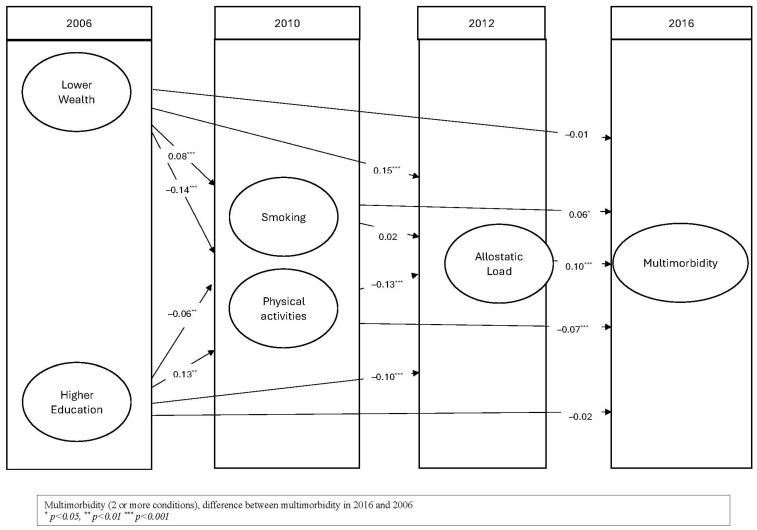
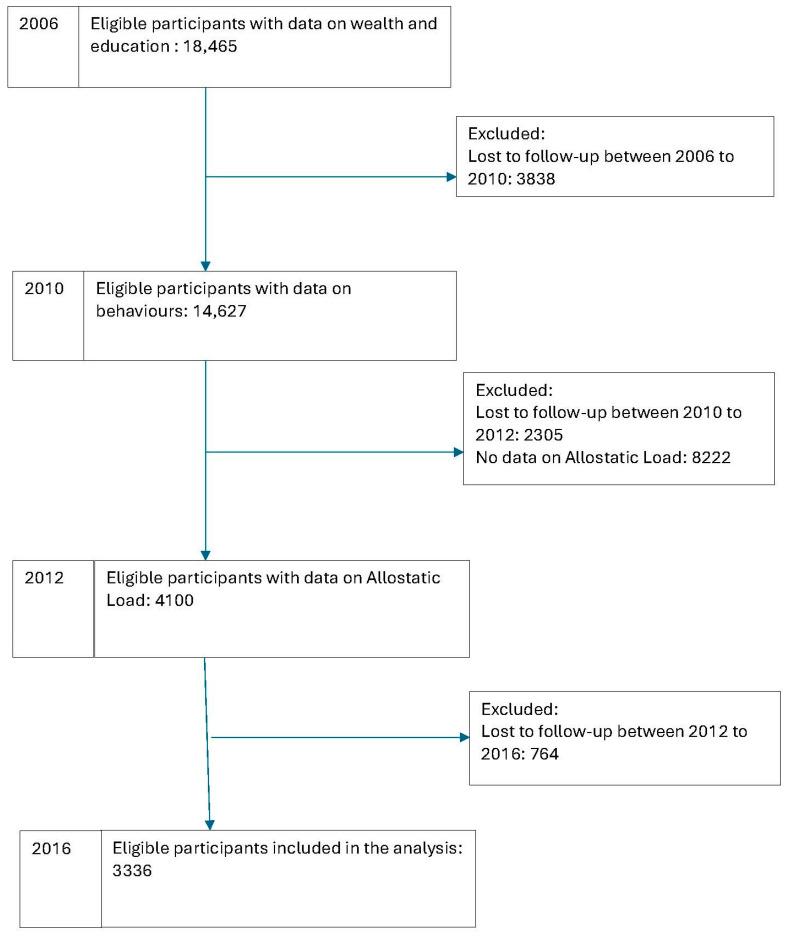
To examine the association between allostatic load and the progression of multimorbidity and the role of socioeconomic factors among older Americans. Data from the Health and Retirement Study (HRS), a longitudinal study of older American adults, were used. Data were included from waves 8 (2006), 10 (2010), 11 (2012), and 13 (2016). Self-reported diagnoses of five chronic conditions (diabetes, heart disease, lung diseases, cancer, and stroke) indicated multimorbidity and were dichotomised to reflect having two or more conditions versus one or fewer. Multimorbidity in 2006 was subtracted from that in 2016 to calculate ten-year change in multimorbidity. Sociodemographic data (age, gender, education, and wealth) were from wave 8 (2006). Behaviours (physical activity and smoking) were from wave 10 (2010). Allostatic load, indicated by five biomarkers (waist circumference, high blood pressure, glycosylated haemoglobin, high-density lipoprotein, and c-reactive protein), was from wave 11 (2012). Structural Equation Modelling (SEM) was used to assess the longitudinal association between the aforementioned factors and the incidence of multimorbidity in 2016. Results: Given that allostatic load was assessed in a subsample of HRS, 8222 were excluded for lack of relevant data. A total of 3336 participants were included in the final analysis. The incidence of multimorbidity in 2016 was 19%. Allostatic load in 2012 was significantly associated with the incidence of multimorbidity in 2016 (estimate 0.10, 95% Confidence Interval (CI) 0.07, 0.14); in other words, for an additional marker of allostatic load, there was an average 0.1 change in the incidence of multimorbidity. Wealth and education (2006) were indirectly associated with multimorbidity through allostatic load and behaviours. Smoking (2010) was positively associated with multimorbidity in 2016, while physical activity showed a negative association. Biological markers of stress indicated by allostatic load were associated with multimorbidity. Adverse socioeconomic conditions appear to induce allostatic load and risk behaviours, which impact the progression of multimorbidity.
研究美国老年人中应激负荷与多种慢性病进展之间的关联以及社会经济因素所起的作用。使用了来自健康与退休研究(HRS)的数据,该研究是一项针对美国老年成年人的纵向研究。数据涵盖了第8轮(2006年)、第10轮(2010年)、第11轮(2012年)和第13轮(2016年)。自我报告的五种慢性病(糖尿病、心脏病、肺病、癌症和中风)诊断表明存在多种慢性病,并将其二分法处理以反映患有两种或更多种疾病与患有一种或更少种疾病的情况。用2016年的多种慢性病情况减去2006年的,以计算多种慢性病的十年变化。社会人口统计学数据(年龄、性别、教育程度和财富)来自第8轮(2006年)。行为(身体活动和吸烟)来自第10轮(2010年)。由五个生物标志物(腰围、高血压、糖化血红蛋白、高密度脂蛋白和C反应蛋白)表示的应激负荷来自第11轮(2012年)。采用结构方程模型(SEM)来评估上述因素与2016年多种慢性病发病率之间的纵向关联。结果:鉴于应激负荷是在HRS的一个子样本中进行评估的,8222人因缺乏相关数据而被排除。最终分析共纳入3336名参与者。2016年多种慢性病的发病率为19%。2012年的应激负荷与2016年多种慢性病的发病率显著相关(估计值为0.10,95%置信区间(CI)为0.07,0.14);换句话说,应激负荷每增加一个标志物,多种慢性病的发病率平均变化0.1。财富和教育程度(2006年)通过应激负荷和行为与多种慢性病间接相关。吸烟(2010年)与2016年的多种慢性病呈正相关,而身体活动则呈负相关。应激负荷所表明的应激生物标志物与多种慢性病相关。不利的社会经济状况似乎会引发应激负荷和危险行为,从而影响多种慢性病的进展。
 Zotero 插件