
中老年人群体圆度指数与代谢综合征的关联:一项中国的前瞻性队列研究
Association between body roundness index and metabolic syndrome in middle-aged and older adults: a prospective cohort study in China.
作者信息
Li Haiwei, Zhang Jing, Wang Huifang, Luo Liang
机构信息
School of Physical Education, Shanxi Normal University, Taiyuan, China.
出版信息
Front Public Health. 2025 Jul 9;13:1604593. doi: 10.3389/fpubh.2025.1604593. eCollection 2025.
BACKGROUND
The Body Roundness Index (BRI), an emerging anthropometric parameter calculated from height and waist circumference ratios, currently lacks substantive evidence delineating its etiological connections with metabolic syndrome (MetS) development. Its predictive utility for MetS and clinical applicability remain poorly understood. This study aimed to investigate the association between BRI and the risk of MetS in middle-aged and older adults in China, using both cross-sectional and prospective cohort analyses. We hypothesized that higher BRI is associated with an increased risk of MetS.
METHODS
The cross-sectional analysis utilized data from the China Health and Retirement Longitudinal Study (CHARLS), comprising 9,398 participants, while the longitudinal analysis was based on a prospective cohort of 5,934 individuals from the same study, followed over a 4-year period. The BRI was calculated using height and waist circumference. Logistic regression and Cox proportional hazards regression models were employed to evaluate associations between BRI and MetS. To ensure the robustness of the findings, restricted cubic spline plots, subgroup analyses, and sensitivity analyses were conducted.
RESULTS
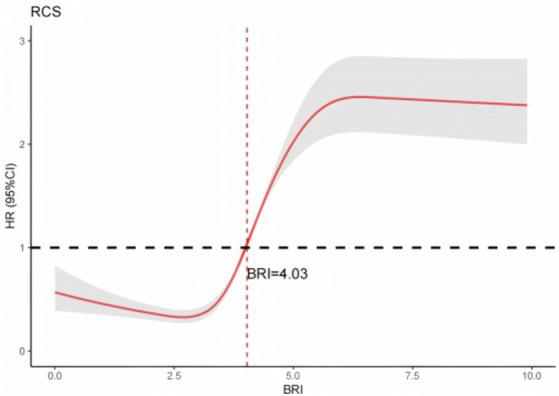
After adjusting for covariates (including age, gender, education, smoking status, drinking status, etc.), cross-sectional analyses revealed that participants in the medium BRI tertile (OR = 4.99, 95% CI: 3.07-8.11) and the high BRI tertile (OR = 13.66, 95% CI: 8.57-21.79) had a significantly higher risk of MetS compared to the low BRI reference group ( < 0.001). Longitudinal analyses demonstrated that the medium BRI group had a 2.71-fold increased risk of MetS (HR = 2.71, 95% CI: 2.29-3.21, < 0.001), while the high BRI group exhibited a 4.64-fold increased risk (HR = 4.64, 95% CI: 3.94-5.47, < 0.001) relative to the low BRI group. Restricted cubic spline analyses indicated a nonlinear dose-response relationship between BRI and MetS risk (P for nonlinearity < 0.001).
CONCLUSION
Elevated BRI is significantly associated with an increased risk of MetS in middle-aged and older adults. Therefore, prospective cohort studies employing longitudinal designs and intervention assessments are needed to determine whether BRI can serve as a modifiable risk marker for MetS.
背景
身体圆润度指数(BRI)是一种根据身高与腰围比值计算得出的新兴人体测量参数,目前缺乏实质性证据来阐明其与代谢综合征(MetS)发生发展的病因学联系。其对MetS的预测效用和临床适用性仍知之甚少。本研究旨在通过横断面分析和前瞻性队列分析,探讨中国中老年人群中BRI与MetS风险之间的关联。我们假设较高的BRI与MetS风险增加相关。
方法
横断面分析使用了中国健康与养老追踪调查(CHARLS)的数据,共9398名参与者;纵向分析基于同一研究中的5934名个体组成的前瞻性队列,随访4年。BRI通过身高和腰围计算得出。采用逻辑回归和Cox比例风险回归模型评估BRI与MetS之间的关联。为确保研究结果的稳健性,进行了受限立方样条图分析、亚组分析和敏感性分析。
结果
在调整协变量(包括年龄、性别、教育程度、吸烟状况、饮酒状况等)后,横断面分析显示,与低BRI参考组相比,中等BRI三分位数组(OR = 4.99,95% CI:3.07 - 8.11)和高BRI三分位数组(OR = 13.66,95% CI:8.57 - 21.79)患MetS的风险显著更高(P < 0.001)。纵向分析表明,与低BRI组相比,中等BRI组患MetS的风险增加了2.71倍(HR = 2.71,95% CI:2.29 - 3.21,P < 0.001),而高BRI组的风险增加了4.64倍(HR = 4.64,95% CI:3.94 - 5.47,P < 0.001)。受限立方样条分析表明,BRI与MetS风险之间存在非线性剂量反应关系(非线性P < 0.001)。
结论
BRI升高与中老年人群患MetS的风险增加显著相关。因此,需要采用纵向设计和干预评估的前瞻性队列研究,以确定BRI是否可作为MetS的一个可改变的风险标志物。

 Zotero 插件