
蛋白质聚集体结构如何影响解聚机制?
How does protein aggregate structure affect mechanisms of disaggregation?
作者信息
Yang YuChen, Rye Hays S
机构信息
Department of Biochemistry and Biophysics, Texas A&M University, College Station Texas, 77845, U.S.A.
出版信息
Biochem Soc Trans. 2025 Aug 29;53(4):881-895. doi: 10.1042/BST20253077.
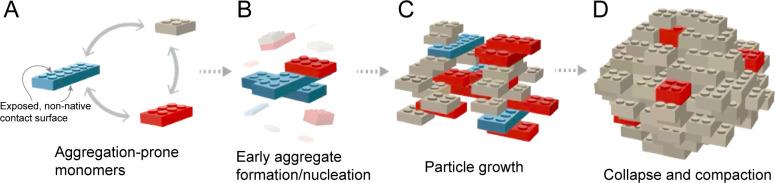
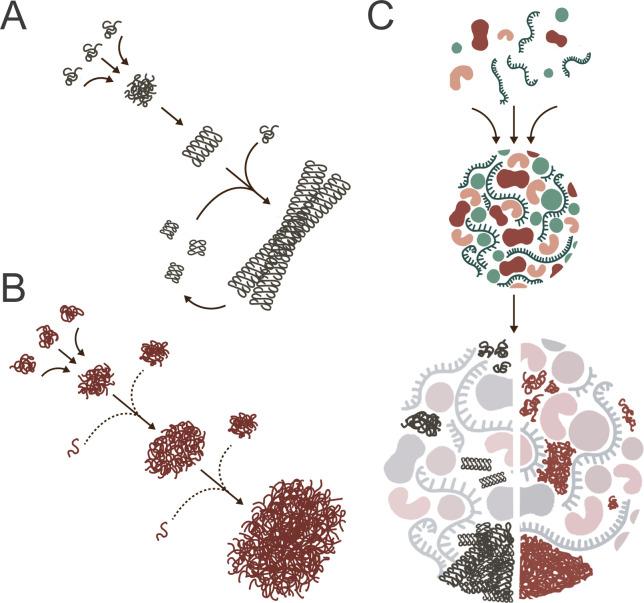
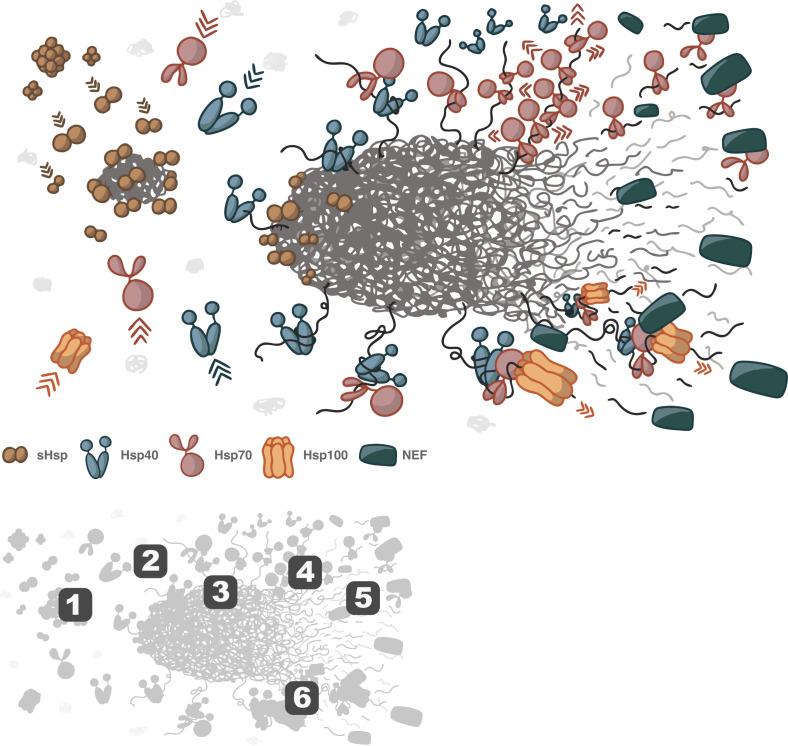
Protein misfolding and aggregation underpin numerous pathological conditions, including Alzheimer's, Parkinson's, and Huntington's diseases. Within cells, the competition between protein folding and misfolding-driven aggregation necessitates intricate quality control systems known collectively as the proteostasis network, with molecular chaperones playing central roles. Critical gaps remain in our understanding of why certain protein aggregates are amenable to efficient chaperone-mediated disassembly, while others resist such intervention. Aggregates can be most broadly categorized into structurally ordered amyloid fibrils and more irregular amorphous clusters. Amyloid fibrils are characterized by a highly structured, cross-β-sheet architecture, and they generally display nucleation-driven growth kinetics. In contrast, amorphous aggregates form through heterogeneous interactions among partially unfolded proteins, which typically lack ordered and repeating structure but still display poorly understood, specific assembly constraints. Importantly, amorphous aggregation and amyloid formation are often linked to one another, with several different types of aggregate structures forming at the same time. The ability of molecular chaperones to remodel and disassemble aggregates is affected by aggregate size, internal structure, surface dynamics, and exposure of chaperone-binding sites. However, despite these insights, the mechanistic complexity, aggregate heterogeneity, and dynamic properties present substantial experimental and theoretical challenges. Addressing these challenges will require innovative approaches combining single-molecule biophysics, structural biology, and computational modeling to unveil universal principles governing protein aggregation and disaggregation within cellular environments.
蛋白质错误折叠和聚集是许多病理状况的基础,包括阿尔茨海默病、帕金森病和亨廷顿病。在细胞内,蛋白质折叠与错误折叠驱动的聚集之间的竞争需要复杂的质量控制系统,统称为蛋白质稳态网络,分子伴侣在其中发挥核心作用。在我们对为什么某些蛋白质聚集体易于通过分子伴侣介导进行有效拆解,而其他聚集体则抗拒这种干预的理解上,仍然存在重大差距。聚集体大致可分为结构有序的淀粉样纤维和更不规则的无定形聚集体。淀粉样纤维的特征是具有高度结构化的交叉β-折叠结构,并且通常呈现成核驱动的生长动力学。相比之下,无定形聚集体通过部分未折叠蛋白质之间的异质相互作用形成,这些蛋白质通常缺乏有序和重复结构,但仍然表现出理解不足的特定组装限制。重要的是,无定形聚集和淀粉样形成往往相互关联,同时形成几种不同类型的聚集体结构。分子伴侣重塑和拆解聚集体的能力受聚集体大小、内部结构、表面动力学以及伴侣结合位点暴露的影响。然而,尽管有这些见解,其机制的复杂性、聚集体的异质性和动态特性带来了重大的实验和理论挑战。应对这些挑战将需要结合单分子生物物理学、结构生物学和计算建模的创新方法,以揭示细胞环境中蛋白质聚集和解聚的普遍原理。
 Zotero 插件