
壬基酚对短期培养的大鼠下丘脑儿茶酚胺、促性腺激素释放激素(GnRH)和亲吻素分泌的影响。
Effects of Nonylphenol on the Secretions of Catecholamines, Gonadotropin-Releasing Hormone (GnRH) and Kisspeptin from Short-Term Incubated Rat Hypothalamus.
作者信息
Kim Hee-Soo, Lee Sung-Ho
机构信息
Department of Biotechnology, Sangmyung University, Seoul 03016, Korea.
出版信息
Dev Reprod. 2025 Jun;29(2):47-54. doi: 10.12717/DR.2025.29.2.47. Epub 2025 Jun 30.
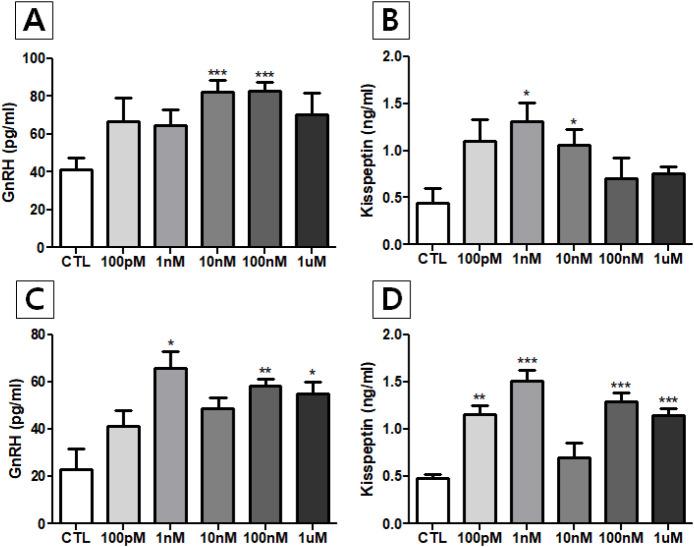
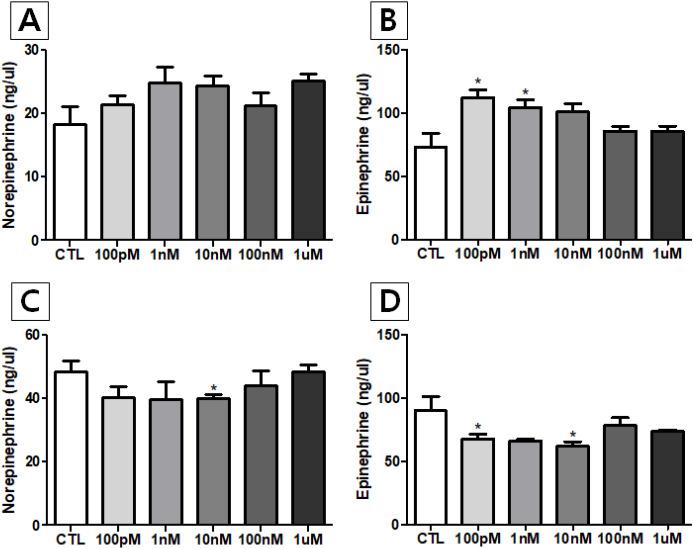
Previously, we developed a short-term incubation method of rat adrenal and demonstrated that nonylphenol (NP) exposure could induce changes in secretions of adrenal hormones. In the present study, the effects of NP on changes in hormonal secretion from hypothalamus were investigated. The catecholamine levels were measured using high-performance liquid chromatography with electrochemical detection (HPLC-ECD) and the levels of gonadotropin-releasing hormone (GnRH) and kisspeptin were measured using enzyme-linked immunosorbent assay (ELISA). The norepinephrine (NE) levels from NP-treated male and female hypothalamus were not significantly changed across the entire treatment concentration (from 1 nM to 1 μM), except male 10 nM-treated group which were significantly lower than control (<0.05). The epinephrine (E) levels from NP-treated female hypothalamus were significantly increased in 100 pM- and 1 nM-trated group (<0.05). However, the E levels from NP-treated male hypothalamus were significantly decreased in 100 pM- and 10 nM-treated group (<0.05). The GnRH levels from NP-treated hypothalamus showed an increasing trend, especially significant in male 10 nM- and 100 nM-treated groups (<0.001) and female 1 nM-, 100 nM- and 1 μM-trated groups (<0.05, <0.01 and <0.05, respectively). Also, the kisspeptin levels in incubated media of both sexes showed a strong increasing trend, especially significant in male 1 nM- and 10 nM-treated groups (<0.05) and all of female groups except 10 nM-treated. In conclusion, our incubation method could be quite suitable for rapidly and effectively measuring endocrine disrupting chemicals (EDC) activity in hypothalamus. NP treatment shown stimulatory effects on both GnRH and kisspeptin secretions from hypothalamus of both sexes, suggesting possible relationship between NP exposure and reproductive phenomena and related disorders.
此前,我们开发了一种大鼠肾上腺短期孵育方法,并证明壬基酚(NP)暴露可诱导肾上腺激素分泌变化。在本研究中,研究了NP对下丘脑激素分泌变化的影响。使用高效液相色谱-电化学检测法(HPLC-ECD)测量儿茶酚胺水平,使用酶联免疫吸附测定法(ELISA)测量促性腺激素释放激素(GnRH)和亲吻素水平。在整个处理浓度范围(从1 nM到1 μM)内,NP处理的雄性和雌性下丘脑的去甲肾上腺素(NE)水平无显著变化,但雄性10 nM处理组显著低于对照组(<0.05)。NP处理的雌性下丘脑的肾上腺素(E)水平在100 pM和1 nM处理组中显著升高(<0.05)。然而,NP处理的雄性下丘脑的E水平在100 pM和10 nM处理组中显著降低(<0.05)。NP处理的下丘脑的GnRH水平呈上升趋势,在雄性10 nM和100 nM处理组(<0.001)以及雌性1 nM、100 nM和1 μM处理组中尤为显著(分别为<0.05、<0.01和<0.05)。此外,两性孵育培养基中的亲吻素水平均呈强烈上升趋势,在雄性1 nM和10 nM处理组中尤为显著(<0.05),在除10 nM处理组外的所有雌性组中也显著。总之,我们的孵育方法非常适合快速有效地测量下丘脑中内分泌干扰化学物质(EDC)的活性。NP处理对两性下丘脑的GnRH和亲吻素分泌均有刺激作用,表明NP暴露与生殖现象及相关疾病之间可能存在关联。
 Zotero 插件