
细胞因子基因多态性在创伤性脑损伤后康复结局中的作用
The Role of Cytokine Gene Polymorphisms in Rehabilitation Outcome After Traumatic Brain Injury.
作者信息
Guerini Franca Rosa, Agliardi Cristina, Zanzottera Milena, Caronni Antonio, Antolini Laura, Derchi Chiara Camilla, Atzori Tiziana, Bolognesi Elisabetta, Navarro Jorge, Clerici Mario, Comanducci Angela
机构信息
Laboratory of Molecular Medicine and Biotechnology, IRCCS Fondazione Don Carlo Gnocchi ONLUS, 20148 Milan, Italy.
Department of Neurorehabilitation Sciences, IRCCS Istituto Auxologico Italiano, 20149 Milan, Italy.
出版信息
Cells. 2025 Jul 10;14(14):1056. doi: 10.3390/cells14141056.
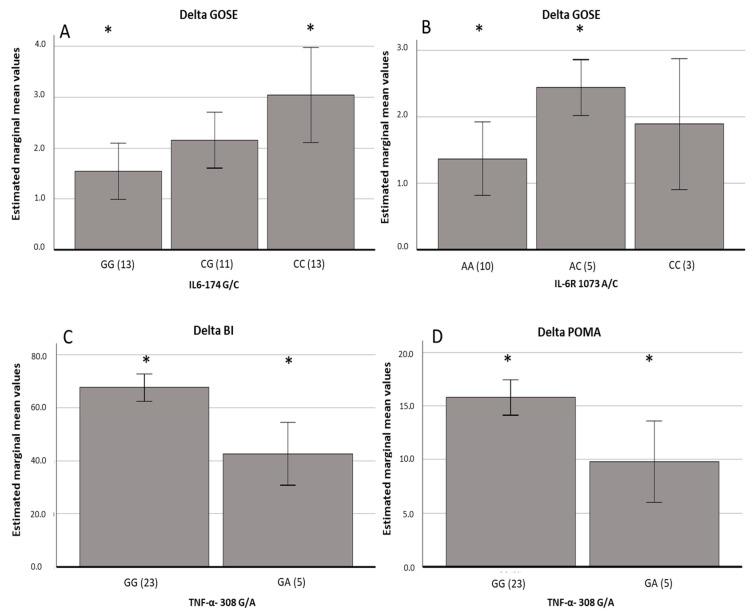
Traumatic brain injury (TBI) affects millions of people worldwide and often results in long-term disabilities. Clinical outcomes vary widely even among patients with similar injury severity, partly due to systemic neuroinflammatory responses mediated by pro- and anti-inflammatory cytokines. Genetic polymorphisms in cytokine-coding genes may influence cytokine expression, thereby affecting rehabilitation and prognosis. We analyzed genetic polymorphisms in the , , receptor, , and genes in 28 subacute TBI patients undergoing rehabilitation. Clinical outcomes were assessed using the Glasgow Outcome Scale Extended (GOSE) and domain-specific scales for cognitive, motor, and functional recovery. Results were correlated with genetic profiles to identify potential predictive biomarkers. The (GG) and 1073 (AA) genotypes correlated with worse GOSE scores ( = 0.02 and = 0.01, respectively). Co-segregation of - G-A alleles was linked to poorer outcomes ( = 0.01). Patients with the (GA) genotype showed less improvement in Barthel and Mobility scores ( = 0.001 and = 0.01, respectively) and had a higher incidence of post-traumatic confusional state after rehabilitation ( = 0.03). Overall, the (GA), (GG), and (AA) genotypes negatively impact rehabilitation outcomes, likely due to their role in enhancing neuroinflammation. Larger studies are needed to develop personalized therapies tailored to genetic profiles, aiming to improve rehabilitation outcomes for TBI patients.
创伤性脑损伤(TBI)影响着全球数百万人,常常导致长期残疾。即使在损伤严重程度相似的患者中,临床结果也存在很大差异,部分原因是促炎和抗炎细胞因子介导的全身神经炎症反应。细胞因子编码基因的遗传多态性可能影响细胞因子表达,从而影响康复和预后。我们分析了28例接受康复治疗的亚急性TBI患者的、、受体、和基因的遗传多态性。使用格拉斯哥扩展预后量表(GOSE)以及认知、运动和功能恢复的特定领域量表评估临床结果。将结果与基因谱相关联,以确定潜在的预测生物标志物。(GG)和1073(AA)基因型与较差的GOSE评分相关(分别为 = 0.02和 = 0.01)。-G-A等位基因的共分离与较差的结果相关( = 0.01)。具有(GA)基因型的患者在Barthel指数和运动评分方面改善较少(分别为 = 0.001和 = 0.01),并且康复后创伤后混乱状态的发生率较高( = 0.03)。总体而言,(GA)、(GG)和(AA)基因型对康复结果产生负面影响,可能是由于它们在增强神经炎症中的作用。需要进行更大规模的研究来开发针对基因谱的个性化疗法,旨在改善TBI患者的康复结果。
 Zotero 插件