
聚乙烯微塑料和镉对土壤-植物系统的耦合效应:对土壤性质及生菜镉吸收的影响
Coupled Effects of Polyethylene Microplastics and Cadmium on Soil-Plant Systems: Impact on Soil Properties and Cadmium Uptake in Lettuce.
作者信息
Zhang Zhiqin, Bi Boyuan
机构信息
School of Materials Engineering, Shanxi College of Technology, Shuozhou 036000, China.
College of Natural Resources and Environment, Northwest A&F University, Yangling, Xianyang 712100, China.
出版信息
Toxics. 2025 Jun 30;13(7):555. doi: 10.3390/toxics13070555.
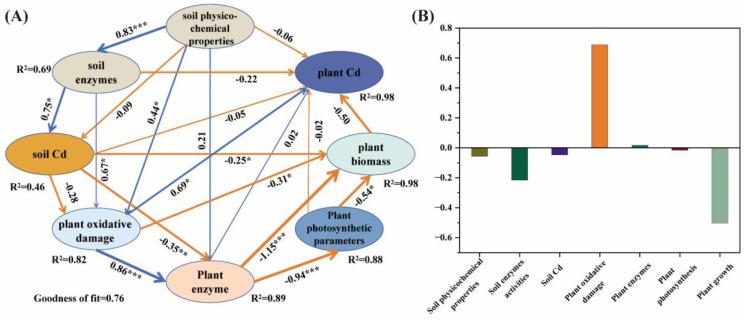
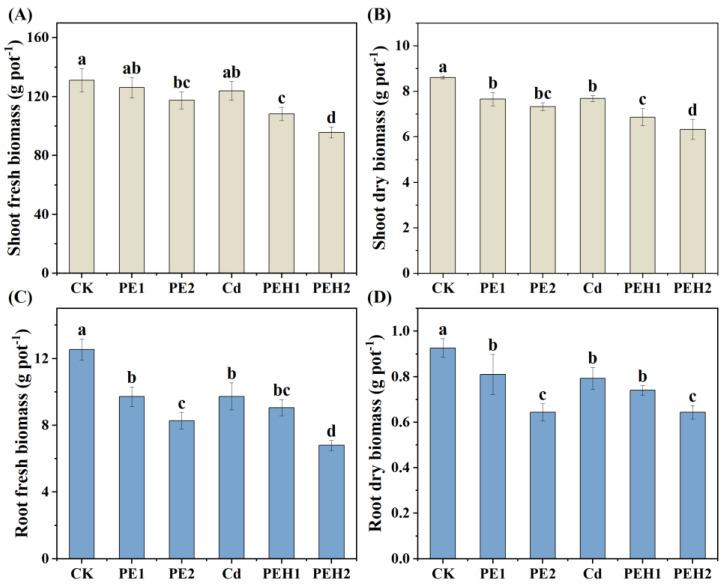
Microplastics (MPs) and cadmium (Cd) in the soil environment are expected to pose a serious threat to agricultural production. However, the effect of the interaction between them on the soil-plant system and the mechanism of MPs on plant Cd uptake are still unclear. Therefore, the effects of different concentrations of polyethylene (PE-MPs, 0, 1.0% and 2.0%), alone or combined with Cd, on soil properties, plant growth and Cd uptake were investigated through pot experiments. The results showed that the single contamination of MPs and Cd and their interaction (MPs + Cd) significantly decreased soil moisture and pH; however, it increased soil organic matter (SOM) and total nitrogen (TN). Soil urease and catalase activities were significantly decreased and sucrase and alkaline phosphatase activities were increased with or without Cd addition. The exposure of PE and Cd, alone or combined, significantly and negatively affected plant biomass, photosynthetic parameters, and caused oxidative damage to plants, and the overall toxicity to plants increases with the increase in PE concentration. Moreover, co-pollution causes greater plant toxicity than the individual pollution of PE or Cd. Plants can resist oxidative stress by increasing superoxide dismutase (SOD) and peroxidase (POD) activities. The heat map showed that soil environmental factors were significantly correlated with plant growth; and the results of redundancy analysis (RDA) indicated that for plant physiological characteristics, soil properties under PE, alone or co-contaminated with Cd, explained a total of 85.77% and 97.45%, respectively. This indicated that the alteration of the soil microenvironment is the key factor influencing plant growth. The results of the partial least squares path model (PLS-PM) indicated that plant oxidative damage and biomass had significant positive and negative direct effects on plant Cd uptake, respectively. The linear model of relative importance (%) further revealed in depth that soil moisture (relative importance: 33.60%) and plant biomass (relative importance: 20.23%) were, respectively, regarded as the most important soil environmental factors and plant indicators affecting their Cd uptake. This study provided theoretical support for assessing the risks of MPs and Cd co-pollution to agricultural ecosystems.
土壤环境中的微塑料(MPs)和镉(Cd)预计会对农业生产构成严重威胁。然而,它们之间的相互作用对土壤 - 植物系统的影响以及微塑料对植物吸收镉的机制仍不清楚。因此,通过盆栽试验研究了不同浓度的聚乙烯(PE - MPs,0、1.0%和2.0%)单独或与镉联合作用对土壤性质、植物生长和镉吸收的影响。结果表明,微塑料和镉的单一污染及其相互作用(MPs + Cd)显著降低了土壤湿度和pH值;然而,它增加了土壤有机质(SOM)和总氮(TN)。无论是否添加镉,土壤脲酶和过氧化氢酶活性均显著降低,蔗糖酶和碱性磷酸酶活性增加。单独或联合暴露的PE和Cd对植物生物量、光合参数有显著负面影响,并对植物造成氧化损伤,且对植物的总体毒性随PE浓度的增加而增加。此外,复合污染比PE或Cd的单独污染对植物毒性更大。植物可通过增加超氧化物歧化酶(SOD)和过氧化物酶(POD)活性来抵抗氧化应激。热图显示土壤环境因素与植物生长显著相关;冗余分析(RDA)结果表明,对于植物生理特征,单独或与镉共同污染的PE处理下的土壤性质分别解释了85.77%和97.45%。这表明土壤微环境的改变是影响植物生长的关键因素。偏最小二乘路径模型(PLS - PM)结果表明,植物氧化损伤和生物量分别对植物镉吸收有显著的正向和负向直接影响。相对重要性(%)的线性模型进一步深入揭示,土壤湿度(相对重要性:33.60%)和植物生物量(相对重要性:20.23%)分别被视为影响其镉吸收的最重要的土壤环境因素和植物指标。本研究为评估微塑料和镉复合污染对农业生态系统的风险提供了理论支持。



 Zotero 插件