
饮食炎症潜能、抗氧化能力及地中海饮食依从性与生物衰老的差异关联:一项英国生物银行研究。
Differential associations of dietary inflammatory potential, antioxidant capacity, and Mediterranean diet adherence with biological aging: A UK Biobank study.
作者信息
Zhang Cong, Han Ren-Fang, Yin Song, Huang Yue-Qing
机构信息
Public Health Department, Gusu District Center for Disease Control and Prevention, Suzhou, China.
Health Management Center, The Affiliated Suzhou Hospital of Nanjing Medical University, Suzhou Municipal Hospital, Nanjing Medical University, Suzhou, China.
出版信息
J Nutr Health Aging. 2025 Jul 24;29(9):100638. doi: 10.1016/j.jnha.2025.100638.
BACKGROUND
Biological aging, distinct from chronological age, significantly impacts chronic disease risk and is a crucial target for health interventions. While diet is hypothesized to influence aging through inflammatory and oxidative pathways, systematic evidence from large populations remains limited. To address this gap, we used UK Biobank data with complementary dietary indices assessing inflammatory and antioxidant properties, providing comprehensive insights into diet-aging links.
METHODS
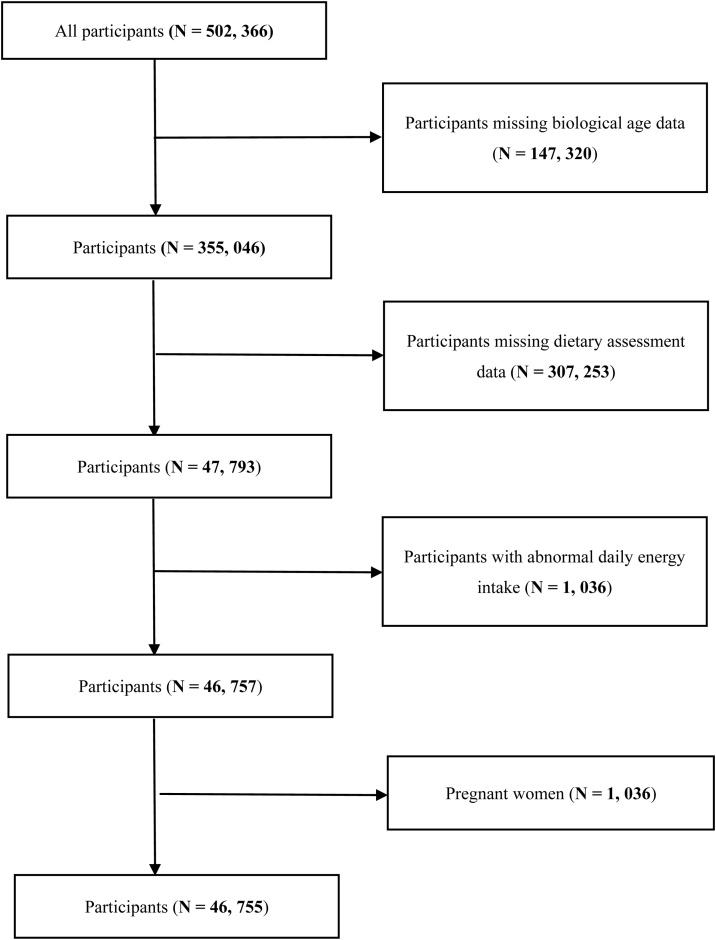
We analyzed data from 46,755 UK Biobank participants in this cross-sectional study. Dietary inflammatory potential, antioxidant capacity, and Mediterranean diet adherence were assessed using the Dietary Inflammatory Index (DII), Composite Dietary Antioxidant Index (CDAI), and Alternative Mediterranean Diet (aMED) scores, respectively, derived from 24-h food consumption reports. Biological age acceleration was quantified by Klemera-Doubal method biological age (KDM-BA) and phenotypic age (PhenoAge). Multivariate linear and logistic regressions, restricted cubic spline models, and mediation analyses were performed, adjusting for extensive confounders.
RESULTS
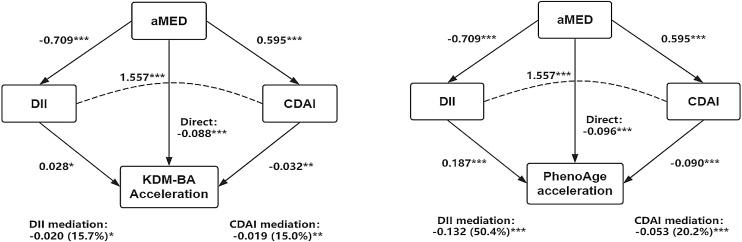
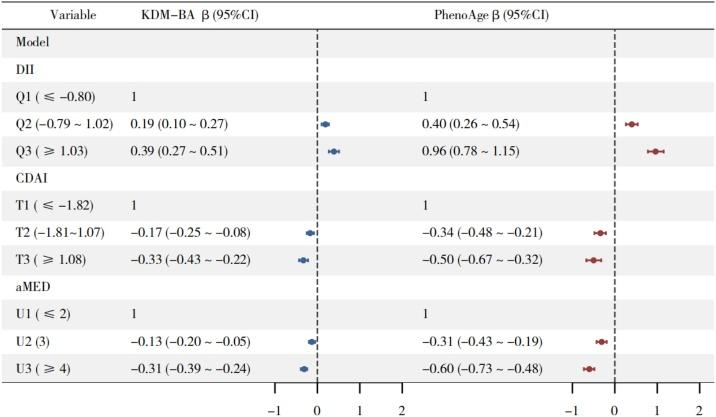
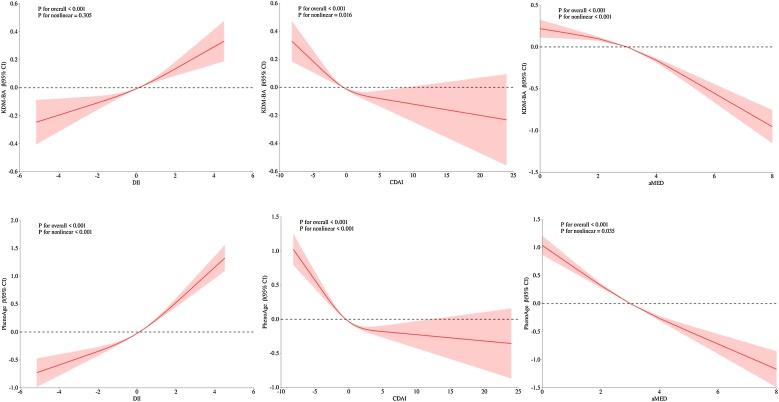
Pro-inflammatory diets (higher DII scores) were significantly associated with increased biological age acceleration (KDM-BA: β = 0.39; PhenoAge: β = 0.96, all P < 0.001), whereas antioxidant-rich diets (higher CDAI scores) and Mediterranean diets (higher aMED scores) showed inverse associations (CDAI: β= -0.33 to -0.50; aMED: β = -0.31 to -0.60, all P < 0.001). Logistic regressions confirmed that aMED adherence reduced odds of biological age acceleration (OR: 0.68-0.69, P < 0.001). Dose-response analyses revealed nonlinear positive associations between DII and PhenoAge acceleration (P < 0.001), nonlinear negative associations for CDAI (P ≤ 0.016), and near-linear negative trends for aMED (P ≤ 0.035). Mediation analyses indicated that DII and CDAI accounted for 15.7%-50.4% and 15.0%-20.2%, respectively, of the association between aMED and biological age acceleration, highlighting anti-inflammatory and antioxidant mechanisms in delaying aging.
CONCLUSION
This study provides robust evidence that dietary pro-inflammatory potential, antioxidant capacity, and Mediterranean diet adherence exhibit independent and differential associations with biological aging. Pro-inflammatory diets are associated with accelerated aging, whereas antioxidant-rich and Mediterranean diets are associated with decelerated biological aging. Mediation analyses reveal that the Mediterranean diet's benefits are partially mediated by its anti-inflammatory and antioxidant properties. Future research should employ longitudinal designs to establish causation and clarify mechanisms, positioning diet as a key modifiable factor for healthy aging.
背景
生物衰老不同于实际年龄,对慢性病风险有重大影响,是健康干预的关键目标。虽然假设饮食通过炎症和氧化途径影响衰老,但来自大量人群的系统性证据仍然有限。为了填补这一空白,我们使用英国生物银行的数据以及评估炎症和抗氧化特性的补充饮食指数,以全面洞察饮食与衰老之间的联系。
方法
在这项横断面研究中,我们分析了来自46755名英国生物银行参与者的数据。分别使用饮食炎症指数(DII)、综合饮食抗氧化指数(CDAI)和替代地中海饮食(aMED)评分来评估饮食炎症潜力、抗氧化能力和地中海饮食依从性,这些评分均来自24小时食物消费报告。通过克莱梅拉 - 杜巴尔方法生物年龄(KDM - BA)和表型年龄(PhenoAge)对生物年龄加速进行量化。进行了多变量线性和逻辑回归、受限立方样条模型以及中介分析,并对大量混杂因素进行了调整。
结果
促炎饮食(较高的DII评分)与生物年龄加速显著相关(KDM - BA:β = 0.39;PhenoAge:β = 0.96,所有P < 0.001),而富含抗氧化剂的饮食(较高的CDAI评分)和地中海饮食(较高的aMED评分)则呈现负相关(CDAI:β = -0.33至 -0.50;aMED:β = -0.31至 -0.60,所有P < 0.001)。逻辑回归证实,坚持地中海饮食可降低生物年龄加速的几率(OR:0.68 - 0.69,P < 0.001)。剂量反应分析显示,DII与PhenoAge加速之间存在非线性正相关(P < 0.001),CDAI存在非线性负相关(P ≤ 0.016),aMED存在近似线性负趋势(P ≤ 0.035)。中介分析表明,DII和CDAI分别占aMED与生物年龄加速之间关联的15.7% - 50.4%和15.0% - 20.2%,突出了抗炎和抗氧化机制在延缓衰老中的作用。
结论
本研究提供了有力证据,表明饮食促炎潜力、抗氧化能力和地中海饮食依从性与生物衰老存在独立且不同的关联。促炎饮食与加速衰老相关,而富含抗氧化剂的饮食和地中海饮食与生物衰老减速相关。中介分析表明,地中海饮食的益处部分由其抗炎和抗氧化特性介导。未来的研究应采用纵向设计来确定因果关系并阐明机制,并将饮食定位为健康衰老的关键可改变因素。

 Zotero 插件