
乳腺癌中免疫检查点抑制剂反应和耐药的生物标志物。
Biomarkers of response and resistance to immune checkpoint inhibitors in breast cancer.
作者信息
Li Michelle, Panet François, Barberi Vittoria, Salgado Roberto, Oliveira Mafalda, Loi Sherene
机构信息
Department of Medical Oncology, Peter MacCallum Cancer Centre, Melbourne, Victoria, Australia; Division of Cancer Research, Peter MacCallum Cancer Centre, Melbourne, Victoria, Australia.
CISSS de la Montérégie-Centre, Département de Médecine, Service d'hémato-oncologie, Longueuil, Québec, Canada.
出版信息
Breast. 2025 Jul 21;83:104545. doi: 10.1016/j.breast.2025.104545.
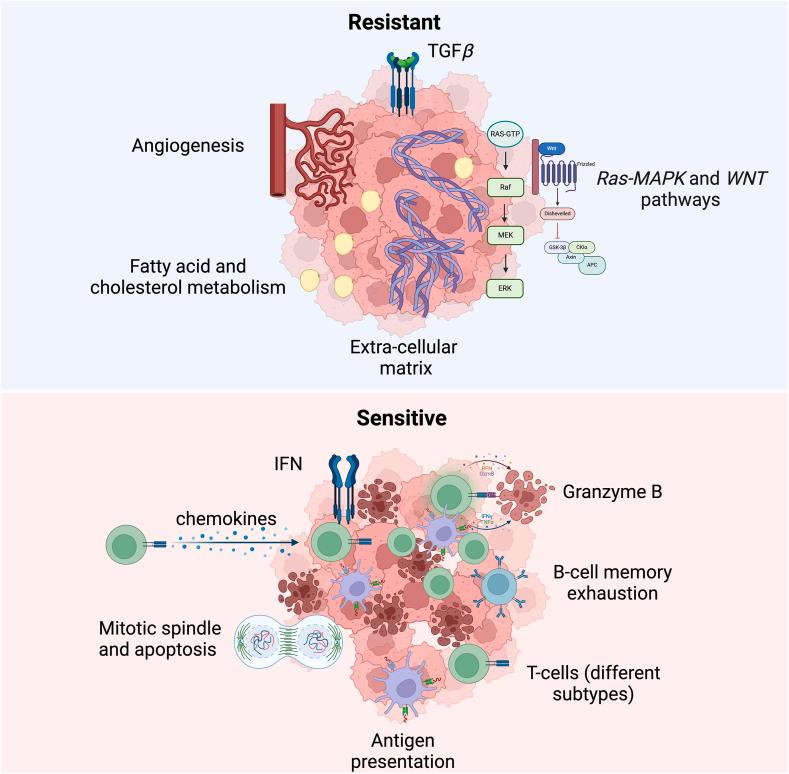
Immune checkpoint inhibitors (ICIs) have recently been approved in subsets of patients with breast cancer (BC). Currently, programmed death ligand 1 (PD-L1) immunohistochemistry is used as a biomarker of response for metastatic triple negative breast cancer (TNBC). Other tumor-agnostic indications in metastatic BC include high tumor mutational burden and mismatch repair deficiency. In early TNBC, the ICI pembrolizumab is routinely added to neoadjuvant chemotherapy, yet no biomarker is currently available to predict response or resistance. Further, while luminal BC is often thought to be immune-depleted, preliminary efficacy data in early-stage disease suggests that the addition of ICIs to neoadjuvant chemotherapy can significantly improve rates of pathological complete response. However, not all patients will benefit from ICI treatment and it also comes with significant treatment toxicities. This review will describe biomarkers of response and resistance to ICIs in BC. These currently include tumor infiltrating lymphocytes, homologous recombination deficiency, CD274 gain or amplification, estrogen receptor and/or progesterone receptor expression, more precise tumoral immune characterization, gene expression analysis, and the T-cell receptor repertoire. Although still investigational, these approaches hold the potential to advance personalized medicine by tailoring the use of ICIs to BC patients who will benefit.
免疫检查点抑制剂(ICIs)最近已在部分乳腺癌(BC)患者中获得批准。目前,程序性死亡配体1(PD-L1)免疫组化被用作转移性三阴性乳腺癌(TNBC)反应的生物标志物。转移性BC中的其他与肿瘤无关的指标包括高肿瘤突变负荷和错配修复缺陷。在早期TNBC中,ICI帕博利珠单抗通常会添加到新辅助化疗中,但目前尚无生物标志物可预测反应或耐药性。此外,虽然管腔型BC通常被认为免疫功能低下,但早期疾病的初步疗效数据表明,在新辅助化疗中添加ICIs可显著提高病理完全缓解率。然而,并非所有患者都能从ICI治疗中获益,而且它还伴有显著的治疗毒性。本综述将描述BC中对ICIs反应和耐药的生物标志物。目前这些包括肿瘤浸润淋巴细胞、同源重组缺陷、CD274获得或扩增、雌激素受体和/或孕激素受体表达、更精确的肿瘤免疫特征、基因表达分析以及T细胞受体库。尽管仍在研究中,但这些方法有可能通过为将受益的BC患者量身定制ICIs的使用来推动个性化医疗。
 Zotero 插件