
血浆代谢物将非传染性疾病与白质高信号增加联系起来。
Plasma Metabolites Link Non-Communicable Diseases to Increased White Matter Hyperintensities.
作者信息
Wang Nan, Qiu Baoshan, Chen Weiqi, Pan Yuesong, Wang Yilong
机构信息
Department of Neurology, Beijing Tiantan Hospital, Capital Medical University, Beijing, China.
China National Clinical Research Center for Neurological Diseases, Beijing, China.
出版信息
CNS Neurosci Ther. 2025 Jul;31(7):e70507. doi: 10.1111/cns.70507.
AIMS
Cerebral small vessel disease (CSVD) and non-communicable diseases (NCDs) are major global health burdens. White matter hyperintensities (WMH) are a key imaging feature of CSVD, but the relationship between WMH and NCDs, especially the role of plasma metabolites in this association, remains unclear. This study aims to elucidate this link.
METHODS
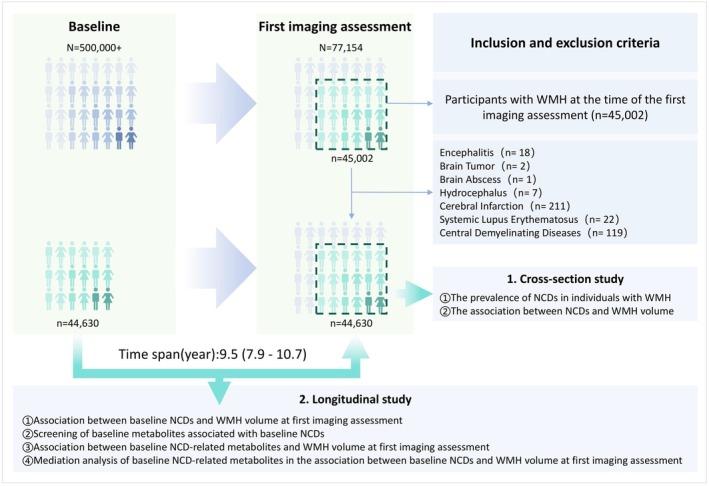
This study included participants with WMH from the UK Biobank cohort and examined the prevalence of 29 common NCDs in this population. General linear regression was used to analyze the association between NCDs and WMH. Propensity score matching and elastic net regression identified plasma metabolites associated with NCDs. Mediation analysis was conducted to explore the role of these metabolites in the association between NCDs and WMH.
RESULTS
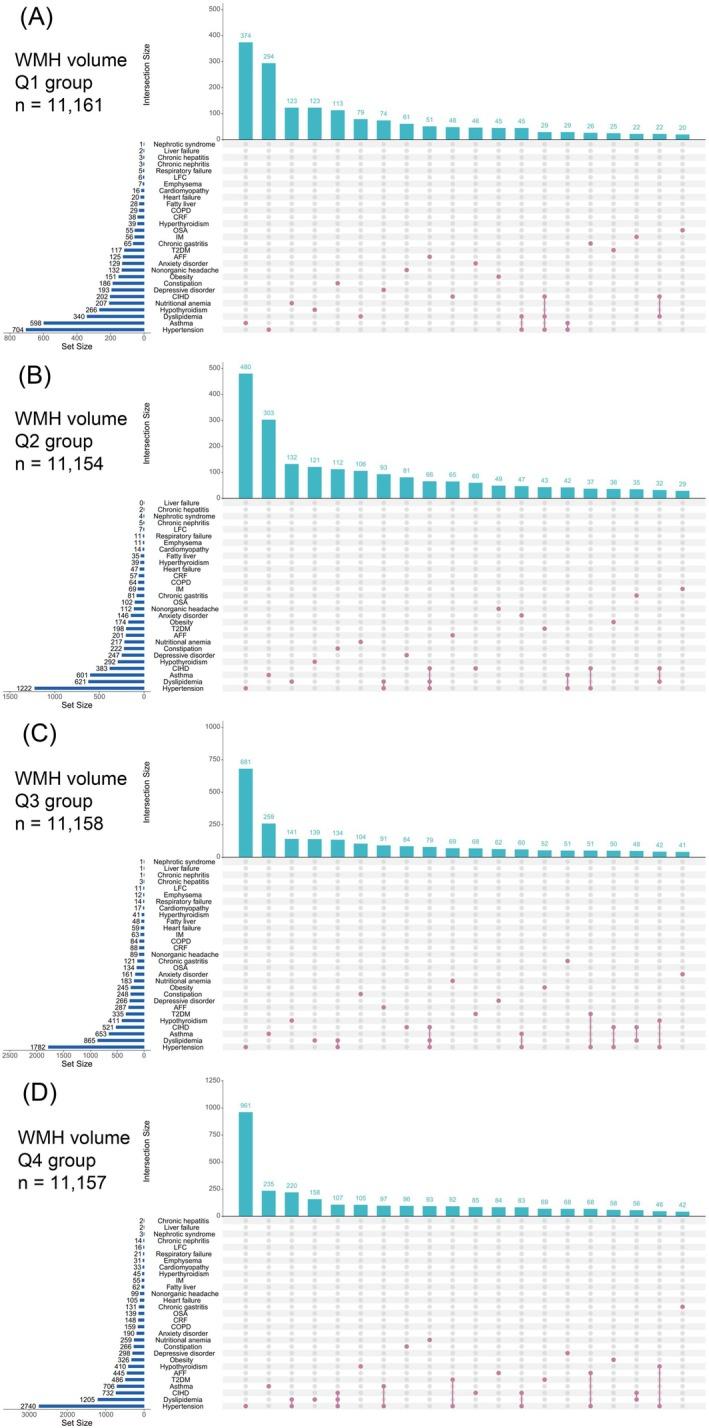
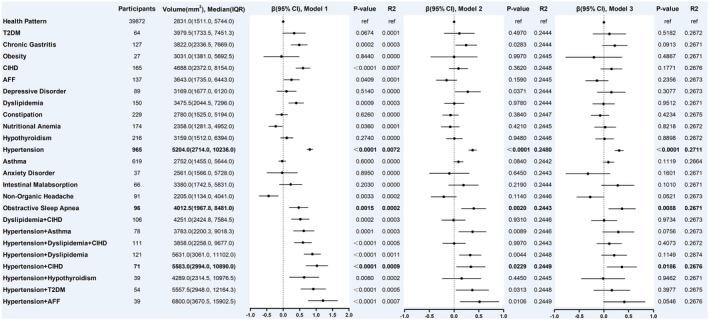
A total of 44,630 participants were included, of whom 47.0% were male. Approximately one-third of the participants had NCDs, with the most common being hypertension, dyslipidemia, and asthma. Compared to those without NCDs, the WMH volume in individuals with one or more comorbid NCDs was significantly increased by 18.43% to 68.15%. During a median follow-up of 9.5 years, individuals with hypertension, obstructive sleep apnea, and hypertension combined with coronary ischemic heart disease had significantly larger WMH volumes compared to those without NCDs, with increases of 30.81%, 36.44%, and 36.75%, respectively. Further analysis revealed that plasma metabolites associated with NCDs mediated this risk.
CONCLUSIONS
This study elucidated the association between WMH and NCDs, showing that common NCDs significantly increase WMH volume. Plasma metabolites associated with NCDs mediate this risk. This provides new insights into preventing WMH progression in individuals.
目的
脑小血管病(CSVD)和非传染性疾病(NCDs)是全球主要的健康负担。白质高信号(WMH)是CSVD的关键影像学特征,但WMH与NCDs之间的关系,尤其是血浆代谢物在这种关联中的作用,仍不清楚。本研究旨在阐明这种联系。
方法
本研究纳入了英国生物银行队列中患有WMH的参与者,并调查了该人群中29种常见NCDs的患病率。采用一般线性回归分析NCDs与WMH之间的关联。倾向得分匹配和弹性网络回归确定了与NCDs相关的血浆代谢物。进行中介分析以探讨这些代谢物在NCDs与WMH关联中的作用。
结果
共纳入44630名参与者,其中47.0%为男性。约三分之一的参与者患有NCDs,最常见的是高血压、血脂异常和哮喘。与无NCDs的参与者相比,患有一种或多种合并NCDs的个体的WMH体积显著增加了18.43%至68.15%。在中位随访9.5年期间,患有高血压、阻塞性睡眠呼吸暂停以及高血压合并冠状动脉缺血性心脏病的个体的WMH体积明显大于无NCDs的个体,分别增加了30.81%、36.44%和36.75%。进一步分析表明,与NCDs相关的血浆代谢物介导了这种风险。
结论
本研究阐明了WMH与NCDs之间的关联,表明常见的NCDs显著增加WMH体积。与NCDs相关的血浆代谢物介导了这种风险。这为预防个体WMH进展提供了新的见解。



 Zotero 插件