
成人自我同情与心理结果之间关系的潜在机制:一项系统综述。
The Mechanisms Underlying the Relationship Between Self-Compassion and Psychological Outcomes in Adult Populations: A Systematic Review.
作者信息
Wang Jun, Drossaert Constance H C, Knevel Maleah, Chen Liyan, Bohlmeijer Ernst T, Schroevers Maya J
机构信息
Department of Health Sciences, University Medical Center Groningen, University of Groningen, Groningen, the Netherlands.
Department of Psychology, Health and Technology, University of Twente, Enschede, the Netherlands.
出版信息
Stress Health. 2025 Aug;41(4):e70090. doi: 10.1002/smi.70090.
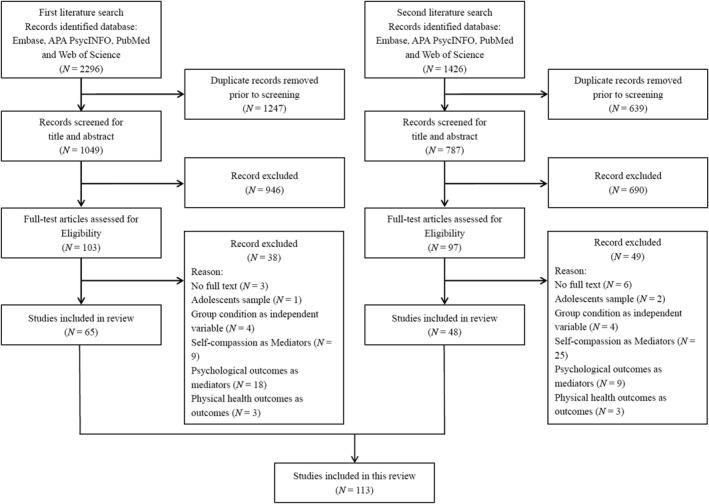
Self-compassion has emerged as a protective factor for psychological health and well-being. Interest has grown in understanding the mechanisms that explain how self-compassion contributes to improved psychological outcomes. This systematic review aimed to identify and synthesise the results of studies that investigated the mediators underlying the relationship between self-compassion and psychological outcomes. Potential eligible studies were searched on Embase, APA PsycINFO, PubMed, and Web of Science (search up till January 2025). Included were peer-reviewed, English-language studies investigating mediators between self-compassion and psychological outcomes. Study quality was assessed using the Mediation Quality Checklist. A total of 113 studies were included, and most were cross-sectional and focused on psychological symptoms rather than well-being. Repetitive negative thinking, such as worry and rumination, was the most studied process and found to be significantly mediating self-compassion and reduced psychological symptoms across studies. There is also growing evidence for experiential avoidance and mindfulness as significant mediators. Limited studies precluded drawing conclusions about other coping strategies, self-concept, and social factors. This systematic review points toward a significant mediational role of maladaptive (e.g. repetitive negative thinking, experiential avoidance) and adaptive (e.g. mindfulness) emotion regulation and coping strategies, that explain the association of self-compassion with psychological outcomes. Future studies with more rigorous designs including intensive longitudinal and experimental designs are needed to clarify causality.
自我同情已成为心理健康和幸福的一个保护因素。人们对理解自我同情如何促进心理状况改善的机制的兴趣日益浓厚。本系统综述旨在识别和综合研究结果,这些研究调查了自我同情与心理状况之间关系的潜在中介因素。在Embase、美国心理学会心理学文摘数据库(APA PsycINFO)、PubMed和科学网(检索截至2025年1月)上搜索了可能符合条件的研究。纳入的是经同行评审的、研究自我同情与心理状况之间中介因素的英文研究。使用中介质量检查表评估研究质量。总共纳入了113项研究,其中大多数是横断面研究,且侧重于心理症状而非幸福感。反复出现的消极思维,如担忧和沉思,是研究最多的过程,并且发现在各项研究中它显著地中介了自我同情与心理症状减轻之间的关系。越来越多的证据表明经验性回避和正念也是重要的中介因素。由于研究有限,无法就其他应对策略、自我概念和社会因素得出结论。本系统综述指出了适应不良(如反复出现的消极思维、经验性回避)和适应性(如正念)情绪调节及应对策略的显著中介作用,这些作用解释了自我同情与心理状况之间的关联。需要采用更严谨设计的未来研究,包括密集纵向研究和实验设计,以阐明因果关系。
 Zotero 插件