
复发/难治性多发性骨髓瘤且既往接受过1-3线治疗患者的真实世界治疗模式与结局:Optum数据库
Real-World Treatment Patterns and Outcomes in Patients With Relapsed/Refractory Multiple Myeloma and 1-3 Prior Lines of Therapy: Optum Database.
作者信息
Dhakal Binod, Einsele Hermann, Schecter Jordan M, Deraedt William, Lendvai Nikoletta, Slaughter Ana, Lonardi Carolina, Nair Sandhya, Varghese Nirosha Elsem, He Jianming, Kharat Akshay, Lee Seina, Cost Patricia, Potluri Ravi, Koneru Mythili, Patel Nitin, Florendo Erika, Rodriguez-Otero Paula, Yong Kwee
机构信息
Medical College of Wisconsin, Milwaukee, Wisconsin, USA.
Universitätsklinikum Würzburg, Medizinische Klinik und Poliklinik II, Würzburg, Germany.
出版信息
Cancer Med. 2025 Aug;14(15):e71093. doi: 10.1002/cam4.71093.
BACKGROUND
Early (often continuous) treatment of multiple myeloma (MM) with lenalidomide has become common practice, leading to an increase in lenalidomide-refractory disease.
METHODS
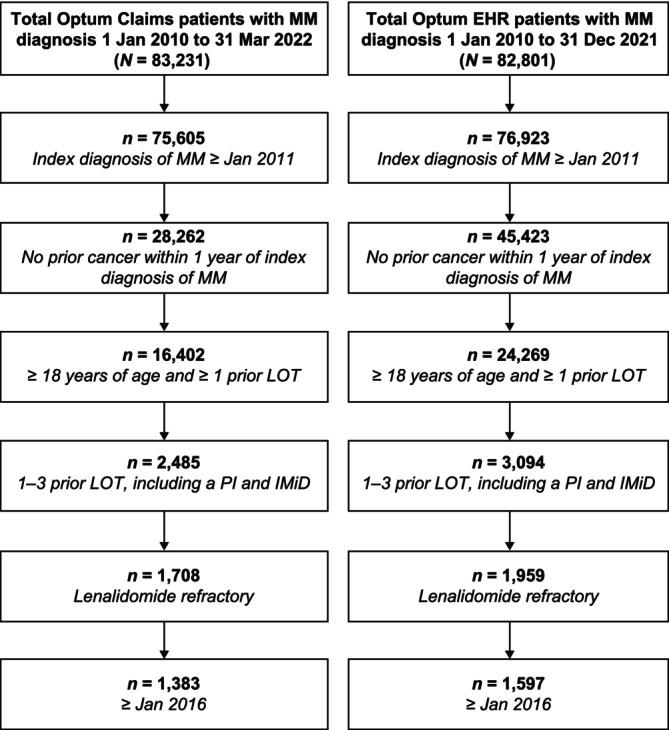
We report real-world treatment patterns, health care resource utilization (HCRU), and outcomes for patients with lenalidomide-refractory MM using data from Optum US Claims and Optum electronic health record (EHR) databases with index date from January 2016 to March 2022 (Claims) or December 2021 (EHR). Eligible patients had received 1-3 prior lines of therapy (LOT), including a proteasome inhibitor.
RESULTS
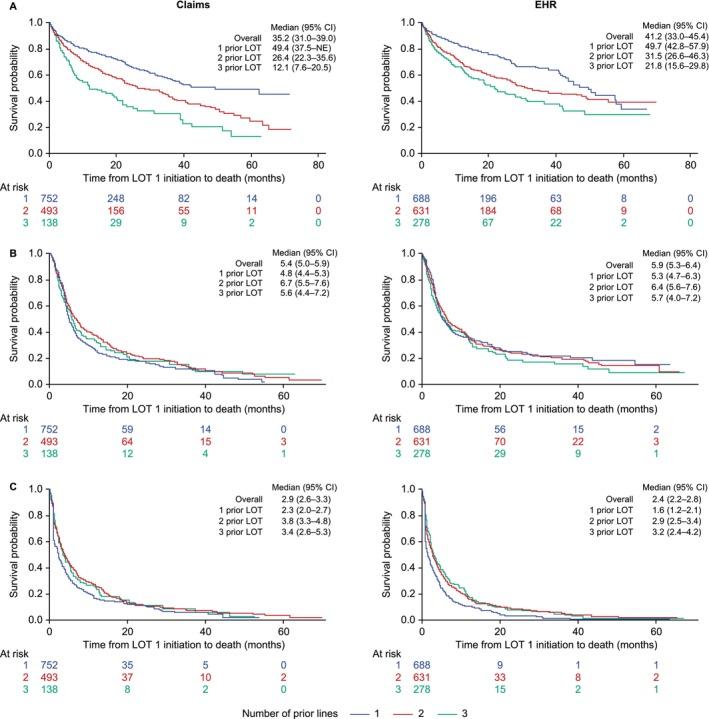
A total of 1383 and 1597 patients with lenalidomide-refractory disease were included from the Claims and EHR databases, respectively, with median ages of 72 and 68 years and mean Charlson Comorbidity Index scores of 4.0 and 3.1. The most common treatment combinations were daratumumab-pomalidomide-dexamethasone, daratumumab-bortezomib-dexamethasone, and pomalidomide-dexamethasone (~5% each). From LOT 2 to LOT 6, treatment attrition (patients who died or received no further treatment) was 95.2% to 95.9%. Median time to next treatment was 5.4 (Claims) and 5.9 months (EHR). Median OS was 35.2 (Claims) and 41.2 months (EHR). HCRU was consistent across LOT.
CONCLUSIONS
Patients with lenalidomide-refractory MM who received 1-3 prior LOT had poor outcomes and moved quickly through available therapies, demonstrating an unmet need to improve outcomes in this difficult-to-treat patient population.
背景
使用来那度胺对多发性骨髓瘤(MM)进行早期(通常是持续)治疗已成为常见做法,导致来那度胺难治性疾病有所增加。
方法
我们利用Optum美国索赔数据库和Optum电子健康记录(EHR)数据库的数据,报告来那度胺难治性MM患者的真实世界治疗模式、医疗保健资源利用(HCRU)情况及结局,索引日期为2016年1月至2022年3月(索赔数据库)或2021年12月(EHR数据库)。符合条件的患者此前接受过1 - 3线治疗(LOT),包括一种蛋白酶体抑制剂。
结果
索赔数据库和EHR数据库分别纳入了1383例和1597例来那度胺难治性疾病患者,中位年龄分别为72岁和68岁,查尔森合并症指数平均得分分别为4.0和3.1。最常见的治疗组合是达雷妥尤单抗 - 泊马度胺 - 地塞米松、达雷妥尤单抗 - 硼替佐米 - 地塞米松和泊马度胺 - 地塞米松(各约占5%)。从第2线治疗到第6线治疗,治疗减员(死亡或未接受进一步治疗的患者)为95.2%至95.9%。下次治疗的中位时间为5.4个月(索赔数据库)和5.9个月(EHR数据库)。中位总生存期为35.2个月(索赔数据库)和41.2个月(EHR数据库)。HCRU在各线治疗中保持一致。
结论
接受过1 - 3线前期治疗的来那度胺难治性MM患者结局不佳,且迅速用完可用疗法,表明在这一难以治疗的患者群体中改善结局的需求尚未得到满足。

 Zotero 插件