
Nonlinear response analysis of plan and vertical asymmetric reinforced concrete buildings under directional seismic loadings.
作者信息
Kumar Pramod, Madhuri Seeram, Olaiya Bamidele Charles
机构信息
Department of Civil Engineering, National Institute of Technology, Jamshedpur, Jharkhand, 831013, India.
Department of Civil Engineering, School of Engineering and Applied Sciences (SEAS), Kampala International University, Western Campus, Ishaka, Uganda.
出版信息
Sci Rep. 2025 Jul 28;15(1):27508. doi: 10.1038/s41598-025-12737-6.
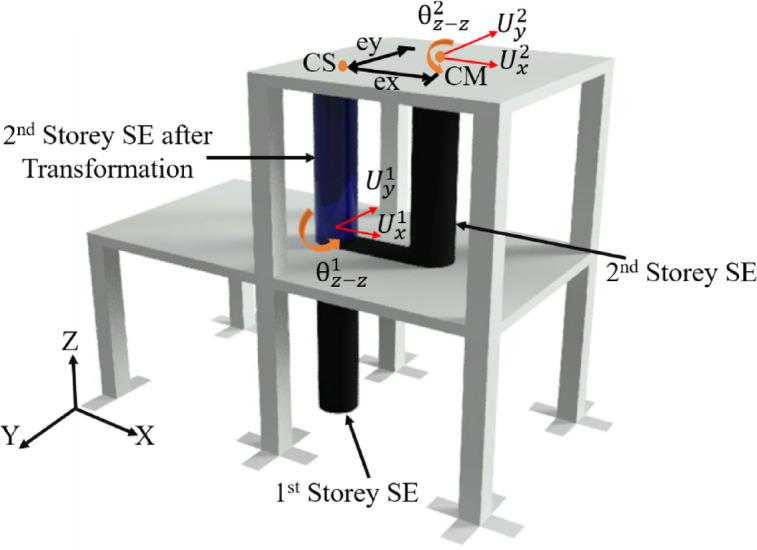
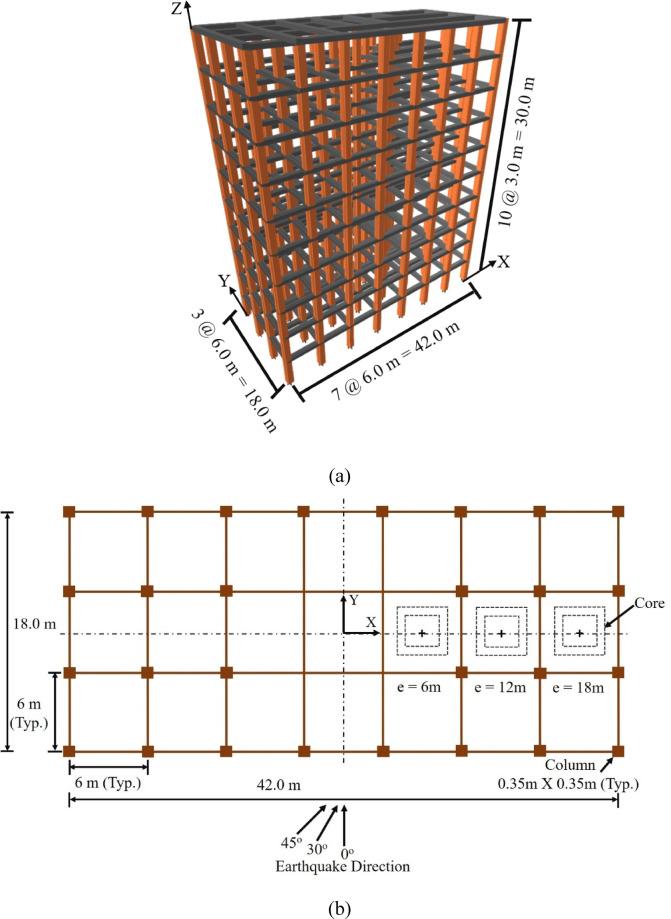
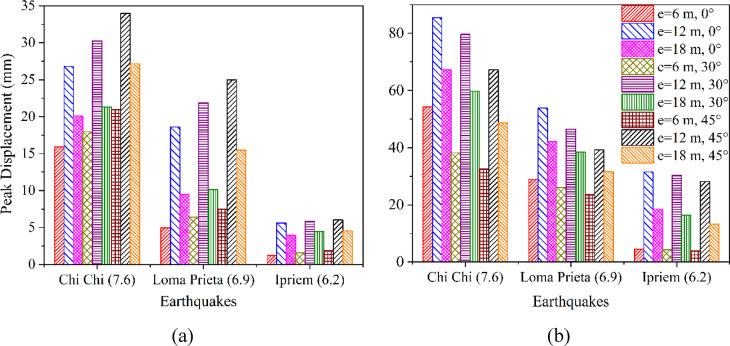
A nonlinear dynamic analysis is conducted on plan and vertically asymmetric reinforced concrete buildings subjected to directional seismic forces. The mathematical models are developed for building models. The plan asymmetry in the building is introduced by imposing uniaxial eccentricities of 6 m, 12 m, and 18 m. The vertical mass and stiffness asymmetry at different building levels is introduced by varying the mass or stiffness in the vertical direction. The peak displacement and the inter-storey drift ratio are evaluated. The vulnerability of asymmetric buildings to earthquake forces increases up to a specific eccentricity. Compared to stiffness and mass asymmetric buildings, stiffness asymmetry at the bottom floor and mass asymmetry at the top floor have shown a larger response in all the earthquakes and angles of study. The peak responses for plan and vertically symmetric buildings are observed under unidirectional earthquake forces. The peak displacement is 80 mm in the Y direction for the plan asymmetric structures. The vertical stiffness of asymmetric structures showed a peak response of 300 mm in the Y direction. The building with mass asymmetry at the top showed 199.18 mm in the Y direction. The authors recommend a detailed analysis of the design and analysis of asymmetric structures, especially to predict material failure.






 Zotero 插件