
ARTEM:一种通过主链排列识别RNA和DNA三级基序的方法。
ARTEM: a method for RNA and DNA tertiary motif identification with backbone permutations.
作者信息
Baulin Eugene F, Bohdan Davyd R, Kowalski Dawid, Serwatka Milena, Świerczyńska Julia, Żyra Zuzanna, Bujnicki Janusz M
机构信息
International Institute of Molecular and Cell Biology in Warsaw, Ul. Ks. Trojdena 4, 02-109, Warsaw, Poland.
IMol Polish Academy of Sciences, Ul. M. Flisa 6, 02-247, Warsaw, Poland.
出版信息
Genome Biol. 2025 Jul 28;26(1):226. doi: 10.1186/s13059-025-03696-2.
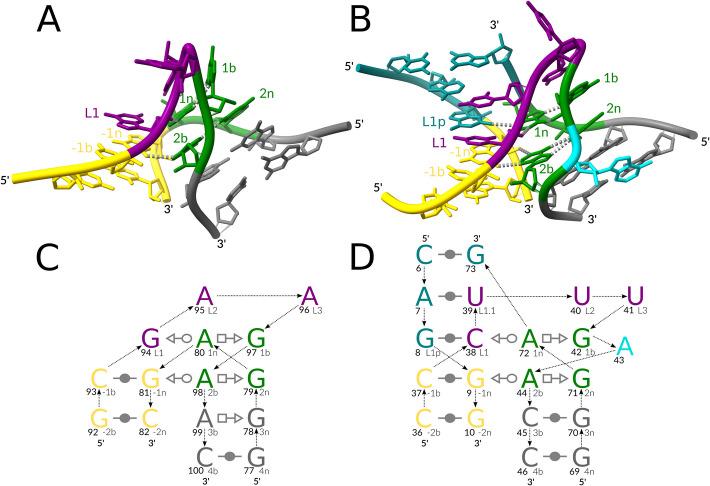
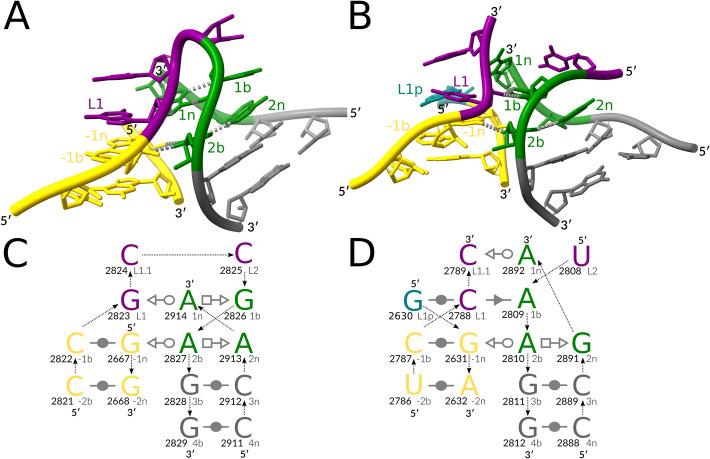
Non-coding RNA functions are largely defined by their 3D structures, which consist of recurrent building blocks, tertiary motifs. The computational motif search problem remains largely unsolved, as standard approaches are restrained by sequence, interactions, or backbone topology. We present ARTEM 2.0, which enables automated, unrestrained searches of RNA and DNA structure databases to identify 3D motifs. We apply ARTEM for searching kink-turns, G-quadruplexes, GNRA tetraloops, and i-motifs. ARTEM outperforms existing methods and enables the discovery of novel motif variants. ARTEM opens a fundamentally new way of studying nucleic acid 3D folds and motifs and analyzing their correlations and variations.
非编码RNA的功能很大程度上由其三维结构决定,该结构由重复的构建模块——三级基序组成。由于标准方法受到序列、相互作用或骨架拓扑结构的限制,计算基序搜索问题在很大程度上仍未得到解决。我们展示了ARTEM 2.0,它能够对RNA和DNA结构数据库进行自动、不受限制的搜索,以识别三维基序。我们将ARTEM应用于搜索扭结、G-四链体、GNRA四环和i-基序。ARTEM优于现有方法,并能够发现新的基序变体。ARTEM为研究核酸三维折叠和基序以及分析它们的相关性和变异开辟了一种全新的方式。



 Zotero 插件