
运动联合锻炼与单纯锻炼对慢性肩峰下疼痛综合征相关中枢敏化患者的影响:一项假手术对照随机临床试验
Mobilization with movement plus exercise versus exercise alone for patients with central sensitization associated with chronic subacromial pain syndrome: a sham-controlled randomized clinical trial.
作者信息
Deniz Volkan, Kelle Bayram
机构信息
Faculty of Health Sciences, Department of Physiotherapy and Rehabilitation, Tarsus University, Mersin, Turkey.
Faculty of Medicine, Department of Physical Medicine and Rehabilitation, Cukurova University, Adana, Turkey.
出版信息
BMC Complement Med Ther. 2025 Jul 28;25(1):289. doi: 10.1186/s12906-025-05028-0.
BACKGROUND
The efficacy of mobilization with movement (MWM) in addressing central sensitization and widespread mechanical hyperalgesia in patients with subacromial pain syndrome (SPS) remains unclear. This study aimed to evaluate the efficacy of MWM combined with exercise in improving the Central Sensitization Inventory (CSI) score, widespread mechanical hyperalgesia, and functional disability in patients with central sensitization associated with SPS.
METHODS
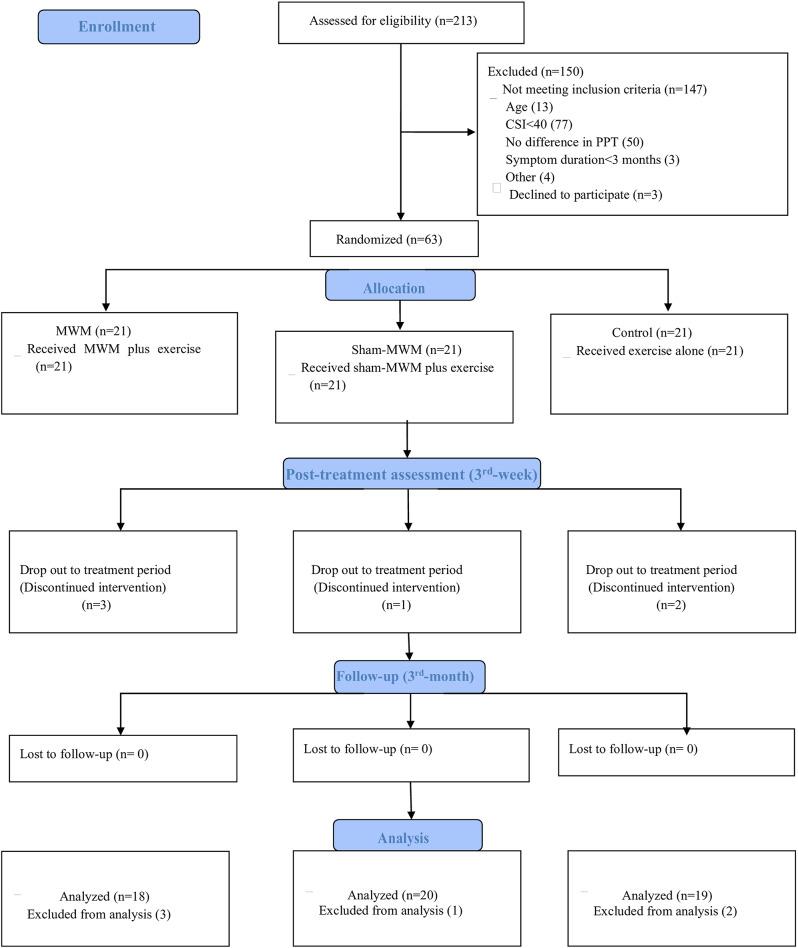
This study was designed as a single-blind, randomized, sham-controlled trial. Sixty-three adult patients with central sensitization associated with chronic SPS were randomly assigned to three groups (MWM, Sham MWM, and Control) using a permuted block randomization method. Outcomes were assessed at baseline, post-intervention (after three weeks), and at a three-month follow-up. The outcome measures included the CSI, pressure pain threshold measurements (PPT), and the Quick Disabilities of the Arm, Shoulder, and Hand questionnaire (Q-DASH). The CSI was used to assess emotional and somatic symptoms associated with central sensitization; PPTs evaluated local and widespread pain hypersensitivity; and the Q-DASH assessed upper extremity physical function and symptoms. A two-factor repeated-measures analysis of variance (group × time) with Bonferroni post-hoc correction was performed to analyze the main outcome variables.
RESULTS
At baseline, there were no significant differences in age, gender, or clinical characteristics among the groups. At the post-intervention stage, MWM combined with exercise did not result in superior improvements in CSI scores, local-widespread PPTs, or functional disability compared to sham-MWM or exercise alone ( > 0.05 for all). However, at the three-month follow-up, the MWM group showed significantly greater improvements in PPTs at the deltoid [ = 0.042, mean difference (MD) (95% CI): 0.6 (0.0 to 1.2)], brachioradialis [ = 0.028, MD (95% CI): 0.9 (0.1 to 1.7)], rectus femoris [ = 0.008, MD (95% CI): 0.9 (0.2 to 1.8)], and tibialis anterior [ = 0.029, MD (95% CI): 0.7 (0.1 to 1.4)] compared to the sham-MWM group. Additionally, significant differences were also found between the MWM and control groups in PPTs at the deltoid [ < 0.001, MD (95% CI): 1.0 (0.4 to 1.5)], brachioradialis [ = 0.012, MD (95% CI): 1.0 (0.2 to 1.8)], rectus femoris [ = 0.005, MD (95% CI): 0.9 (0.3 to 1.6)], and tibialis anterior [ = 0.022, MD (95% CI): 0.8 (0.1 to 1.5)].
CONCLUSIONS
In patients with central sensitization associated with chronic subacromial pain syndrome, the combination of mobilization with movement and exercise did not result in significant short-term (three-week) improvements in emotional and somatic symptoms of central sensitization or widespread pain hypersensitivity, compared to sham mobilization with movement plus exercise or exercise alone. However, this intervention led to greater mid-term (three-month) reductions in both local and widespread mechanical hyperalgesia in these patients.
TRIAL REGISTRATION
ClinicalTrials.gov (Clinical trial number: NCT05524870, First Submitted Date: 15.02.2022).
SUPPLEMENTARY INFORMATION
The online version contains supplementary material available at 10.1186/s12906-025-05028-0.
背景
关节松动术(MWM)在治疗肩峰下疼痛综合征(SPS)患者的中枢敏化和广泛机械性痛觉过敏方面的疗效尚不清楚。本研究旨在评估MWM联合运动在改善与SPS相关的中枢敏化患者的中枢敏化量表(CSI)评分、广泛机械性痛觉过敏和功能障碍方面的疗效。
方法
本研究设计为单盲、随机、假对照试验。采用置换区组随机化方法,将63例患有与慢性SPS相关的中枢敏化的成年患者随机分为三组(MWM组、假MWM组和对照组)。在基线、干预后(三周后)和三个月随访时评估结果。结果测量包括CSI、压力疼痛阈值测量(PPT)和上肢、肩部和手部快速功能障碍问卷(Q-DASH)。CSI用于评估与中枢敏化相关的情绪和躯体症状;PPT评估局部和广泛的疼痛超敏反应;Q-DASH评估上肢的身体功能和症状。采用双因素重复测量方差分析(组×时间)并进行Bonferroni事后校正,以分析主要结果变量。
结果
在基线时,各组之间在年龄、性别或临床特征方面无显著差异。在干预后阶段,与假MWM组或单独运动相比,MWM联合运动在CSI评分、局部-广泛PPT或功能障碍方面并未带来更显著的改善(所有P>0.05)。然而,在三个月随访时,与假MWM组相比,MWM组在三角肌[P=0.042,平均差值(MD)(95%CI):0.6(0.0至1.2)]、肱桡肌[P=0.028,MD(95%CI):0.9(0.1至1.7)]、股直肌[P=0.008,MD(95%CI):0.9(0.2至1.8)]和胫前肌[P=0.029,MD(95%CI):0.7(0.1至1.4)]的PPT方面显示出显著更大的改善。此外,在三角肌[P<0.001,MD(95%CI):1.0(0.4至1.5)]、肱桡肌[P=0.012,MD(95%CI):1.0(0.2至1.8)]、股直肌[P=0.005,MD(95%CI):0.9(0.3至1.6)]和胫前肌[P=0.022,MD(95%CI):0.8(0.1至1.5)]的PPT方面,MWM组和对照组之间也发现了显著差异。
结论
在患有与慢性肩峰下疼痛综合征相关的中枢敏化的患者中,与假关节松动术联合运动或单独运动相比,关节松动术联合运动在中枢敏化的情绪和躯体症状或广泛疼痛超敏反应方面并未带来显著的短期(三周)改善。然而,这种干预导致这些患者的局部和广泛机械性痛觉过敏在中期(三个月)有更大程度的减轻。
试验注册
ClinicalTrials.gov(临床试验编号:NCT05524870,首次提交日期:2022年2月15日)。
补充信息
在线版本包含可在10.1186/s12906-025-05028-0获取的补充材料。

 Zotero 插件