
表征制备方法对用于心脏纤维化研究的机械可调明胶水凝胶的影响。
Characterizing the Impact of Fabrication Methods on Mechanically Tunable Gelatin Hydrogels for Cardiac Fibrosis Studies.
作者信息
Folh Jordyn, Tran Phan Linh Dan, Horton Renita E
机构信息
Cardiovascular Tissue Engineering Laboratory, Biomedical Engineering Department, Cullen College of Engineering, University of Houston, Houston, TX 77204, USA.
William A. Brookshire Department of Chemical and Biomolecular Engineering, Cullen College of Engineering, University of Houston, Houston, TX 77204, USA.
出版信息
Bioengineering (Basel). 2025 Jul 13;12(7):759. doi: 10.3390/bioengineering12070759.
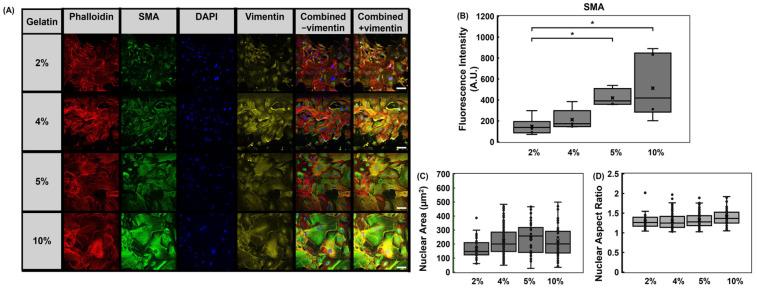
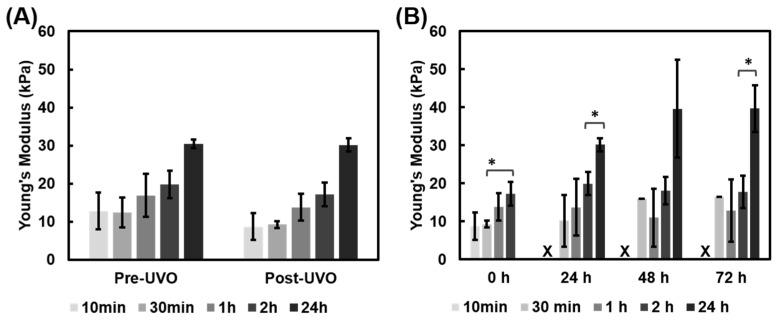
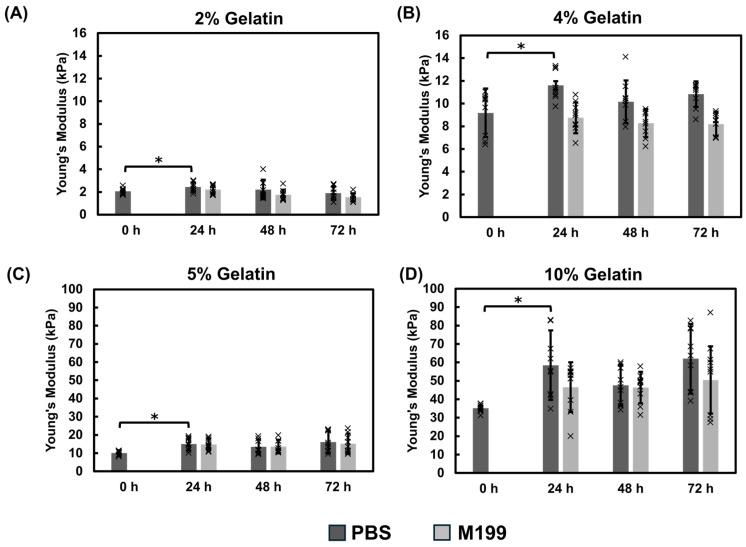
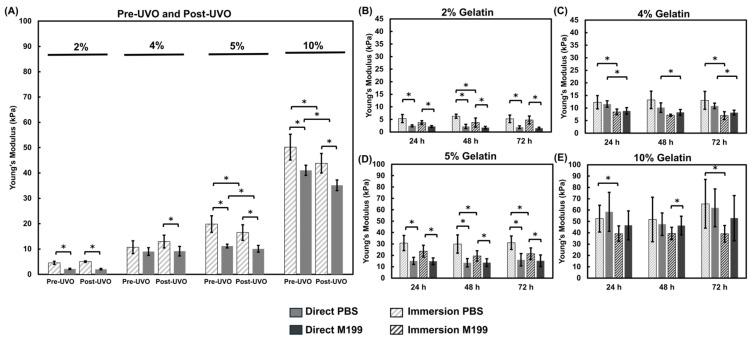
The mechanical properties of the extracellular matrix critically influence cell behavior in both physiological and pathophysiological states, including cardiac fibrosis. In vitro models have played a critical role in assessing biological mechanisms. In this study, we characterized mechanically tunable enzymatically crosslinked gelatin-microbial transglutaminase (mTG) hydrogels for modeling cardiovascular diseases. Gelatin hydrogels were fabricated via direct mixing or immersion crosslinking methods. Hydrogel formulations were assessed using the Piuma nanoindenter and Instron systems. This study investigates the effects of fabrication methods, UV ozone (UVO) sterilization, crosslinking methods, and incubation media on hydrogel stiffness. Further, this study examined the response of murine cardiac fibroblasts to hydrogel stiffness. The hydrogels exhibited modulus ranges relevant to both healthy and fibrotic cardiac tissues. UVO exposure led to slight decreases in hydrogel modulus, while the fabrication method had a significant impact on the modulus. Hydrogels incubated in phosphate buffered saline (PBS) were stiffer than those incubated in Medium 199 (M199), which correlated with lower pH in PBS. Fibroblasts cultured on stiffer hydrogels display enhanced smooth muscle actin (SMA) expression, suggesting sensitivity to material stiffness. These findings highlight how fabrication parameters influence the modulus of gelatin-mTG hydrogels for cardiac tissue models.
细胞外基质的力学性能在生理和病理生理状态下(包括心脏纤维化)对细胞行为有着至关重要的影响。体外模型在评估生物学机制方面发挥了关键作用。在本研究中,我们对用于模拟心血管疾病的机械可调酶交联明胶-微生物转谷氨酰胺酶(mTG)水凝胶进行了表征。明胶水凝胶通过直接混合或浸泡交联方法制备。使用Piuma纳米压痕仪和Instron系统评估水凝胶配方。本研究调查了制备方法、紫外线臭氧(UVO)灭菌、交联方法和孵育培养基对水凝胶硬度的影响。此外,本研究检测了小鼠心脏成纤维细胞对水凝胶硬度的反应。这些水凝胶表现出与健康和纤维化心脏组织相关的模量范围。UVO暴露导致水凝胶模量略有下降,而制备方法对模量有显著影响。在磷酸盐缓冲盐水(PBS)中孵育的水凝胶比在199培养基(M199)中孵育的水凝胶更硬,这与PBS中较低的pH值相关。在较硬水凝胶上培养的成纤维细胞显示出增强的平滑肌肌动蛋白(SMA)表达,表明对材料硬度敏感。这些发现突出了制备参数如何影响用于心脏组织模型的明胶-mTG水凝胶的模量。



 Zotero 插件