
慢性肾脏病中腺嘌呤诱导的大鼠血管钙化模型的比较
Comparison of Adenine-Induced Rat Models for Vascular Calcification in Chronic Kidney Disease.
作者信息
Kang Ho Won, Kim Ji Hye, Yoon A Ro, Kim Jahyung, Kim Joonhee, Kyung Min Gyu, Lee Dong Yeon
机构信息
Department of Orthopedic Surgery, Inha University Hospital, Incheon 22332, Republic of Korea.
Department of Orthopedic Surgery, Seoul National University College of Medicine, Seoul 03080, Republic of Korea.
出版信息
Biology (Basel). 2025 Jul 4;14(7):814. doi: 10.3390/biology14070814.
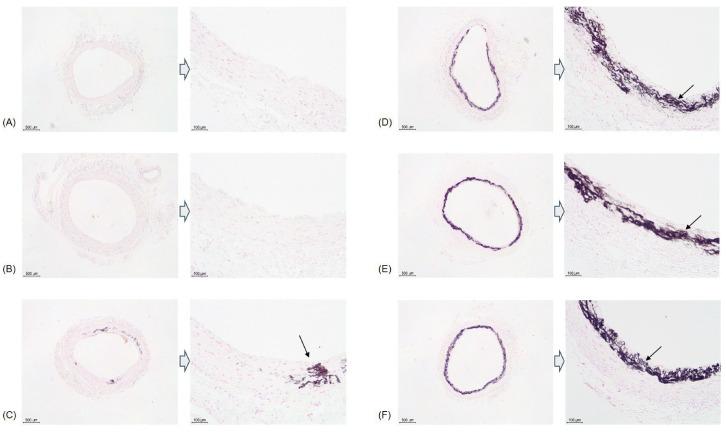
Vascular calcification significantly contributes to cardiovascular complications and limb loss in chronic kidney disease (CKD). To establish an optimal rat model for vascular calcification, we tested varying adenine concentrations and feeding durations in Sprague-Dawley rats (n = 72), divided into six groups (n = 12 each). The control group received a standard diet for 18 weeks. Group 1 was given 0.5% adenine for 4 weeks, followed by a standard diet. Group 2 received 0.5% adenine for 4 weeks, then 0.25% for 14 weeks. Group 3A received 0.5% adenine for 12 weeks and then standard diet; group 3B received 0.5% adenine for 12 weeks, followed by 0.25% for 6 weeks; group 3C received 0.5% adenine for 18 weeks. At week 18, vascular calcification was absent in the control and group 1. Groups 2 and 3A showed low incidence (12.5%), while groups 3B and 3C showed high incidence (66.7%). However, survival rates differed: 75.0% in 3B and 50.0% in 3C after 12 wk. Thus, 0.5% adenine for 12 weeks followed by 0.25% for 6 weeks effectively induced vascular calcification while maintaining acceptable survival, providing a practical model for studying CKD-related vascular pathology.
血管钙化是导致慢性肾脏病(CKD)患者心血管并发症和肢体丧失的重要因素。为建立理想的血管钙化大鼠模型,我们在72只Sprague-Dawley大鼠中测试了不同的腺嘌呤浓度和喂养时间,将其分为六组(每组12只)。对照组接受标准饮食18周。第1组给予0.5%腺嘌呤4周,之后给予标准饮食。第2组给予0.5%腺嘌呤4周,然后给予0.25%腺嘌呤14周。第3A组给予0.5%腺嘌呤12周,之后给予标准饮食;第3B组给予0.5%腺嘌呤12周,之后给予0.25%腺嘌呤6周;第3C组给予0.5%腺嘌呤18周。在第18周时,对照组和第1组未出现血管钙化。第2组和第3A组的发生率较低(12.5%),而第3B组和第3C组的发生率较高(66.7%)。然而,生存率有所不同:12周后,第3B组为75.0%,第3C组为50.0%。因此,给予0.5%腺嘌呤12周,然后给予0.25%腺嘌呤6周可有效诱导血管钙化,同时保持可接受的生存率,为研究CKD相关血管病理提供了一个实用模型。


 Zotero 插件