
静止多元宇宙。
Quiescence Multiverse.
作者信息
Laporte Damien, Sagot Isabelle
机构信息
CNRS, Institut de Biochimie et Génétique Cellulaires, UMR5095, Université de Bordeaux, 33077 Bordeaux, France.
出版信息
Biomolecules. 2025 Jul 4;15(7):960. doi: 10.3390/biom15070960.
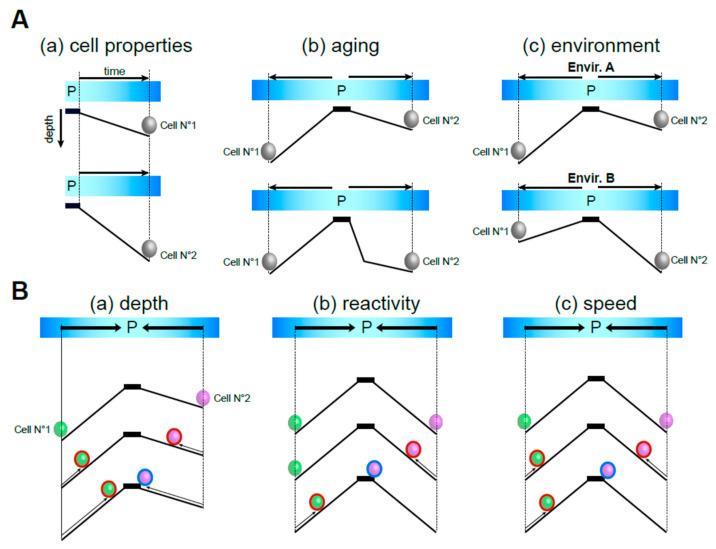
Cellular quiescence is operationally defined as a temporary and reversible cessation of proliferation. This state encompasses a wide range of physiological situations since most cells, from microbes to cells composing complex tissues, spend most of their lives non-dividing, waiting for signals to reproliferate. As such, individual quiescent cells must withstand the effects of time not only to survive but also to maintain their ability to divide. These capacities are shaped by a combination of deterministic factors relying on cell history and cumulative stochastic events linked to the environment but also to time. In addition, with time, quiescence deepens, the quiescence exit process being extended. Yet, this deepening is not necessarily sensed evenly by each individual quiescent cell, and some cells exit quiescence faster than others. Hence, time generates heterogeneity within quiescent cell populations, heterogeneity that, in turn, increases cell population resilience and robustness to time. In this review, we discuss some of the loops that link quiescence and time.
细胞静止在操作上被定义为增殖的暂时且可逆的停止。这种状态涵盖了广泛的生理情况,因为从微生物到构成复杂组织的细胞,大多数细胞在其生命的大部分时间里都处于非分裂状态,等待重新增殖的信号。因此,单个静止细胞不仅必须经受时间的影响以存活,还必须维持其分裂能力。这些能力是由依赖于细胞历史的确定性因素以及与环境和时间相关的累积随机事件共同塑造的。此外,随着时间的推移,静止会加深,静止退出过程会延长。然而,这种加深并不一定被每个静止细胞均匀地感知到,一些细胞比其他细胞更快地退出静止。因此,时间在静止细胞群体中产生异质性,而这种异质性反过来又增加了细胞群体对时间的恢复力和稳健性。在这篇综述中,我们讨论了一些将静止与时间联系起来的循环。

 Zotero 插件