
噬菌体减少从角膜感染中分离出的细菌所产生生物膜的能力。
The Ability of Bacteriophages to Reduce Biofilms Produced by Isolated from Corneal Infections.
作者信息
Urgeya Kuma Diriba, Subedi Dinesh, Kumar Naresh, Willcox Mark
机构信息
School of Optometry and Vision Science, The University of New South Wales (UNSW), Sydney, NSW 2052, Australia.
School of Biological Sciences, Monash University, Clayton, VIC 3800, Australia.
出版信息
Antibiotics (Basel). 2025 Jun 20;14(7):629. doi: 10.3390/antibiotics14070629.
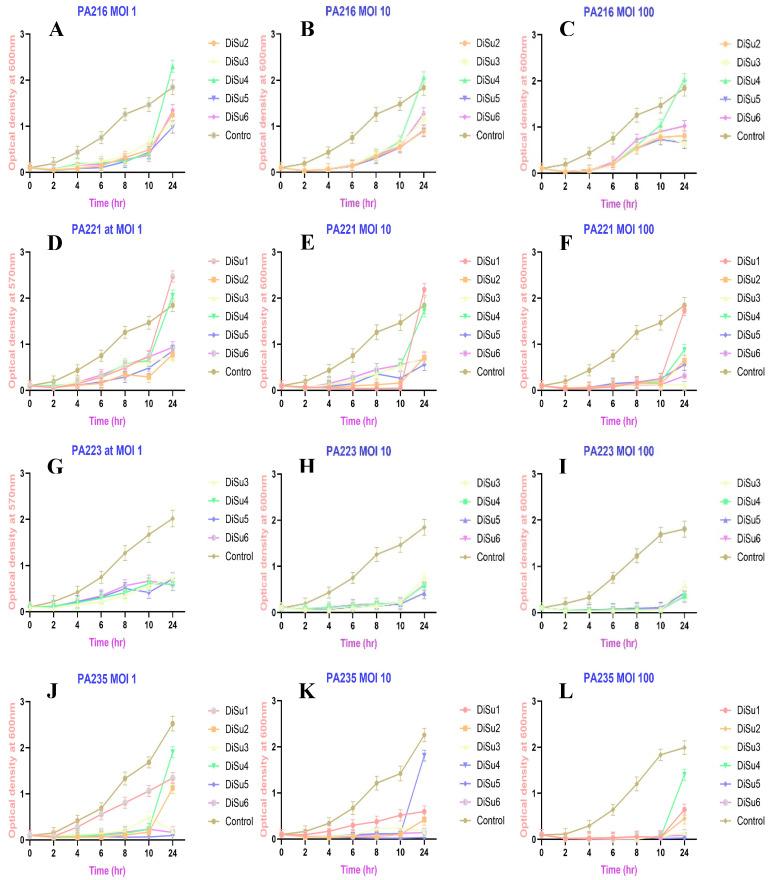
() is a common antibiotic-resistant pathogen, posing significant public health threats worldwide. It is a major cause of ocular infections, mostly linked to contact lens wear. often produces biofilm during infections, and these are also associated with antibiotic resistance. Bacteriophage (phage) therapy is emerging as a promising approach for treating multidrug-resistant . : This study aimed to assess the antibiofilm effects of six phages against biofilms isolated from patients with corneal infections. : This study examined strains for their ability to form biofilms using crystal violet assay. Six bacteriophages (DiSu1 to DiSu6) were used, which were isolated from sewage water in Melbourne, Australia. Spot tests were used to assess phage sensitivity. The effect of phages against strains was determined using time-kill assay and efficiency of plating. The ability of phage to inhibit biofilm formation over 24 h or reduce preformed biofilms was also studied and confirmed using confocal laser scanning microscopy with Live/Dead staining. : After 24 h of incubation, all tested strains formed moderate to strong biofilms. All strains were sensitive to at least four of the six phages. The highest level of bacterial growth inhibition in the liquid infection model was observed when phages were applied at a multiplicity of infection (MOI) of 100. Certain bacteria/phage combinations were able to inhibit biofilm formation over 24 h, with the combination of strain PA235 and phage DiSu3 producing the highest inhibition (83%) at a MOI of 100. This was followed by the combinations of PA223/DiSu3 (56%), and PA225/DiSu5 (52%). For the reduction in preformed biofilms, the best combinations were PA235 (90%), PA221 (61%), and PA213 and PA225 (57% each), all with DiSu3 after 3 h. However, exposing the biofilm with phages for over 24 h appeared to promote phage resistance as there was evidence of biofilm growth, with the only combination still showing a significant reduction being PA221/DiSu3 (58%) at MOI of 100. : This study showed that the effect of phages against is concentration (MOI) dependent. Phages at higher MOI have the ability to disrupt, inhibit, and reduce biofilms. However, prolonged exposure of the biofilm with phages appeared to promote phage resistance. To enhance phage efficacy and address this form of resistance, further studies utilizing phage cocktails or a combination of phages and antibiotics is warranted.
(某病原体)是一种常见的耐抗生素病原体,在全球范围内对公众健康构成重大威胁。它是眼部感染的主要原因,大多与隐形眼镜佩戴有关。(该病原体)在感染期间常产生生物膜,这些生物膜也与抗生素耐药性有关。噬菌体疗法正成为治疗多重耐药(该病原体感染)的一种有前景的方法。研究目的:本研究旨在评估六种噬菌体对从角膜感染患者分离出的(该病原体)生物膜的抗生物膜作用。研究方法:本研究使用结晶紫测定法检测(该病原体)菌株形成生物膜的能力。使用了六种(该病原体)噬菌体(DiSu1至DiSu6),它们是从澳大利亚墨尔本的污水中分离出来的。采用点滴试验评估噬菌体敏感性。使用时间杀菌试验和平板接种效率来确定噬菌体对(该病原体)菌株的作用。还使用活/死染色的共聚焦激光扫描显微镜研究并证实了噬菌体在24小时内抑制生物膜形成或减少预先形成的生物膜的能力。研究结果:孵育24小时后,所有测试的(该病原体)菌株都形成了中度至强生物膜。所有(该病原体)菌株对六种噬菌体中的至少四种敏感。在液体感染模型中,当以感染复数(MOI)为100应用噬菌体时,观察到最高水平的细菌生长抑制。某些细菌/噬菌体组合能够在24小时内抑制生物膜形成,菌株PA235与噬菌体DiSu3的组合在MOI为100时产生最高抑制率(83%)。其次是PA223/DiSu3(56%)和PA225/DiSu5(52%)组合。对于减少预先形成的生物膜,最佳组合是PA235(90%)、PA221(61%)以及PA213和PA225(各57%),在3小时后均与DiSu3组合。然而,用噬菌体暴露生物膜超过24小时似乎会促进噬菌体耐药性,因为有生物膜生长的证据,唯一仍显示出显著减少的组合是在MOI为100时的PA221/DiSu3(58%)。研究结论:本研究表明噬菌体对(该病原体)的作用取决于浓度(MOI)。较高MOI的噬菌体有能力破坏、抑制和减少(该病原体)生物膜。然而,用噬菌体长时间暴露生物膜似乎会促进噬菌体耐药性。为了提高噬菌体疗效并解决这种耐药形式,有必要进一步开展利用噬菌体鸡尾酒或噬菌体与抗生素组合的研究。




 Zotero 插件