
预测宫颈涂片筛查异常女性诊断前后的抑郁症:一种神经网络方法。
Predicting Pre- and Post-Diagnostic Depression in Women with Abnormal Pap Screening Tests: A Neural Network Approach.
作者信息
Ilic Irena, Babic Goran, Sipetic Grujicic Sandra, Zivanovic Macuzic Ivana, Ilic Milena, Ravic-Nikolic Ana, Milicic Vesna
机构信息
Faculty of Medicine, University of Belgrade, 11000 Belgrade, Serbia.
Department of Gynecology and Obstetrics, Faculty of Medical Sciences, University of Kragujevac, 34000 Kragujevac, Serbia.
出版信息
Life (Basel). 2025 Jun 30;15(7):1041. doi: 10.3390/life15071041.
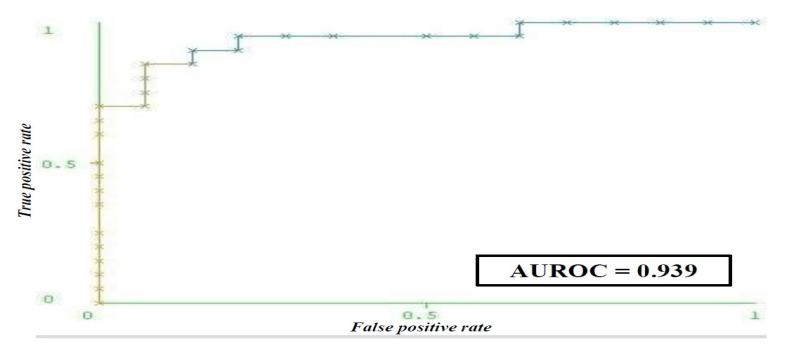
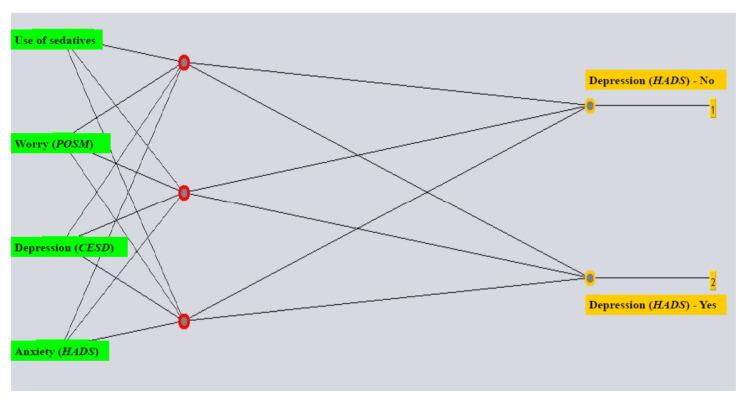
(1) Background: After receiving an abnormal Papanicolaou smear result, very often women fail to adhere to further procedures due to depression. Using a neural network approach, this research aimed to predict pre- and post-diagnostic depressive symptoms in women with abnormal Pap screening tests. (2) Methods: The study was conducted at the Clinical Center of Kragujevac, Serbia, among 172 women with a positive Pap screening result before and after diagnostic procedures (colposcopy/biopsy/endocervical curettage). Just before and 2 to 4 weeks after the diagnostic procedures, women filled out a socio-demographic questionnaire and the Hospital Anxiety and Depression Scale (HADS). Multilayer perceptron neural networks were modeled. (3) Results: Depression was present in 37.2% of women before diagnostic procedures and in 48.3% after. Feature selection showed four variables that correlated with depression before diagnostic procedures-anxiety (according to the HADS), depression according to the CESD scale, worry score on the POSM scale and use of sedatives. Model for predicting pre-diagnostic depression yielded an accuracy of 79.41%, with a value of 0.842 for area under the receiver operating characteristic curve (AUROC). The HADS anxiety score, place of residence and CESD score were the most important attributes for predicting post-diagnostic depression, with an ANN model accuracy of 88.24% and AUROC 0.939. (4) Conclusions: This research revealed a possible way of predicting depression occurrence in those women who received a positive Pap screening test and who are undergoing follow-up diagnostics, aiding medical doctors in the provision of successful and on-time psychological assistance.
(1) 背景:在收到巴氏涂片异常结果后,女性常常因抑郁而未能坚持进一步的检查程序。本研究采用神经网络方法,旨在预测巴氏筛查试验异常的女性在诊断前后的抑郁症状。(2) 方法:该研究在塞尔维亚克拉古耶瓦茨临床中心对172名巴氏筛查结果为阳性的女性进行,这些女性在诊断程序(阴道镜检查/活检/宫颈管刮术)前后接受检查。在诊断程序前及之后2至4周,女性填写社会人口统计学问卷和医院焦虑抑郁量表(HADS)。建立了多层感知器神经网络模型。(3) 结果:诊断程序前37.2%的女性存在抑郁,诊断程序后这一比例为48.3%。特征选择显示有四个变量与诊断程序前的抑郁相关——焦虑(根据HADS)、根据CESD量表的抑郁、POSM量表上的担忧得分以及镇静剂的使用。预测诊断前抑郁的模型准确率为79.41%,受试者操作特征曲线下面积(AUROC)值为0.842。HADS焦虑得分、居住地点和CESD得分是预测诊断后抑郁的最重要属性,人工神经网络模型准确率为88.24%,AUROC为0.939。(4) 结论:本研究揭示了一种预测巴氏筛查试验阳性且正在接受后续诊断的女性抑郁发生情况的可能方法,有助于医生及时提供成功的心理援助。


 Zotero 插件