
食物暴露组对动脉粥样硬化斑块稳定性的影响:来自人类颈动脉内膜切除术标本的代谢组学见解。
Impact of Food Exposome on Atherosclerotic Plaque Stability: Metabolomic Insights from Human Carotid Endarterectomy Specimen.
作者信息
Doche Emilie, Leclercq Barbara, Sulowski Constance, Magoncia Ellen, Tardivel Catherine, Svilar Ljubica, Sarlon-Bartoli Gabrielle, Martin Jean-Charles, Bartoli Michel, Rossillon Alexandre, Suissa Laurent
机构信息
Stroke Unit, University Hospital La Timone, AP-HM, 13005 Marseille, France.
Centre de Recherche en Cardiovasculaire et Nutrition, INSERM 1263, INRAE 1260, Aix Marseille University, Campus Timone, 13005 Marseille, France.
出版信息
Int J Mol Sci. 2025 Jul 21;26(14):7018. doi: 10.3390/ijms26147018.
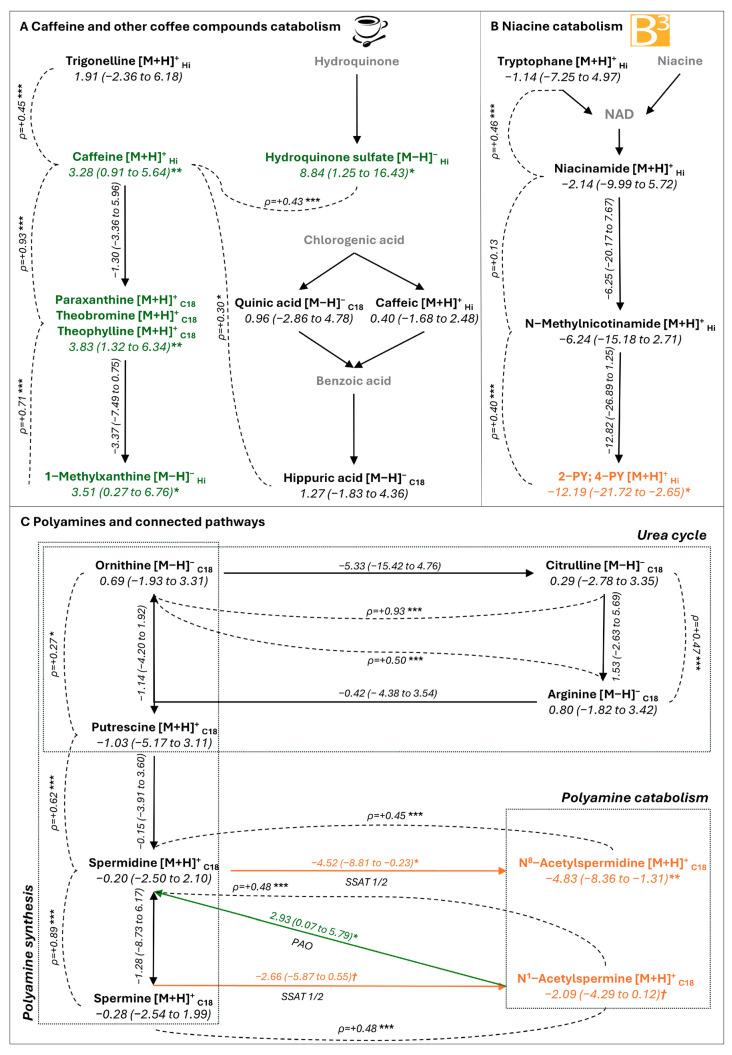
Carotid atherosclerotic stenosis (CAS) is a leading cause of ischemic stroke. Current understanding of plaque vulnerability remains largely confined to histopathological characterization. Consequently, identifying molecular determinants of plaque stability represents a major challenge to advance prevention strategies. Untargeted metabolomic analysis was performed using mass spectrometry coupled to liquid chromatography on carotid plaques removed from patients with CAS undergoing endarterectomy. To identify factors influencing plaque stability, we compared 42 asymptomatic with 30 symptomatic CAS patients. Associations between each annotated metabolite in plaques and asymptomatic CAS status were assessed using logistic regression models. Asymptomatic patients exhibited lower plasmatic levels of C-reactive protein (CRP) and higher HDL-cholesterol. Within the plaques, caffeine and its catabolites, paraxanthine and methylxanthine, were associated with plaque stability and were correlated with HDL-cholesterol. Additional plant-based diet biomarkers including N5-acetylornithine, gentisic acid, proline betaine, and homostachydrine were also associated with plaque stability. In contrast, N-methylpyridone carboxamides, reflecting niacin excess, involved in vascular inflammatory processes, were both associated with plaque vulnerability and also correlated with higher CRP. Our findings provide molecular evidence that plant-based diets, including coffee, promote carotid plaque stability, while excessive niacin intake, linked to processed foods, may be detrimental. Metabolomics offers new insights into food exposome-related vascular risk.
颈动脉粥样硬化狭窄(CAS)是缺血性中风的主要原因。目前对斑块易损性的认识在很大程度上仍局限于组织病理学特征。因此,确定斑块稳定性的分子决定因素是推进预防策略的一项重大挑战。使用液相色谱-质谱联用技术对接受颈动脉内膜切除术的CAS患者切除的颈动脉斑块进行非靶向代谢组学分析。为了确定影响斑块稳定性的因素,我们比较了42例无症状CAS患者和30例有症状CAS患者。使用逻辑回归模型评估斑块中每种注释代谢物与无症状CAS状态之间的关联。无症状患者的血浆C反应蛋白(CRP)水平较低,高密度脂蛋白胆固醇(HDL-胆固醇)水平较高。在斑块内,咖啡因及其分解代谢物,如副黄嘌呤和甲基黄嘌呤,与斑块稳定性相关,并与HDL-胆固醇相关。其他基于植物性饮食的生物标志物,包括N5-乙酰鸟氨酸、龙胆酸、脯氨酸甜菜碱和高车前碱,也与斑块稳定性相关。相比之下,反映烟酸过量的N-甲基吡啶酮羧酰胺参与血管炎症过程,与斑块易损性相关,也与较高的CRP相关。我们的研究结果提供了分子证据,表明包括咖啡在内的植物性饮食可促进颈动脉斑块稳定性,而与加工食品相关的过量烟酸摄入可能有害。代谢组学为与食物暴露组相关的血管风险提供了新的见解。



 Zotero 插件